Photo: Trisha Downing / Unsplash
Today’s global economy is characterized by often long, complex supply chains that bring commodities, goods and services to consumers, and economic benefits to producers. Applying innovative tools and analytical approaches, SEI explores the sustainability implications and potentials of global supply chains and broader consumption-to-production systems.
437 results / 44 of 49 pages
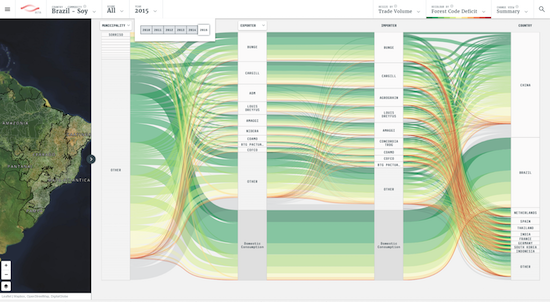
Feature / The Trase supply chain transparency platform Trase gets even better supply chain mapping for Brazilian soy and Indonesian palm oil, plus new functions.

Journal article / This article examines the roles played by large interests and smallholders in creating agricultural frontiers, focusing on the Gran Chaco region.
Other publication / This book chapter suggests how producer jurisdictions can play a more effective role in making agricultural commodity more sustainable.
Journal article / The article suggests that non-monetary factors, as well as lack of infrastructure, explain the persistence of cattle-ranching and other unsustainable land uses.
Feature / How do we keep food on the plates of UK households in the coming decades? This is a central question for IKnowFood, a major new collaborative research project.
Feature / SEI and the Global Canopy Programme unveil a raft of improvements and new features to our ground-breaking supply chain transparency and sustainability platform.
Project / EMAS as a Nest to Help and Nurture Circular Economy (ENHANCE) improves implementation of regional policy instruments to increase resource efficiency.
Other publication / How the PRINCE project is using multiregional input-output modeling for more accurate consumption footprints in Sweden
Perspective / How businesses, governments, civil society and others can use our new transparency platform to promote more sustainable, deforestation-free supply chains.