Skip navigation
wood
Project

Wood Solution Thailand Program – Engagement Phase

The Wood Solution Thailand Program (March–June 2026) will lay the groundwork for a long-term initiative that will promote sustainable wood-based construction, forest restoration, and climate-smart bioeconomy solutions in Thailand.

Wood-based materials and engineered timber can play a key role in reducing emissions from the construction sector. Photo: DL314 Lin / Unsplash.

Active project

2026

Thailand has a significant opportunity to drive climate mitigation and rural economic development through low-carbon, sustainable wood construction. Wood-based materials and engineered timber can play a key role in reducing emissions from the construction sector while stimulating rural economic development and improving forest management. 

The Engagement Phase of the Wood Solution Thailand Program (March–June 2026) will lay the groundwork for a proposed 7-year, long-term initiative to build a sustainable timber construction ecosystem. This preparatory project is a collaboration between the Stockholm Environment Institute (SEI), the Eco-Innovation Foundation (EIF), Thai-Nordic Innovation Unit (TNIU), the Royal Thai Embassy in Stockholm and the Embassy of Sweden in Thailand, as well as numerous stakeholders from academia, industry and government. 

The project is designed to strengthen Thai–Swedish collaboration across the wood value chain. The phase will support the two organisation’s partnership in this area, building on each other’s relative strengths, networks and areas of expertise, as well as the strong Thai-Sweden relationship in the sector.  

Background

Sustainable timber construction offers a pathway for Thailand to reduce emissions in the building sector while stimulating rural development and improving forest management. Sweden has world-leading expertise in sustainable forestry, engineered wood products, and climate-smart building systems, making it an ideal partner for Thailand.

Since 2019, the Eco Innovation Foundation (EIF) has led a development effort aimed at designing a concept for how a market system for sustainable timber construction can be initiated and rapidly scaled in tropical countries. The ambition is to establish timber construction as both a driver of economic development and a systemic natural climate solution, where forests and cities become interconnected parts of a mutually reinforcing industrial system. This work builds on several decades of experience in international collaboration focused on sustainable forestry, landscape restoration, and timber value chains in tropical regions.

These discussions align closely with the broader Wood Solution concept, which emphasizes collaboration between forestry, industry, construction, finance, academia and public institutions to enable the emergence of sustainable timber cities supported by restored forest landscapes. In response to an invitation from Sida Bangkok, SEI and EIF therefore present this joint application for an engagement phase to build on the existing momentum with broad support from many Thai and Swedish actors.  

The proposed Wood Solution Thailand Program is envisioned as seven- to ten-year initiative aimed at enabling and scaling the development of a sustainable timber construction ecosystem. 

The Engagement Phase (March–June 2026) is the first preparatory step. It will mobilize partners, identify viable pilot initiatives, and establish the institutional, technical, and financial groundwork needed to launch the full program.

The Engagement Phase aims to achieve five main objectives:

  • Support pioneer initiatives across the full value chain – from forestry to construction – that demonstrate practical wood‑based solutions.
  • Initiate a Thai program organization that will eventually host and manage the long‑term Wood Solution Thailand Program.
  • Develop the Wood Solution Support Platform, an international network of experts and technology providers that can assist Thailand and other tropical countries in building sustainable timber construction ecosystems.
  • Build funding partnerships with bilateral, multilateral, philanthropic, and private‑sector actors to support the next phase.
  • Align with the Thailand–Sweden Strategic Partnership signed in August 2025 related to green transition and forestry, creating business‑to‑business collaboration opportunities between Thai enterprises and their Swedish counterparts.

The project is structured into six mutually reinforcing components:

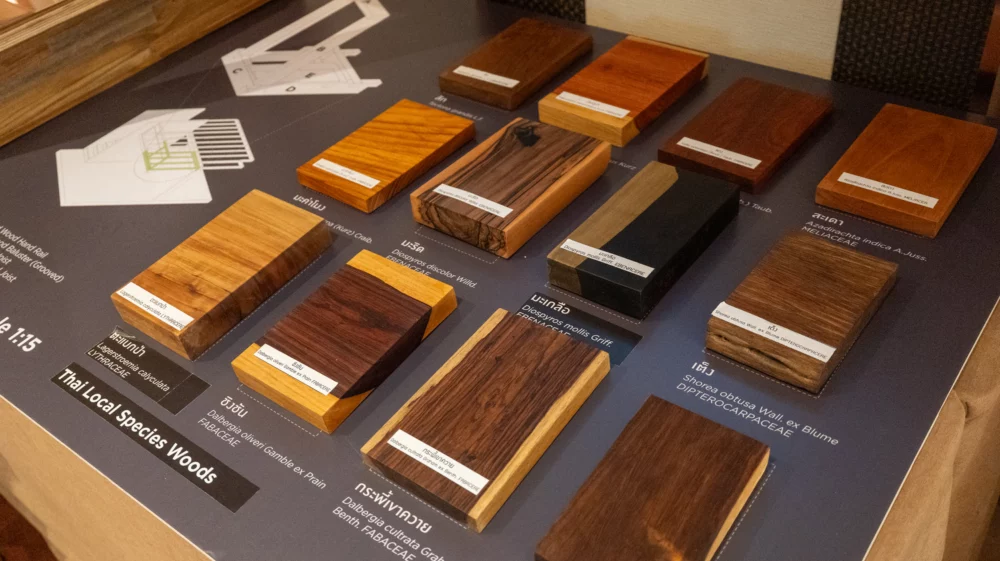
  1. Opportunity, Feasibility and Roadmap Study and a structured engagement process – A comprehensive assessment of the full value chain for timber construction in Thailand, including resource mapping, market potential, and a co‑created roadmap with Thai stakeholders. It also includes testing of Thai wood species for construction use and development of a monitoring and evaluation framework.
  2. Thai Pioneer Initiatives support – Coaching and acceleration of ~4‑5 selected pilot initiatives, including value‑chain projects (e.g., pilot buildings, engineered wood products), training programmes, and research & development concepts. Swedish experts will mentor the teams to develop concept notes and pitch decks.
  3. Wood Solution Support Platform – Assembling a first cohort of Swedish/international value‑chain experts (at least 8) and technology providers (at least 10) who are interested in the Thai market. The platform will provide technical assistance, curated business matchmaking, and knowledge exchange.
  4. Thai Organisation and Transition – Engaging prospective members of a future Thai “steering committee” for the program and co‑developing a concept and roadmap for the Thai organisation that will own and run the program.
  5. Gathering Event (Vision & Roadmap) – A two‑day convening in Bangkok (June 2026) to present study findings, pilot concepts, and the program vision; to reinforce collaboration; and to engage potential funders.
  6. Funding Partnership Development – Mapping and outreach to potential funding partners, drafting a joint funding partnership concept, and preparing concept notes for the subsequent Inception Phase.
figure

Figure 1: The Engagement Phase approach consists of six mutually reinforcing components designed to achieve the program objectives and contributes to building the technical, institutional and partnership foundations required for launching the program.

By the end of the Engagement Phase (June 2026), the project will deliver:

  • A validated, gender‑mainstreamed program framework for the Wood Solution Thailand Program.
  • A pipeline of pioneer initiatives ready for further development.
  • A functioning partnership platform linking Thai and Swedish stakeholders.
  • Initial funding partnerships and investment pathways.
  • A clear roadmap for launching the full multi‑year program.

The project is led by SEI Asia in Bangkok, in close collaboration with the Eco‑Innovation Foundation, the Thai‑Nordic Innovation Unit, and a core team of Swedish and international experts.

Thanapon Piman
Thanapon Piman

Senior Research Fellow

SEI Asia

Wanaporn Yangyuentham

Programme Manager

SEI Asia

Raja Asvanon

Research Associate

SEI Asia

Unchulee Lualon

Programme Coordinator

SEI Asia

Rajesh Daniel

Head of Communications, SEI Asia

Communications

SEI Asia

Diane Archer

Senior Research Fellow

SEI Asia

Ivar Virgin
Ivar Virgin

Senior Research Fellow

SEI Headquarters

Madeleine Fogde
Madeleine Fogde

Team Leader: Agriculture, Land and Bioeconomy; Senior Expert

SEI Headquarters

Alice Tunfjord
Alice Tunfjord

Project Manager

SEI Headquarters

  • Eco‑Innovation Foundation (EIF) – Co‑developer of the Wood Solution concept, responsible for platform development, pioneer initiative coaching, and fundraising.
  • Thai‑Nordic Innovation Unit (TNIU) – Facilitator and event organiser.
  • Royal Thai Embassy in Stockholm – Strategic partner and co‑funder.
  • Kasetsart University – Lead partner for the opportunity and feasibility study.
  • Chulalongkorn University – Partner for prototype development and research.
  • Swedish stakeholders – Including RISE, Limträteknik, Södra, SLU, and multiple technology providers and experts.

The development of the Wood Solution Thailand concept has been underway since 2023 and has involved a series of activities, trips, and events. Throughout this process, the Royal Thai Embassy in Stockholm has played a leading role, driven by its interest in advancing Thailand’s forest industry and improving the livelihoods of small-scale forest farmers and forest-adjacent communities. 

The Thai-Nordic Innovation Unit (TNIU) is an affiliated organization to the embassy, tasked with fostering collaboration with the Nordic countries. They have been involved from the very beginning and have organized most of the activities. TNIU has built strong relationships with all actors in the Thai pioneer group and developed solid knowledge of the value chain. They will act as a facilitator in most project components, as well as the organizer of the planned event (Component 4). 

Additional expertise through procurement  

In addition to SEI and EIF, additional specialists will be engaged for specific tasks during the project. This includes a group of three senior core experts who have worked in close collaboration with EIF on the development of the Wood Solutions Platform.  

In addition to these three core experts, it is estimated that for this phase approximately four experts across the value chain will be required to support the teams involved in Component 2: Pioneer Projects. External expertise may also be required to support the development of the Support platform and Thai program organization. 

The Engagement Phase is supported by Sida. Co‑funding is provided by the Royal Thai Embassy in Stockholm and by PMUC (Thailand) for complementary research activities.

Topics and subtopics
Land : Ecosystems
Related centres
SEI Asia, SEI Headquarters