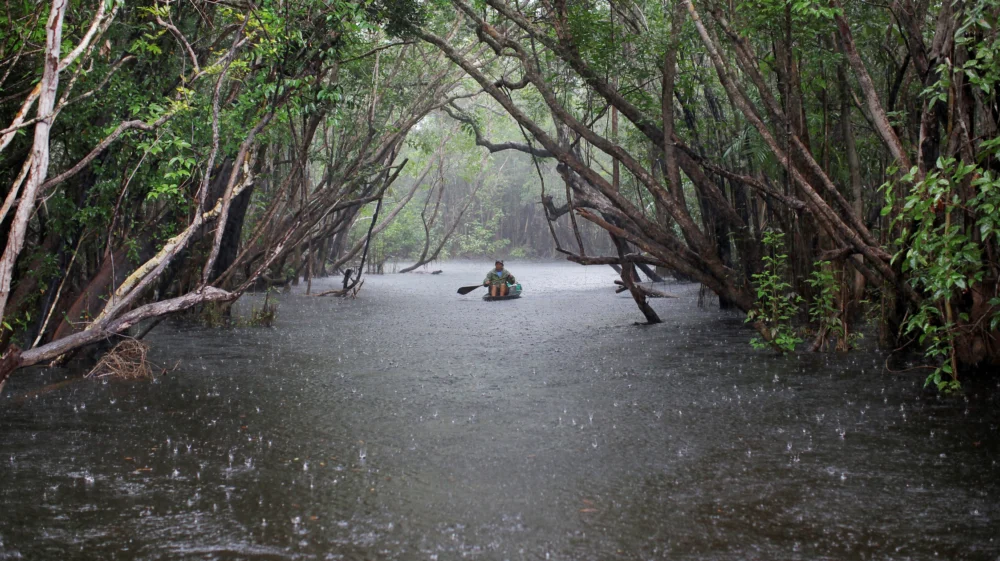
In order to address the accelerating biocultural loss in the Amazon region, science and policy must move away from reductionist, quantifiable carbon and biodiversity-centred frameworks, to instead recognize and engage with the plurality of Indigenous and local knowledge systems that generate locally relevant and just solutions that safeguard the Amazon’s ecological integrity and the well-being of people living in the region.
The Amazon is rapidly approaching an ecological tipping point driven by deforestation, forest degradation and global climate change. These are visible issues that receive increasing political and public attention.
However, the accelerating biocultural loss in the Amazon, including the extinction of Indigenous languages, the disruption of Indigenous and local knowledge systems, and the disintegration of culturally embedded livelihoods, remains largely invisible and receives little attention. These losses are compounded by the organized crime and illicit economies that displace communities, alongside the imposition of external conservation and development models on Indigenous Peoples and Local Communities.
In this perspective, the authors present an interdisciplinary analysis of the intertwined visible and invisible threats to the Amazon’s biocultural diversity and argue that science and policy must move away from reductionist, quantifiable carbon and biodiversity-centred frameworks. Instead, they must recognize and engage with the plurality of Indigenous and local knowledge systems that generate locally relevant and just solutions that safeguard the Amazon’s ecological integrity and the well-being of people living in the region.
By linking biodiversity conservation with territorial rights, socioeconomic equity and climate justice, the authors highlight that the Amazon needs to be understood as a living pluriverse, a place home to multiple worldviews, languages, laws, ontologies, knowledges and management systems where social and ecological vitality are inseparable and interconnected. Meaningful climate and biodiversity outcomes for the Amazon depend on policies that prioritize its biocultural integrity, strengthen territorial rights and local self-governance, and dismantle the systemic drivers that fuel its social-ecological collapse.
Journal article / This research examines how climate extremes are changing across Amazonia, identifying patterns in temperature and water deficit across seasons and locations.
Feature / After years of compiling data, a critical update arrived in December: a map of the Amazon that lays bare the real-time footprint of oil and gas expansion.
Project / This evaluation it's about measuring impact and shaping the future of conservation and sustainable development in one of the world’s most critical ecosystems