part of SEI and the Sustainable Development Goals
Start readingNow in its fourth edition, Science Day at the High-level Political Forum has become a key platform for dialogue between scientists, policy-makers, UN leaders and practitioners on the role of science in advancing sustainable development.
Co-organized by the International Science Council (ISC), the Stockholm Environment Institute (SEI), the Sustainable Development Solutions Network (SDSN) and the United Nations Department of Economic and Social Affairs (UN DESA), the 2026 edition explored a central question: if scientific knowledge has never been stronger, why does turning it into meaningful action remain so difficult? While discussions ranged from tropical forests and Pacific Island communities to artificial intelligence and the future of the Sustainable Development Goals (SDGs), a common thread emerged throughout the day. Producing scientific knowledge is only part of the equation. Equally important are the institutions, relationships and political cultures that enable societies to act on it.
Watch the full recording of Science Day 2026 at the HLPF here.
When science journalist and host of Science Friday Flora Lichtman opened Science Day 2026, she did so with the story of Nobel laureate Katalin Karikó. For decades, Karikó pursued research into messenger RNA with little recognition or support, long before the technology would underpin COVID-19 vaccines. The science existed years before the world knew what to do with it.
It proved to be a fitting introduction to the conversations that followed.
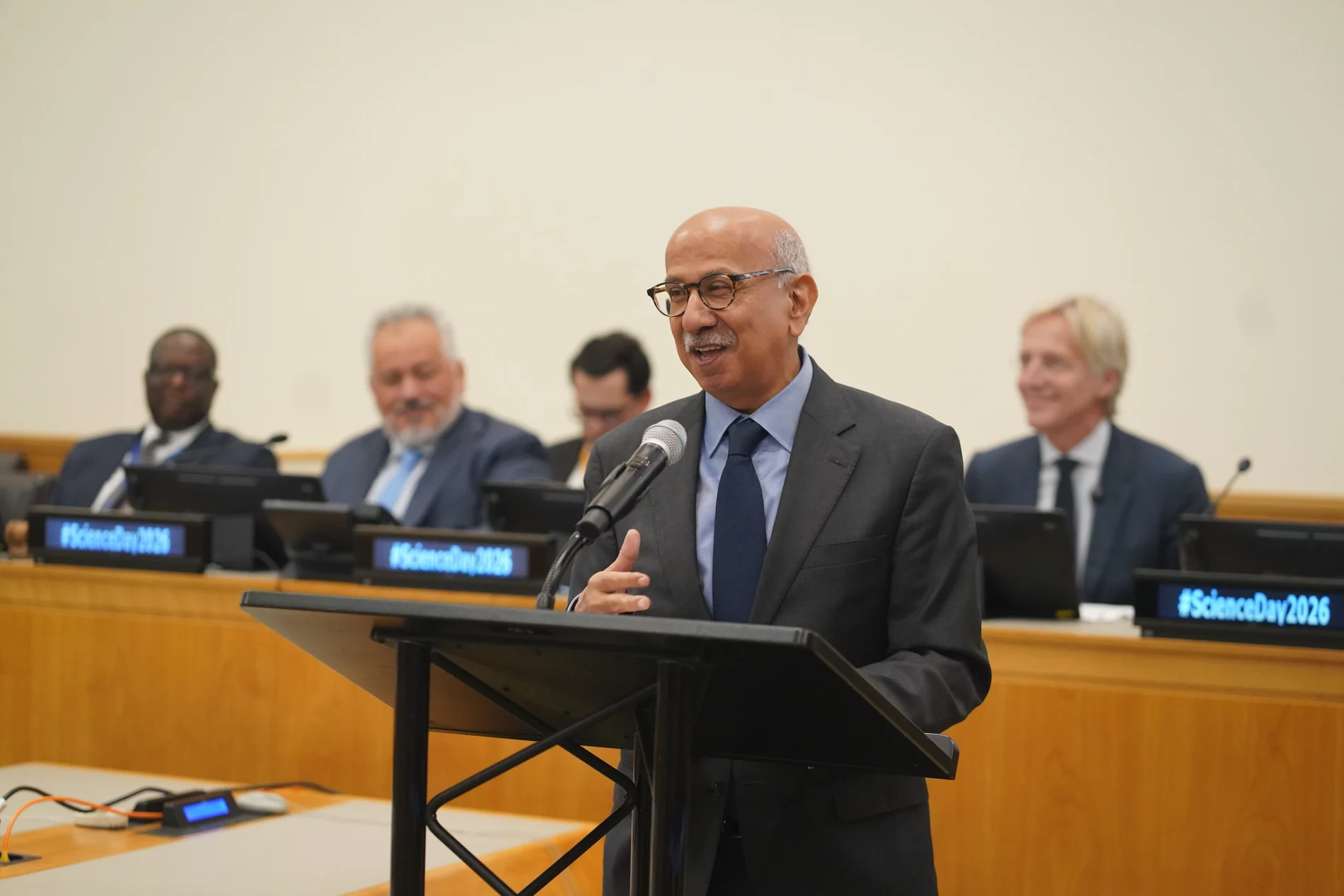
The opening discussion, led by ISC President-elect Robbert Dijkgraaf and UN Assistant-Secretary-General Navid Hanif, challenged participants to step back from the annual cycle of reporting on the Sustainable Development Goals (SDGs) and ask a more fundamental question: if scientific understanding of the world’s interconnected challenges has advanced so significantly, why does translating that knowledge into meaningful action remain so difficult? Their remarks converged on a common diagnosis. The obstacle, they argued, is not a shortage of scientific evidence, but the institutions, leadership and governance needed to turn that evidence into effective policy and implementation.
That perspective set the tone for the discussions that followed, shifting attention away from demonstrating the value of science and towards the conditions that allow scientific knowledge to shape decisions.
UN Assistant-Secretary-General Navid Hanif
Nyu Wang / UN DESA
The political discussion that followed suggested there was remarkably little disagreement about that diagnosis.
Speaking from very different national contexts, Ilka Hirt from the German Ministry for the Environment, Ambassador Gregor Koessler, Permanent Representative of Austria, Ambassador Chola Milambo, Permanent Representative of Zambia, and Raúl Sánchez, Deputy Permanent Representative of Colombia, each described the importance of strengthening the institutions that connect scientific expertise with public decision-making. While their priorities differed – from scientific advisory systems and international cooperation to research capacity and equitable participation in knowledge production – they shared a common conviction that effective science-policy interfaces cannot be improvised during moments of crisis. They require long-term investment, trust and sustained collaboration.
Sánchez perhaps captured the spirit of the discussion most succinctly when he reflected that transformative ideas often require persistence and political courage before they are recognized. The discussion that followed suggested that familiar barriers – including political will, fragmented governance, financing constraints and weak science-policy connections – are all manifestations of a deeper challenge: building institutions capable of turning scientific knowledge into effective action.
The debate quickly moved beyond diagnosing barriers and instead asked whether the relationship between science and policy itself is evolving.
The panellists suggested that it is.
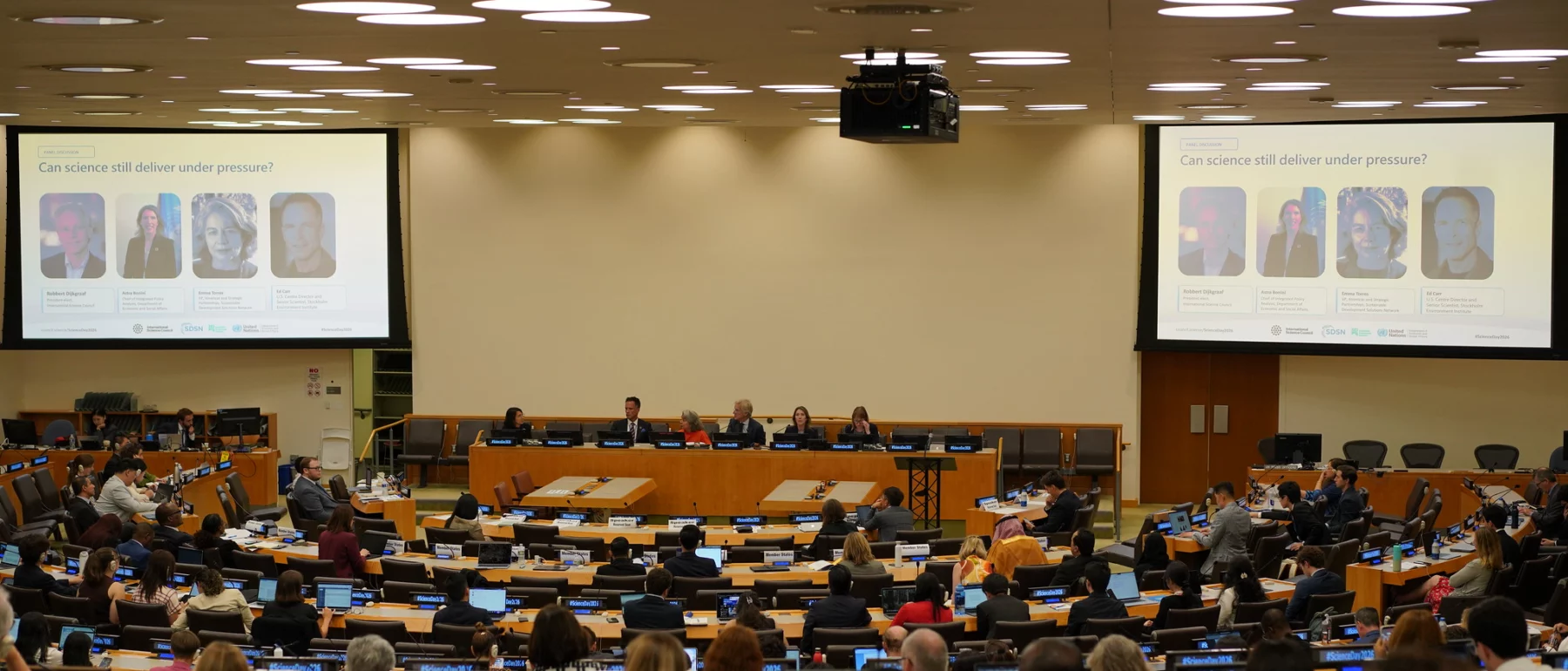
Panellists Robbert Dijkgraaf (International Science Council), Emma Torres (UN Sustainable Development Solutions Network), Ed Carr (Stockholm Environment Institute and Scientific and Technical Advisory Panel of the Global Environment Facility) and Astra Bonini (UN DESA) all approached the question from different perspectives, but converged on a common conclusion: the relationship between science and policy is itself evolving.
Today’s sustainability challenges demand approaches that cut across disciplines, sectors and knowledge systems. Scientific excellence increasingly includes the ability to work with policy-makers, practitioners and communities to shape solutions collaboratively. Examples such as the Science Panels for the Amazon, Congo Basin and Borneo (SDSN) illustrated how research agendas are being developed alongside the people most directly affected by environmental change, rather than for them.
Nyu Wang / UN DESA
At the same time, the panellists argued that science cannot evolve in isolation. Universities and research systems will need to better recognize engagement with policy and implementation, while public institutions must become more capable of absorbing and acting on integrated scientific evidence. As science has become more sophisticated in understanding the interconnections between global challenges, the systems responsible for translating those insights into policy have not always kept pace.
Across the discussion, a consistent picture emerged. The conversation had moved well beyond securing science a place in decision-making. The more pressing question was whether governments, research institutions and international organizations are equipped to learn from, absorb and act on scientific knowledge.
Another recurring theme throughout the day was that today’s sustainability challenges can no longer be understood or governed in isolation. Climate change, biodiversity loss, inequality, food systems, finance and technological change are deeply interconnected, and participants repeatedly argued that the science-policy interface must evolve accordingly. Rather than producing more sectoral evidence, science is increasingly being asked to help governments understand interdependencies, anticipate trade-offs, identify synergies and design interventions capable of generating benefits across multiple objectives. In other words, the challenge is no longer only generating knowledge but strengthening the capacity to translate systems understanding into implementation.
The focus talks that followed offered a series of practical answers. Rather than debating what effective science-policy should look like, they showcased how it is already taking shape in communities, cities and institutions around the world.
The focus talks shifted the discussion from diagnosis to practice. Across very different contexts – from climate adaptation and Indigenous knowledge to urban development, foresight and human wellbeing – the speakers challenged the idea that scientific evidence simply flows from researchers to policy-makers. Across these examples, science-policy emerged as an ongoing process of collaboration, built around relationships, trust and shared problem-solving.
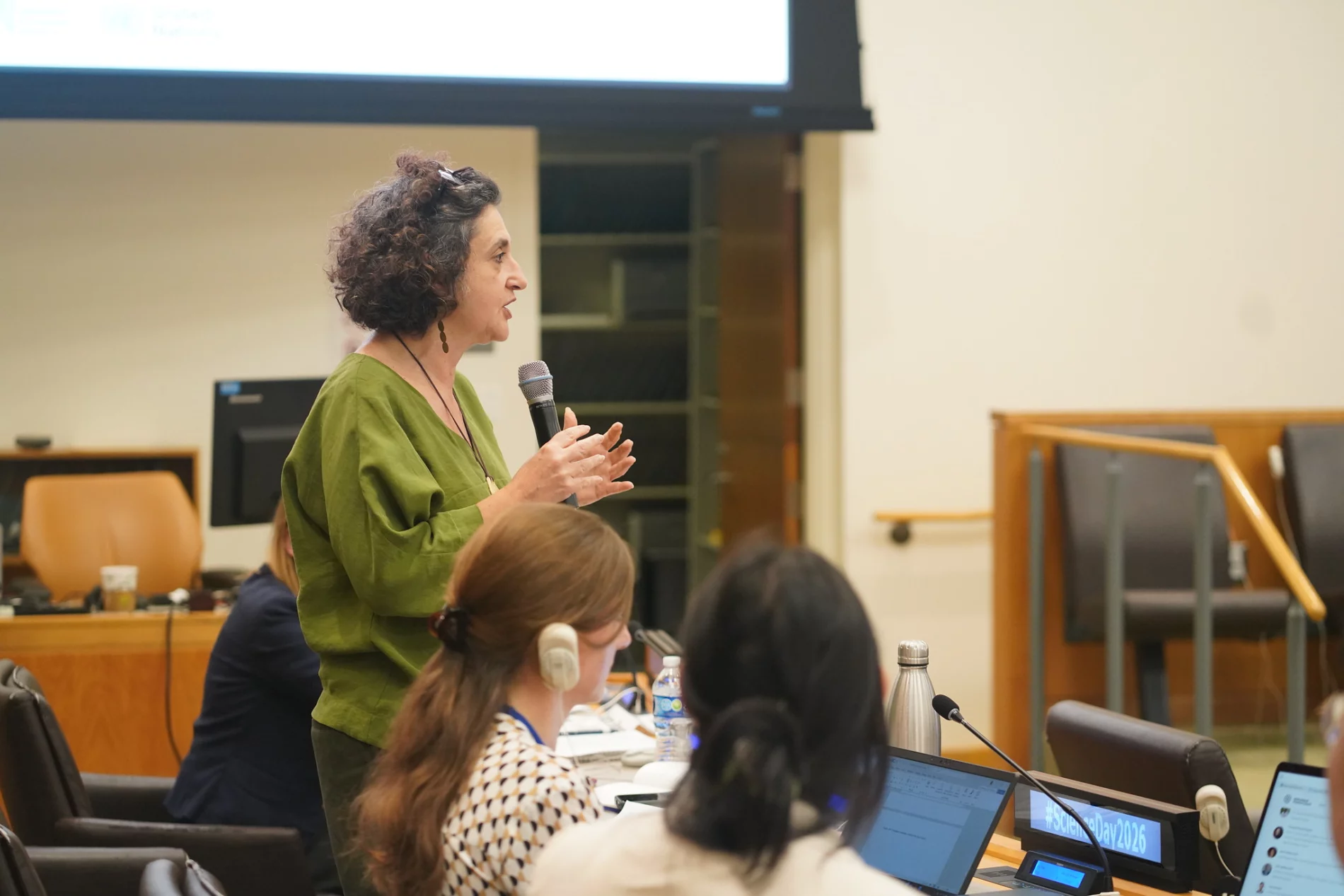
Joshua Amponsem, founder of the Youth Climate Justice Fund, argued that climate resilience is strongest when scientific evidence is developed alongside the communities expected to act on it. That emphasis on co-production was echoed by Roannie Ng Shiu, Executive Director of the Pacific Academy of Sciences, who reflected on the Pacific’s long tradition of combining scientific observation with Indigenous knowledge and argued that local expertise must move from the margins to the centre of decision-making.
Looking ahead, Amir AghaKouchak, Professor of Civil and Environmental Engineering at the University of California, Irvine, called for science-policy to become more anticipatory, arguing that foresight, early warning systems and risk-informed decision-making will be essential as climate risks become increasingly systemic. Turning to cities, Marie-Hélène Zerah, Research Director at the French National Research Institute for Sustainable Development (IRD), and Ivan Shumkov, Co-Chair of the UN-Habitat Partnership on the Future of Cities, highlighted the need for continuous collaboration across disciplines, sectors and communities to address increasingly complex urban challenges.
Marie-Hélène Zerah, Research Director at the French National Research Institute for Sustainable Development (IRD)
Nyu Wang / UN DESA
The final provocation came from Brendan Case, Associate Director for Research at Harvard University’s Human Flourishing Program, who challenged participants to think beyond conventional measures of development. Drawing on evidence from the Global Flourishing Study, he suggested that future development agendas may need to place greater emphasis on meaning, relationships, character and wellbeing alongside health and material prosperity.
Despite their different contexts, the talks pointed towards a common conclusion. Effective science-policy is neither linear nor one-size-fits-all. Whether addressing climate adaptation, urban development or human wellbeing, progress depended on sustained dialogue, mutual learning and institutions capable of bringing together different forms of knowledge in response to complex challenges.
The day’s closing conversation looked beyond the immediate task of delivering the Sustainable Development Goals and asked a broader question: what kind of science-policy architecture will be needed beyond 2030?
Moderated by Ed Carr (SEI), the discussion with Norichika Kanie of Keio University and Marianne Beisheim of the German Institute for International and Security Affairs deliberately resisted the temptation to focus on what might replace the SDGs. Instead, it considered what the international community should carry forward from the past decade.
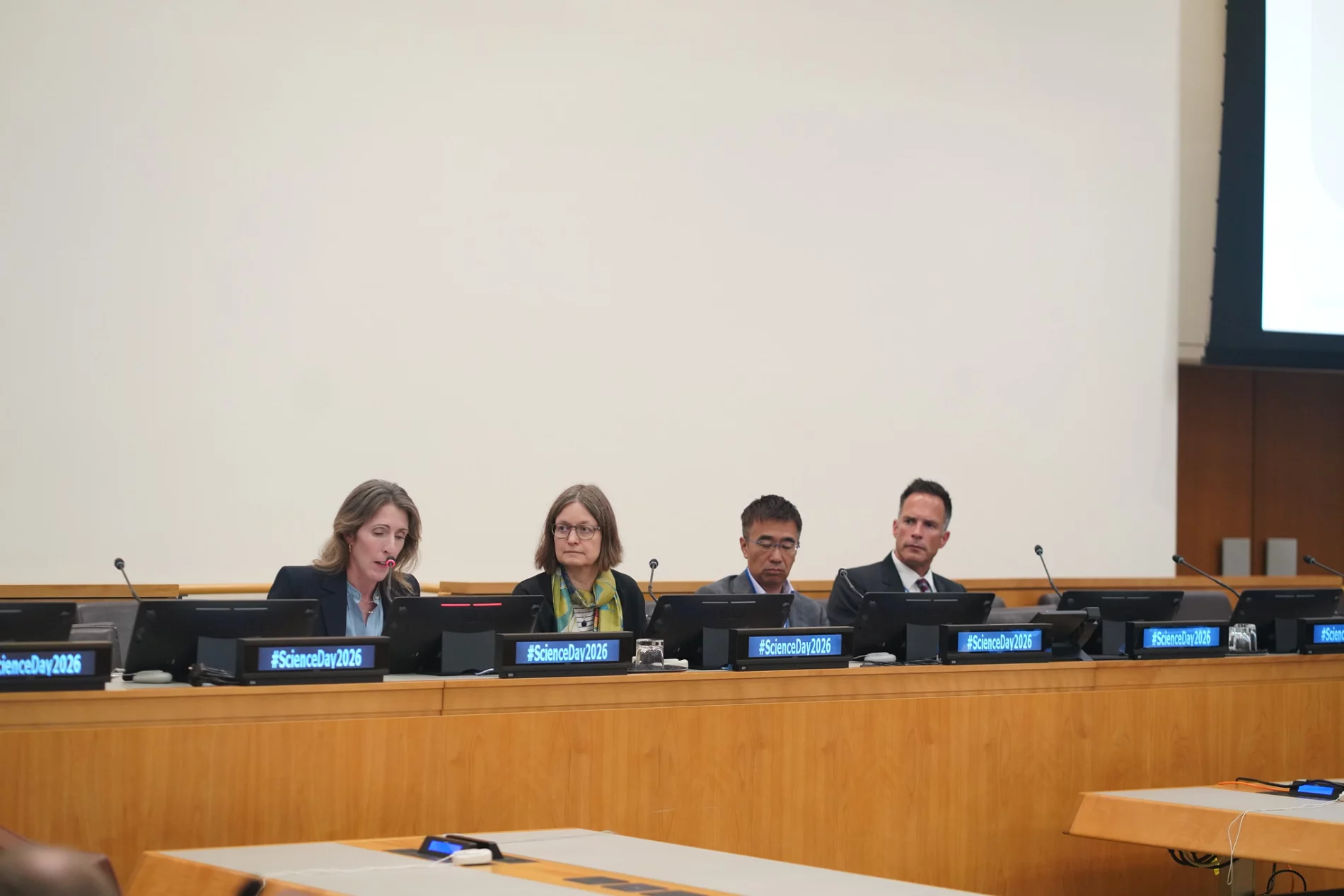
Astra Bonini, UN DESA ; Marianne Beisheim, SWP ; Norichika Kanie, Keio University, Ed Carr, SEI
Nyu Wang / UN DESA
Among the most enduring legacies of the 2030 Agenda, participants suggested, has been a growing recognition that global challenges cannot be addressed in isolation. Research on SDG interactions, systems thinking and transboundary spillovers has shown that climate change, biodiversity, health, inequality, technological change and economic development are deeply interconnected, demanding approaches that are equally integrated. While science has increasingly embraced this reality, the question now is whether governance systems can evolve at the same pace and use these insights to support implementation.
Participants also pointed to a growing need for institutions that do more than respond to today’s crises. They argued for stronger capacities in foresight, anticipation and systems thinking – approaches that help policy-makers navigate uncertainty rather than simply react to it. As emerging technologies, geopolitical shifts and environmental change accelerate, science-policy interfaces will need to become more agile, more inclusive and better equipped to inform decisions over longer time horizons.
One message resurfaced repeatedly throughout the day. The future of science-policy will depend as much on the institutions, incentives and partnerships surrounding scientific knowledge as on the knowledge itself. Those are the conditions that determine whether evidence ultimately informs action.
Flora Lichtman’s opening story of Katalin Karikó therefore carried a deeper significance by the close of the event. Scientific breakthroughs do not transform societies simply because they exist. They do so because people, institutions and political leaders create the conditions for knowledge to be recognized, trusted and applied.
Looking ahead, the conversation suggested that the central question for Beyond 2030 may not be what goals come next, but what capacities governments, institutions and societies will need to navigate an increasingly interconnected world. That places new expectations on science: not simply to explain complexity, but to help decision-makers act within it.
This story was written by James Waddell and originally published by the International Science Council (ISC) here.
Project / This project uses geospatial analysis and public engagement to determine how data centre siting in California affects vulnerable communities' water security.
Media advisory / SEI invites journalists to a media briefing where its experts will share their perspectives on key topics ahead of the UN Biodiversity Conference (COP17).
Feature / SEI collaborated with Sustainable Food Systems Ireland to develop the Malawi Food Systems Transformation Tool using the SDG Synergies platform.