Transforming a food system requires coordinating decisions that span multiple sectors, institutions and development goals. To support this challenge, SEI collaborated with Sustainable Food Systems Ireland under the Irish-Malawi Agrifood Systems Support Program to develop the Malawi Food Systems Transformation Tool using SEI’s SDG Synergies platform.
As part of the Ireland–Malawi Agrifood Systems Support Programme, SEI collaborated with Sustainable Food Systems Ireland (SFSI) to develop the Malawi Food Systems Transformation Tool as an interactive, web-based decision-support platform, hosted on SEI’s SDG Synergies system. Designed to drive coordinated and strategic action, the tool enables policymakers and stakeholders to visualize how goals across multiple policies interact, highlighting synergies and trade-offs.
The tool incorporates a curated and structured library of the policies in Malawi that are most relevant to achieving the nation’s objectives for transforming its food systems. Each policy is organized into Policy Priority Areas (PPA) and Policy Statements (PS). Some policies also include objectives, pillars, enablers, goals and key priority actions. The tool was designed for use by Government of Malawi officials and practitioners and was shaped by their direct feedback through an online survey, ensuring it reflects the realities of policy work on the ground.
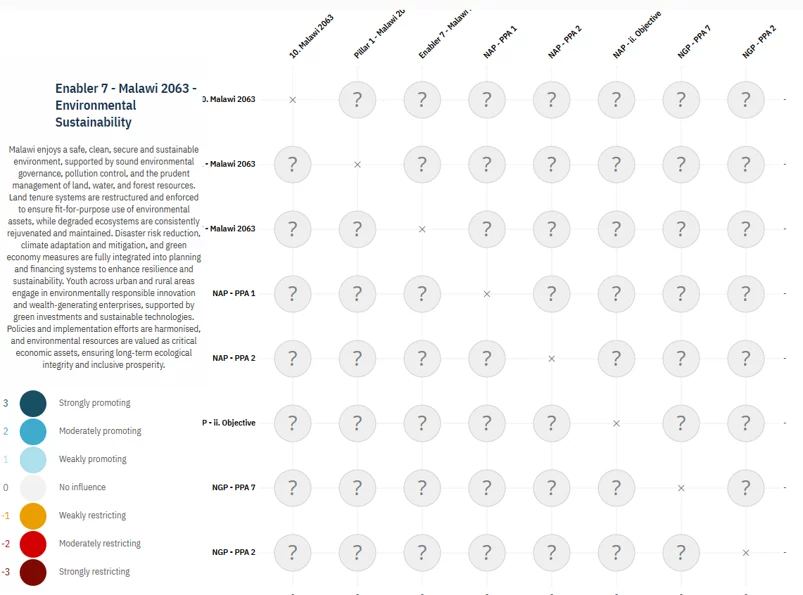
Through interactive matrices, government officials and decision-makers can assess how progress in one policy area might influence, support or hinder progress in another. Using a robust cross-impact analysis methodology, the tool applies a seven-point scoring system, ranging from +3 (strongly supports) to –3 (strongly hinders), to score these interactions.
Figure 1. Example of cross-impact matrix in SDG Synergies
Fuente: SDG Synergies
This visual representation of interlinkages allows policymakers to coordinate across sectors, identify high-impact actions and prioritize interventions that maximize synergies while mitigating trade-offs.
The most influential policies in the tool were the Malawi’s Vision: An Inclusively Wealthy and Self-reliant Nation (Malawi 2063) and the National Agriculture Policy (NAP). Based on the priorities of Malawi government experts, the tool includes all pillars and enablers from Malawi 2063. For the NAP, the tool captures all PPA and their associated PS. The PS identified in SEI’s previous network analysis of the NAP and the Food Systems Roadmap are also included (see Box 1).
BOX 1. NETWORK ANALYSIS: Action clusters between Malawi’s national agriculture program (NAP) and national pathways for food systems transformation
SEI supported SFSI in identifying strategies and action tracks to promote policy coherence in Malawi’s food systems agenda. The goal was to use network policy analysis to identify cluster policies that could foster coherence and coordination for the NAP and the National Pathways for Food Systems Transformation.
Sectoral policies were also incorporated: the Irrigation Policy, the Fisheries and Aquaculture Policy, the Livestock Development Policy, the Agriculture Land Resources Management Policy and the Gender Policy. The PPA, PS and policy objectives are sequenced in the tool according to the priorities of the consulted experts.
The customized SDG Synergies platform for Malawi includes the SDG Synergies geographical spillovers feature. This feature is useful for seeing how policy interactions between areas may impact different scales (i.e. national, regional or international). The tool offers subspaces in the matrix (submatrices) corresponding to interactions between pairs of territories. This feature helps identify coordination mechanisms between scales, showing how progress or hindrance in food systems transformation objectives in one place can affect another.
In practice, government officials could use the tool to identify synergies and trade-offs between different policies, mapping where these agendas reinforce or conflict with each other and with Malawi’s broader food systems transformation goals. For instance, a policy team could similarly use it to assess how a national nutrition strategy interacts with local agricultural priorities, strengthening coherence across implementation levels. For those working across administrative boundaries, the geographic spillovers feature allows users to trace how policies interact from national to local levels.
The Malawi Food Systems Transformation Tool offers a practical and flexible platform that supports evidence-based decision-making for stakeholders involved in food systems policy. It allows users to select and combine policies across sectors, and tailor the analysis to their specific policy questions or priorities.
SDG Synergies is a platform for governments who want to see how their policies interact to transform their food systems in relation to other areas, using to systems thinking. Furthermore, it is now possible to analyse policy impacts across different geographic scales. Contact us to learn how to use SDG Synergies and the geographic spillovers feature at [email protected].
Project / SEI is piloting the SDG Synergies approach in Sri Lanka for coherent policy-making and implementation.
Tool / A practical tool for understanding how groups of policy areas and targets interact, using systems thinking.
SEI brief / This brief demonstrates the SDG Synergies tool's new geographic spillovers feature by comparing metropolitan and state climate policies in Monterrey, Mexico.
Feature / We review the SDG Synergies tool and country examples to see how analysing synergies and trade-offs between the SDGs will support implementation of Agenda 2030.
Media advisory / Experts from SEI will be at CBD COP17 in Yerevan from 19–30 October and are available for commentary and analysis.