SEI and ONWR are collaborating to identify priorities, share expertise, co-design solutions, and mobilize partnerships that are needed to implement effective solutions for water and climate resilience in Thailand and throughout the region.
Water-related challenges are complex, intertwined, intersectoral and often transboundary in nature. Addressing issues of this magnitude and complexity requires moving beyond individual project implementation towards more collaborative approaches that combine policy level priorities, technical expertise and practical lessons to co-develop meaningful solutions.
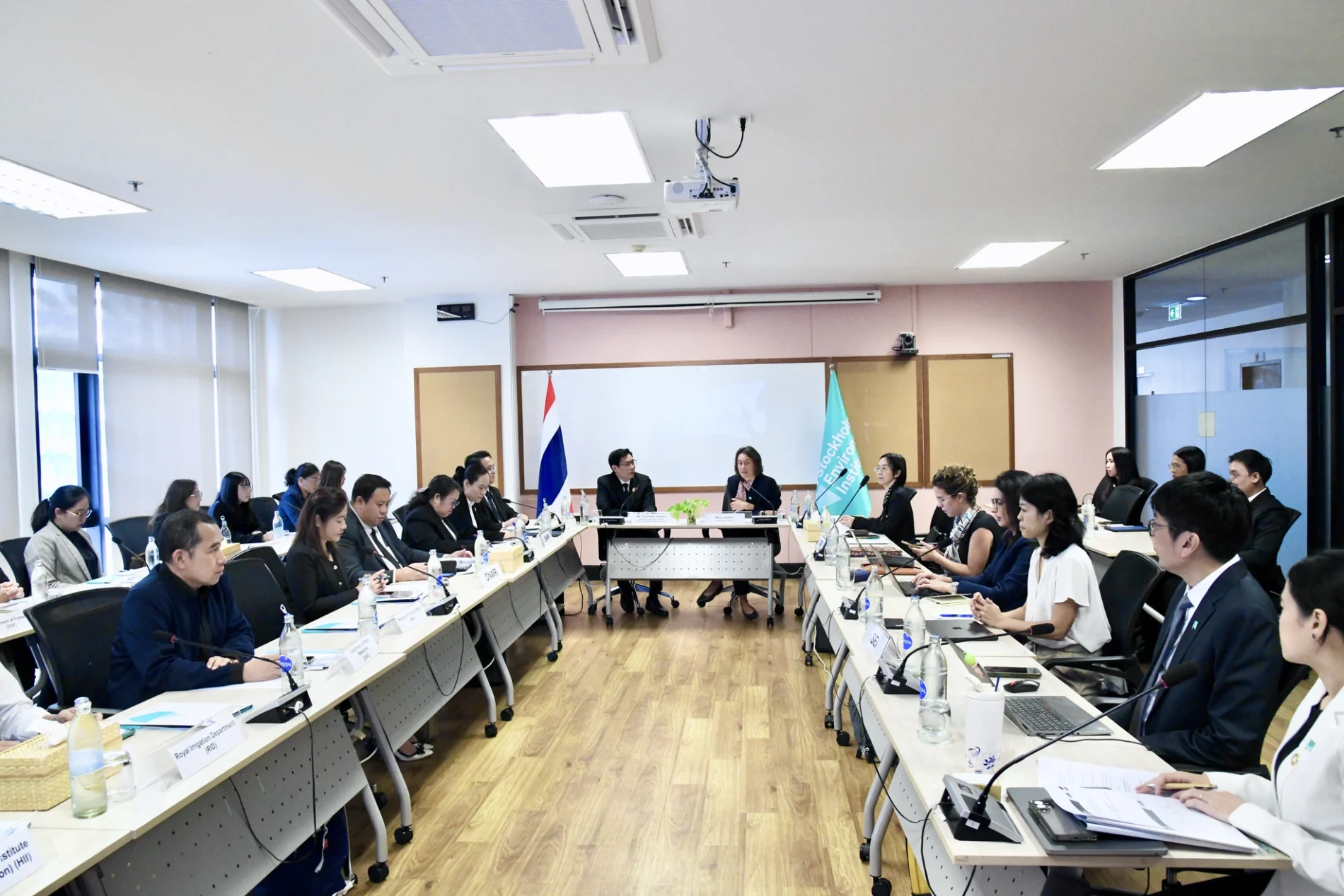
The second Joint Steering Committee (JSC) Meeting under the memorandum of understanding between Thailand’s Office of National Water Resources (ONWR) and Stockholm Environment Institute (SEI), held on 20 August 2026 at SEI Asia, provided a key opportunity to reflect on their institutional collaboration for water-related challenges. At this meeting, SEI and ONWR jointly identified priorities, reviewed progress on actions, and shaped the next phase of cooperation to address water and climate issues in Thailand, the Greater Mekong Region (GMS) and ASEAN.
In 2025 and 2026, the ONWR-SEI partnership progressed from shared commitments to joint action across three themes: research, knowledge exchange, and partnership development. The partnership’s collaborative research initiatives included the completion of the Water Tenure Assessment, Accounting Roadmap and Water Scarcity Action Plan supported by FAO, as well as Joint Community Research on Climate Change Adaptation in Bung Khla, Thailand undertaken with MRC and ONWR.
Beyond research, SEI and ONWR jointly contributed on nine regional and international events during this period to provide a solid foundation for sustained partnership. These events included Mekong Environmental Resilience Week, the P-LINK Regional Stakeholder Forum, Regional knowledge exchange on water storage management, the Asia-Pacific Forum on Sustainable Development, and World Water Day.
This institutional arrangement also enables cooperation and collaboration across relevant Thai water agencies and partners, bringing together scientific and technical expertise alongside sectoral knowledge and implementation experience. A key highlight of this ongoing cooperation is the project on wetland monitoring that brings together the Department of Water Resources (DWR) institutional mandate with SEI’s expertise in remote sensing, geographic information systems (GIS), and the application of the Wetland Monitoring tool to strengthen approaches for monitoring wetland health and integrate the knowledge into planning and decision-making.
Joint implementation is key to this partnership to develop technical approaches, strengthen capacities, and engage local communities and key stakeholders for high impact on the ground. Three incoming projects funded by Lancang Mekong Cooperation’s Special Fund will provide a platform and opportunity to promote cooperation between Thailand, Myanmar, Lao PDR and China, aiming to translate into tangible actions and benefits for local people. These projects include strengthening urban community resilience to flash floods in Sai and Ruak transboundary river basins, a water sector youth leadership network for practical solutions, and the Heung Transboundary IWRM project.
Co-design is also central to SEI and ONWR’s partnership, bringing together ONWR’s policy mandate and Thai national water-related priorities with SEI’s research on policy expertise and regional networks. Co-design approaches are being utilized to develop a project in Nan River Basin (NAN nexus) using databases and scientific tools to monitor and analyze water-related conditions, as well as develop approaches to assess loss and damage from floods. These efforts would support long-term planning for flood prevention, risk reduction and resilience building. ONWR also proposed expanding collaboration on the application of the Water Evaluation and Adaptation Planning (WEAP) tool to support water scenario analysis, assessment of policy options, and review of the 20-Year Water Resources Management Master Plan (2018–2037).
Photo: Noraset Kunjara Na Ayudhya / SEI Asia.
The Joint Steering Committee operates as a strategic guiding mechanism for review, learning, and refining SEI and ONWR’s joint work program. Lessons learnt from the first year of implementation have successfully informed the design and revision of the work program, including future priority projects, mechanisms of regional cooperation, and key policy processes to engage with. The work program provides a dynamic framework for continued collaboration, while exchange visits, joint engagement with development partners, and co-development of proposals create opportunities to enhance successful outcomes and scale their impact.
Six shared priorities were identified during the Joint Steering Committee meeting that will guide the future of this partnership:
Past event / SEI and ONWR will sign an agreement to strengthen Mekong Region water governance on 3 June 2025.
Press release / On 3 June, SEI and ONWR has signed a five-year agreement to strengthen Mekong Region water governance.
Event on 20 September – 27 September in New York City / SEI joins the Climate Week in New York to highlight global leadership and finance solutions for accelerating the transition to net zero industry.