SEI LA
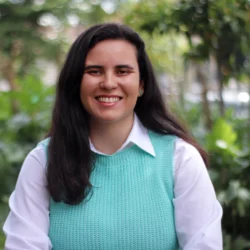
Cláudia is an affiliated researcher at SEI Latin America and a PhD student in Geography and the Environment at the University of Oxford. Parallel to her doctoral studies, she is a researcher with the Oxford Martin School’s Agile Initiative, contributing to the sprint on deforestation and the UK food system.
Her doctoral research examines transboundary water governance in the Amazon Basin, exploring how shared water systems are governed across political, territorial, and institutional boundaries, particularly in frontier and borderland contexts. Her current empirical focus is the Acre River Basin, a tri-border region shared by Bolivia, Brazil, and Peru, where she investigates how these dynamics unfold across interconnected socio-environmental and governance systems.
Within the Agile Initiative, Cláudia contributes to research on the forest–food nexus, analysing how forest-related actions in producer countries shape agricultural production, trade stability, and food-system resilience in the UK, with a particular focus on soy in Brazil and cocoa in Ghana.
More broadly, her work sits at the intersection of water, climate, land use, and environmental governance, with a strong interest in how interdisciplinary, participatory, and data-informed approaches can support more integrated, equitable, and evidence-based environmental decision-making. Her research focuses on the interface between science, policy, and practice in water and climate governance.
Cláudia’s background is in Environmental Management (University of São Paulo – USP, Brazil, and Indiana University Bloomington, USA), with an MSc in Water Science, Policy and Management from the University of Oxford and an MBA in Data Science from USP, which informs her interest in combining governance studies with analytical and data-driven approaches to environmental challenges.
Prior to starting her PhD, Cláudia worked at SEI Latin America for six years, contributing to interdisciplinary research and environmental governance initiatives across the region. Her work combined participatory and data-informed approaches to water and sanitation, climate, and ecosystem services, with gender and social equity as cross-cutting dimensions across diverse socio-environmental contexts, including the Amazon Basin, the Bolivian Andes, the Colombian Coffee Region, and Brazil’s Atlantic Forest.