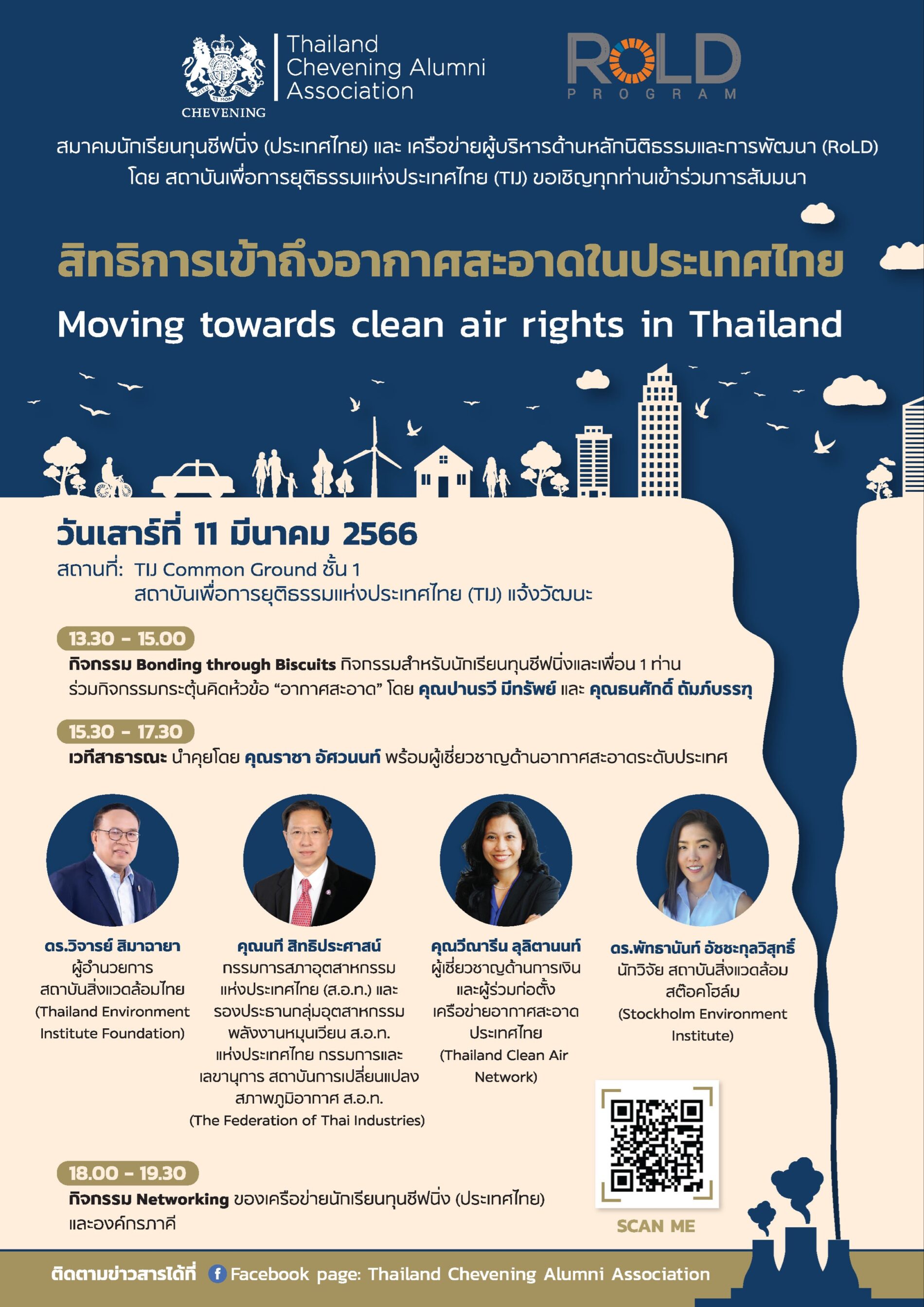
The ‘Chevening Thailand Policy Forum: Towards the Rights to Clean Air’ co-organized by the Thailand Chevening Alumni Associate and Thailand Institute of Justice (TIJ) aims to explore and discuss why the right to clean air is crucial for everyone. Join SEI Asia’s Research Fellow, Ploy Achakulwisut and Research Associate, Raja Asvanon on 11 March 2023.
Graphic: Thailand Chevening Alumni Association.
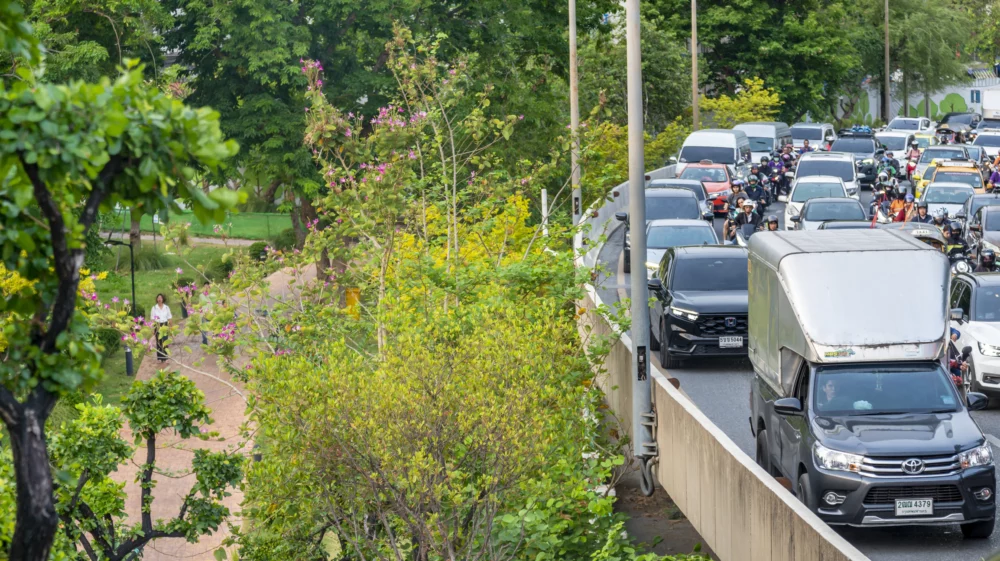
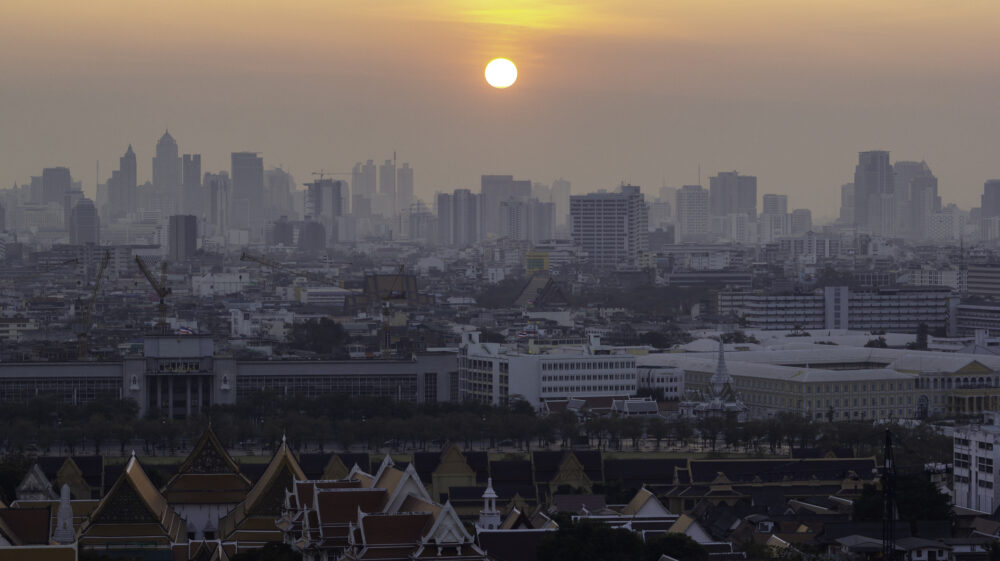
Past attempts by the Thai government to address air pollution have failed to effectively reduce exposures to harmful air pollutants such as particulate matter (PM), ozone, and nitrogen oxides, and mobilize the actions needed to address the root causes. Calls from health experts, development agencies, civil sector, and policymakers alike have emphasized that current efforts are insufficient and ineffective to improve the situation.
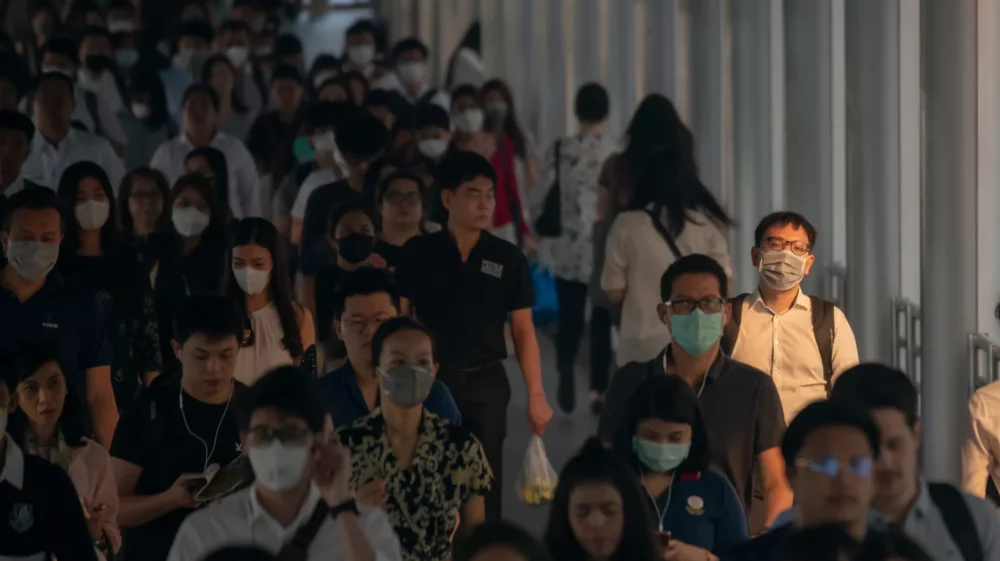
Decades of scientific research have shown that air pollution affects every major organ system in the human body and is a leading cause of death and illness worldwide. Research and discussion of the health impacts of air pollution specific to the Thai population have been accumulating over recent years, but evidence-based policy approaches to improve air quality are not gaining equal traction. Studies on the health impacts of air pollution on the general population and vulnerable groups in Thailand are continuously being put forward, warning that more people are suffering from respiratory diseases due to PM air pollution.1 Research has shown that improving the air quality can increase the life expectancy of people in Thailand by 1.8 years.2
Yet, since the government declared particulate matter air pollution to be on the national agenda on 12 February 2019, inclusive and holistic measures have not materialized to improve the air quality and health conditions.
Since 2020, awareness and movement to resolve air pollution has been increasing. Four draft legislations have been presented to the parliament for review including, Bhumjaithai Party3, Move Forward Party4, Palang Pracharath Party5, Thailand CAN (Clean Air Network)6, and the citizen-led draft legislation7. However, two (Palang Pracharath Party and Thailand CAN) of the five drafted legislation have been accepted by the Prime Minister to review and present to the parliament. Underpinning this movement is the recognition of clean air as a human right for everyone living in Thailand. The question is whether relevant policy makers are ready to rethink this agenda as a pathway to building a green, healthy and fair environment for everyone.
Thailand Chevening Alumni Association (TCAA) project 2023 aims to organize activities which will lead a positive impact to Thai society. This year’s topic: Towards the Right to Clean Air consists of two activities; A) Tea and Biscuits, an informal discussion session designed for Chevening alumni and their peers to explore and discuss why the right to clean air is crucial for everyone. B) A policy forum, a panel of discussion among experts on air pollution issues in Thailand.
Please note that the forum will be conducted in Thai.
Join SEI Asia’s Research Fellow, Ploy Achakulwisut and Research Associate, Raja Asvanon to hear more on the rights to clean air in Thailand.
Feature / บทเรียนจากสวน 15 นาที ของกรุงเทพฯ เผยให้เห็นว่าการออกแบบและทำเลที่ตั้ง ส่งผลต่อสุขภาวะ และวิธีที่ผู้คนใช้พื้นที่สีเขียวในเมืองอย่างไร
Feature / สวน 15 นาทีในกรุงเทพฯ ปรับเปลี่ยนการเข้าถึงพื้นที่สีเขียวในเมืองและให้แนวคิดใหม่เรื่องความเท่าเทียม สุขภาพ และความยืดหยุ่นของคนในเมือง
Media coverage / เวทีสาธารณะ เรื่อง ‘สิทธิการเข้าถึงอากาศสะอาดในประเทศไทย’ ที่มีผู้เชี่ยวชาญมาร่วมให้ความรู้และเสนอแนวทางแก้ไขปัญหาไว้อย่างน่าสนใจ