African leaders have led the way through regional platforms on climate change showcasing best practice and asking for partnership. Interaction through the science policy interface was exemplified by the release of the Integrated Assessment of Air Pollution and Climate Change for Sustainable Development in Africa report, which provided a chance for regional leaders to continue action based on the recommended measures across five key sectors including energy, agriculture, and waste management.
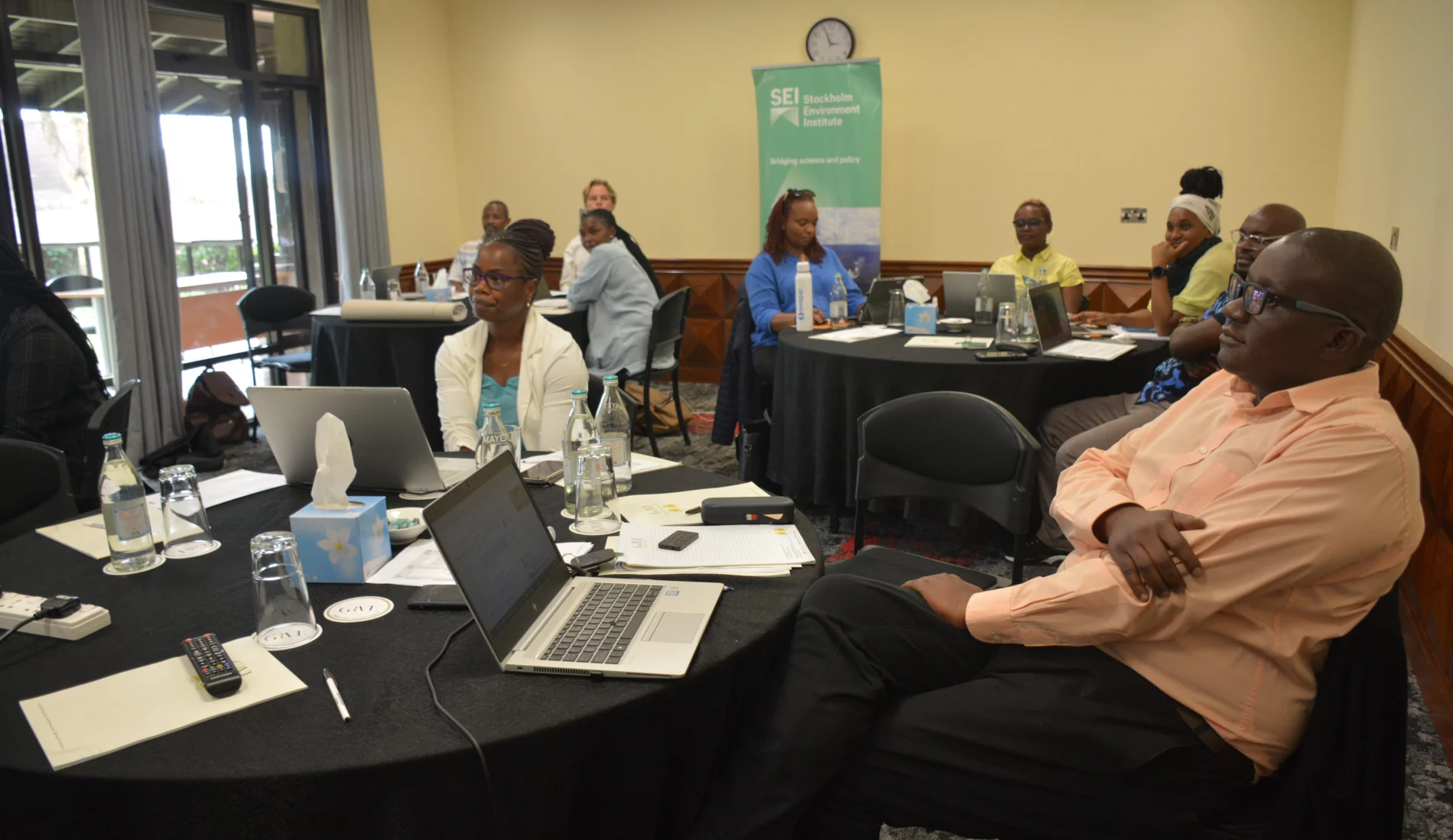
SEI Africa staff in a retreat session
Photo: Lawrence Nzuve/SEI
This workshop has an overarching aim to outline how to build on and coordinate the community of practice of science and policy makers assembled from three key sectors, energy, waste, and agriculture.
The reduction of anthropogenic short-lived climate pollutant (SLCP) emissions together with the limiting of CO2 and other long-lived GHG emissions has long-term benefits for climate change as well as near-term benefits in reduction of environmental pollution, protection of biodiversity, human health, and livelihoods.
At the 19th Ordinary session of the Africa Ministerial Conference for the Environment (AMCEN), reduction of non-CO2 emissions was included in climate change actions, while the 18th and 17th AMCEN Sessions included support for integrated actions on greenhouse gases and SLCPs.
The political momentum in Africa also echoes the global pledge to reduce methane emissions by at least 30% anthropogenic from 2020 levels by 2030 with more than 30 countries signing onto the pledge by October 2023.
The 18th session of AMCEN in 2022 urged African countries to support further development and implementation of the recommended measures as a continent-wide Africa Clean Air Program, coordinated by strong country-led initiatives, cascaded to the Regional Economic Communities and higher levels of policy.
Day 1 (Saturday): 24th February 2024
| Time | Session Item | Responsible Person(s) | |
| 1 |
08:30-09:00 EAT |
Arrival and registration |
Gerry Opondo, ECI |
| 2 | 09:00-09:15 EAT | Program introduction & moderation |
Moderator: Philip Osano Rapporteur: Lawrence Mwangi, Stockholm Environment Institute and Lydia Okolla, ECI |
| 3 | 09:15 – 10:15 EAT | Scene setting |
Kevin Hicks, Stockholm Environment Institute, University of York |
| 4 | 10:15 – 11:00 EAT | Tea break, group photo, and networking | Gerry Opondo, ECI |
| 5 | 11:00- 11:30 EAT | Sector focus: Agriculture |
Principal Scientist, The International Livestock Research Institute (ILRI) |
| 6 | 11:30 – 12:00 EAT | Sector focus: Energy |
Youba Sokona, Special Advisor for Sustainable Development at the South Centre |
| 7 | 12:00 – 12:30 EAT | Sector focus: Waste |
Aderiana Mbandi, UNEP |
| 8 | 12:30- 14:00 EAT | Lunch break and networking |
Gerry Opondo, ECI |
| 9 | 14:00 – 15:00 EAT |
Writeshop into sectors-outline of the priorities of the sectors agreed on |
1. Agriculture 2. Energy 3. Waste |
| 10 | 15:00- 16:00 EAT |
Plenary feedback from the write shop sessions |
Gerry Opondo, ECI |
Day 2 (Sunday): 25th February 2024
| Time | Session Item | Responsible Person(s) | |
| 1 | 09:00- 09:15 EAT |
Program introduction and moderation |
Moderator: Philip Osano Rapporteur: Lawrence Mwangi, Stockholm Environment Institute and Lydia Okolla, ECI |
| 2 | 09:15- 09:30 EAT |
Presentation on the National Priorities for the Energy Sector (South Africa) |
Jongikaya Witi |
| 3 | 09:30 – 09:45 EAT |
Presentation on the National Priorities for the Waste Sector (Egypt) |
Nagwa ElKarawy |
| 4 | 09:45- 10:00 EAT |
Presentation on the National Priorities for the Agriculture sector (Uganda) |
Irene Chekwoti |
| 5 | 10:00 – 10:15 EAT |
Presentation on the Continental Priority on Energy, Waste and Agriculture |
Harsen Nyambe, Director, Sustainable Environment and Blue Economy Directorate, African Union Commission |
| 5 | 10:15 – 10:30 EAT | Questions to the panelists |
Moderator: Philip Osano Rapporteur: Mr Lawrence Mwangi, Stockholm Environment Institute and Lydia Okolla, ECI |
| 6 | 10:30- 11:00 EAT | Teabreak and networking | Gerry Opondo |
| 8 | 11:00 – 12:30 EAT |
Science, Policy and Practitioners Interface in the Energy, Waste and Agriculture Sectors- Who is in the room and who isn’t? |
Moderator: Philip Osano Rapporteur: Mr Lawrence Mwangi, Stockholm Environment Institute and Lydia Okolla, ECI |
| 9 | 12:30 – 13:30 EAT | Lunch break |
Gerry Opondo |
| 10 | 14:00- 15:30 EAT |
Outline from write shop sessions, timelines and responsibilities |
Gerry Opondo |
| 11 | 15:30- 15:45 EAT | Closing Remarks |
Philip Osano, SEI Africa |
Past event / The session will present key results of the upcoming Integrated Assessment of Air Pollution and Climate Change for Sustainable Development in Africa report.
Past event / This event launched the Summary for Decision Makers of the Integrated Assessment of Air Pollution and Climate Change for Sustainable Development in Africa.
Other publication / Thirty-seven actions in five key sectors could be the key to tackling climate change and air pollution in Africa simultaneously.