Editor’s choice
Editor’s choice
Experts working under the auspices of the United Nations are preparing an assessment of pollinators and food production to inform decision-making and the post-2015 development agenda.
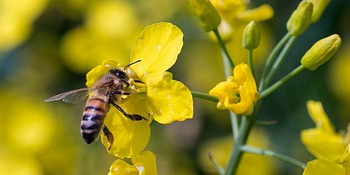
A bee pollinates a flower on a rapeseed field.
Photo: “Sweet Nectar” by Matthias Buehler, CC BY-NC 2.0
One of the objectives of the Intergovernmental Platform on Biodiversity and Ecosystem Services (IPBES) is to “strengthen the science-policy interface on biodiversity and ecosystem services with regard to thematic and methodological issues”. To achieve this, it enlisted experts from around the world to prepare several thematic assessments, including one on pollination.
The team is charged with examining the role of different types of pollinators, their status and trends, drivers of change, impacts on human well-being, and the effectiveness of responses to pollination declines and deficits. Kaja Peterson, a senior expert and programme director in SEI’s Tallinn Centre, is areview editor for the project, and participated in an expert meeting in July.
Q: How did you get involved in this?
KP: The story goes back to 2009, when I and my colleagues Piret Kuldna, Helen Poltimäe and Meelis Uustal at SEI Tallinn formed a team of experts on socio-economic issues related to pollinator loss in the European Commission EC FP7 project ALARM. We were the first to systematically review the drivers of pollinator loss based on published evidence but also on expert evaluation. We also published a paper that has been extensively cited since then, and we continue to work on policies that affect pollinators and other ecosystem services.
It was a big honour for me to be invited to serve as a review editor. This was my first experience with IPBES and the very distinguished experts across the world it brings together. Estonia is not a member yet, though the government is considering joining the platform.
I have also a personal link with the pollinators – the honeybees. My husband is a hobby beekeeper, and thus I could be called as an assistant beekeeper…
Q: What is the role of the review editors?
KP: There are six content chapters to the report, plus the Summary for Policy Makers (SPM). Each of the chapters has several authors and thematic lead authors, but also two coordinating lead authors and two review editors. I was appointed as one of the two Review Editors of chapter 6, which is about the policy responses to risks and opportunities associated with pollinators and pollination services.
My fellow Review Editor was Professor Kamaljit Bawa from the University of Massachusetts. Our task was to ensure that the authors have taken into account the comments from external reviewers, both other experts and government officials. Most of our work during the week contributed to the refinement of the key findings of the chapter to be further included in the SPM.
Q: How important is pollination in the general food cycle?
KP: It is absolutely vital, since more than one third of our daily food is co-produced by pollinators. The UN Food and Agriculture Organization hosted our the IPBES meeting, and it has also taken an active role in promoting pollinator-friendly practices, since FAO facilitates the International Pollinators Initiative established under the Convention on Biological Diversity of 2000.
Q: Not so long ago there were photos in the media of French bees producing blue and green honey. What does the research show on pesticides and their effect on pollination and the food cycle?
KP: There is an established understanding that chemicals such as neonicotinoids and other insecticides a have lethal effect on pollinators. However, the dose of the chemicals that can cause the death of pollinators is still debated. It has also been established that exposure to pesticides is one of many effects that cause pollinator decline and pollination deficit. But other aspects also play a role, such as landscape diversity, field size and agro-technical management.
Q: Organic agriculture is gaining ground in many countries. What are the views on conventional vs. organic farming in the chapter you were involved in?
KP: One of the insights that I got was that there are more than just conventional and organic farming practices. There is ecological farming, agro-ecological farming, ecologically intensified farming and much more. Since the key message of enhancing pollinator diversity and food production is to diversify landscapes and farming practices, it is not just organic farming that delivers it. Some of those other approaches can also deliver both pollinator diversity and good food. It is crucial to maintain the diversity of both wild and managed pollinators for the purposes of genetic diversity. That, in turn, ensures better resistance of pollinators to pathogens, diseases and climatic changes.
Q: What happens now with the research and the work you carried out?
A: The report is in the final phase now. It shall be presented to the national governments in February 2016 in Kuala Lumpur. It will be a powerful report in many respects, since it comprehensively assembles current knowledge on pollinators and pollination from around the world. Once published, it will be the most authoritative source of information to guide action for the conservation of pollinator diversity to ensure our food supply without harming the planet or human well-being.
To learn more about the IPBES pollination assessment, visit the IPBES website.
Perspective / The heatwave that coincided with London Climate Action Week underscores the UK's urgent need to adapt to limit the threats to schools, the economy and society.
Other publication / This protocol provides a means of reviewing 10 years of CGIAR climate adaptation policy research to assess what actions most effectively achieve which goal.
Journal article / This Nature Climate Change column illustrates how climate resilient development (CRD) can support urgently needed climate and adaptation policies.