SEI is leading a program aimed at training members of the Wayuu Indigenous people to represent their interests during the development of wind energy projects and their related infrastructure.
In 2025, SEI researchers, in collaboration with the University of La Guajira, launched the first edition of the training program, “Intercultural Dialogue, Wind Energy and Community Participation” in La Guajira, Colombia. The initiative seeks to strengthen the capacities of the Wayuu Indigenous people by providing theoretical, practical, and methodological tools that enable them to effectively represent their communities’ interests during the implementation processes of wind energy projects and their associated infrastructure such as transmission lines, measurement towers, substations and access roads.
The program was co-designed during 2023 and 2024 through workshops and dialogues with Wayuu leaders, authorities, and community members, as well as actors from the private and public sectors, academia, and community advisors. These discussions defined thematic priorities, key culturally appropriate methods, and modules tailored to the territory’s needs and expectations.
Forum “The role of advisors in wind energy prior consultations: experiences and challenges” in Uribia, La Guajira
Eduar Monsalve/SEI
Working groups during workshop in Cabo de la Vela, La Guajira
Eduar Monsalve/SEI
With 150 hours of training distributed across 10 thematic modules, the program combines theory and practice through lectures, workshops, case studies, and field visits, with in-person classes held at the University of La Guajira and in local communities. The course covers content in technical, legal, cultural, financial, and project development areas, as well as community governance. It also includes several field visits so that participants can learn about the projects firsthand and exchange knowledge and experiences with local communities.
The program also integrates a gender perspective into its content and activities, uncovering gender inequalities in participation, access to opportunities, and managing impacts associated with wind energy projects.
This program provides participants with key general knowledge, including direct and experiential interaction with wind energy and its positive and negative aspects, taking into account the needs of the territory.
Luz Edith Córdoba, Director of the Bachelor’s Program in Ethnoeducation and Interculturality at the University of La Guajira
The first cohort is made up of 20 students (10 women and 10 men) from different Wayuu clans (e’irükuus) and municipalities – Uribia, Maicao, Riohacha and Albania – each of whom represents a community located in areas of wind energy influence. This diversity enriches collective learning, as shared experiences provide lessons that can be applied in multiple local contexts.
Communities benefit from having information and building skills so that when it comes time to make decisions, we have the best knowledge to ensure collective well-being.
Victor Pushaina, Program participant
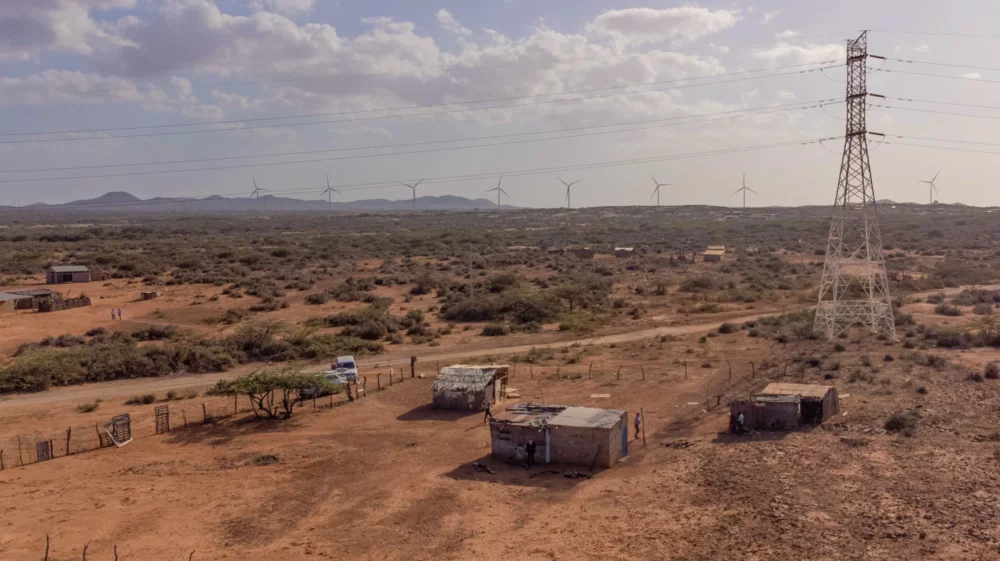
La Guajira. Key elements: infrastructure that affects the surroundings of the participants, characterized by wind turbines, access roads, transmission lines, electrical substations, and measurement towers.
Photo: Eduar Monsalve / SEI
The program began on April 25 and will run until September 2025, with sessions scheduled every two weeks on Fridays and Saturdays. The start of the program revealed strong interest from both the student group and the teaching team, who showed enthusiasm and commitment to the training process. This motivation reflects, on one hand, that the participants view the program as a valuable opportunity to acquire practical knowledges. On the other hand, the instructors see it as a learning space that brings value both to their professional practice and to the development of the student group and their communities.
The course allows us to strengthen our knowledge, to be active participants in our communities’ prior consultation processes, and to foster effective sociocultural relations among the various actors in the territory.
Yolimar Ipuana, Program participant
Field visit of the program participants to a demonstration wind turbine.
Eduar Monsalve/SEI
Germán Saénz, SEI researcher, facilitating the session on electric transmission.
Eduar Monsalve/SEI
Video: Eduar Monsalve and Camilo Martelo / SEI
Program / This programme aims to build a collaborative platform to accelerate renewable energy deployment in La Guajira.
Project / This project aims to steer renewable energy development in La Guajira towards more equitable and socially beneficial paths.
Project / A new alliance championing socially responsible renewable energy implementation with meaningful participation and benefits for communities across the globe.
SEI report / The authors identify enabling factors of social acceptance for wind energy projects and, more broadly, of a just energy transition in La Guajira.
Other publication / This book explores the complexities of making renewable energy transitions just and draws on real-world experiences from regions engaged in these efforts.
SEI working paper / Colombia’s renewable energy auctions can foster a just and inclusive energy transition by integrating socio‑economic and community interactions.