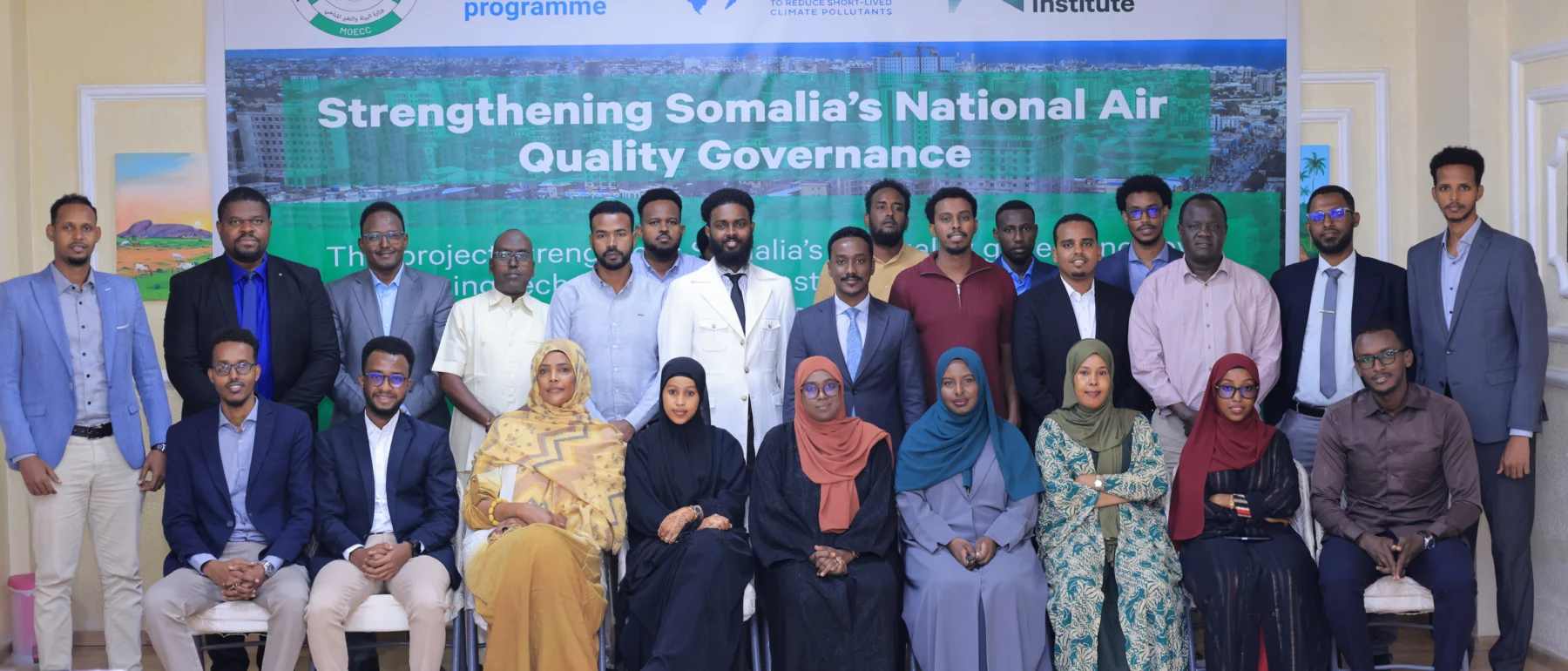
Technical experts from across the Somali government met in Mogadishu in August for SEI-led training to strengthen the foundations of a national air quality framework.
From 3 to 5 August 2026, technical experts from across the Somali government gathered in Mogadishu for a national training workshop on air quality monitoring and management. By the end of the three days, participants had established a multisectoral working group to take forward the framework.
As Somalia advances its climate and environmental agenda, strengthening air quality management has emerged as a growing priority. While the country has made progress through the establishment of the Pollution Monitoring Unit (PMU) within the Ministry of Environment and Climate Change, the creation of the Somali National Meteorological Agency (SNMA) and the installation of its first air quality monitoring station, at Aden Adde International Airport in Mogadishu. Significant gaps remain, however: there is no routine ambient air quality monitoring, analytical capacity is limited, environmental information systems are fragmented and coordination is insufficient across the sectors responsible for environment, health, transport, energy and meteorology.
The workshop brought together representatives from a wide range of government institutions and academic partners, spanning environment, health, transport and civil aviation, energy, disaster management, statistics, planning and urban development. Their participation reflected on the reality that air pollution is not solely an environmental issue: its sources and impacts cut across sectors.
Throughout the three-day training, participants explored the foundations of air quality management, from monitoring technologies and data quality assurance to satellite observations, emissions inventories and environmental data analysis. Using the monitoring station at Aden Adde as a practical example, participants examined how air quality data is collected, managed, interpreted and ultimately translated into policy and planning.
A key focus of the workshop was helping participants understand how scientific evidence can be used in decision-making. Discussions explored how air quality information can contribute to public health protection, climate action, environmental management, and the development of future monitoring and early warning systems. Through practical exercises and group discussions, participants also identified institutional priorities and opportunities for strengthening coordination among agencies responsible for air quality management.
The training forms part of the CCAC-supported Targeted Expert Assistance (TEA) implemented by SEI Africa to strengthen Somalia’s institutional capacity for evidence-based air quality governance. The initiative supports the development of the country’s future Air Quality Management Framework by enhancing technical expertise, improving environmental data systems, and fostering collaboration among key institutions.
By the end of the workshop, participants had developed recommendations to inform Somalia’s future air quality planning and policy development. The training also helped build a shared understanding of the roles different institutions play in addressing air pollution and protecting public health.
The training forms part of the CCAC-supported Targeted Expert Assistance (TEA), implemented by SEI Africa in partnership with the Climate and Clean Air Coalition (CCAC) and Somalia’s Ministry of Environment and Climate Change (MoECC), to strengthen Somalia’s institutional capacity for evidence-based air quality governance. The initiative supports the development of the country’s future Air Quality Management Framework by enhancing technical expertise, improving environmental data systems, and fostering collaboration among key institutions.
Project / This project strengthens Somalia’s national air quality governance through policy development and targeted capacity building
Feature / A new initiative aims to build Somalia's first national air quality governance system, laying foundations for monitoring, data and policy.
Project / This project strengthens Somalia’s national air quality governance through policy development and targeted capacity building
Perspective / Conservationist policies could be more effective if they respected the spiritual beliefs that already guide forest use, preserve biodiversity and livelihoods.