part of Same same but different: mobility and spatial justice in Tallinn and Bangkok
Start readingTransport infrastructures silently encodes values. Spatial (in)justice is not accidental – it is designed into the environment.
The Same same but different series explores mobility and spatial justice in Tallinn and Bangkok and is part of SEI’s research program on sustainable transport. This chapter captures both equitable and inequitable examples of how mobility space is planned, regulated and experienced in both cities.
Sidewalk widths, crossings, curb heights and path connectivity signal who is expected to move comfortably – and who must endure detours, risk and inconvenience. Spatial justice is not abstract. It becomes visible in who occupies the centre of movement and who is pushed to the edge.
We asked:
Too much is allocated to vehicles, leaving limited room for pedestrians. People spill over safety islands, cross from blind spots and sometimes wait between traffic lanes or descend into dark underpasses.
In an urban space designed for cars, motor vehicles move smoothly, while people are often squeezed onto narrow refugee islands.
Photo: Anette Parksepp / SEI
Pedestrians have to pass dark underground tunnels.
Photo: Anette Parksepp / SEI
Cyclists face similar risks. Bike paths may disappear, merge into traffic or become obstructed. Riders are pushed onto sidewalks, passing uncomfortably close to pedestrians and bus queues.
Insufficient infrastructure for different types of mobility can create conflicts in the urban space.
Photo: Anette Parksepp / SEI
Informal “elephant paths” across grass reveal where official routes fail. When accessibility is missing, people improvise – squeezing through sharp fences or navigating muddy detours around construction.
A way from a local store to residential buildings has been cut off by a fence, so local residents walk through the hole in the fence every day.
Photo: Anette Parksepp / SEI
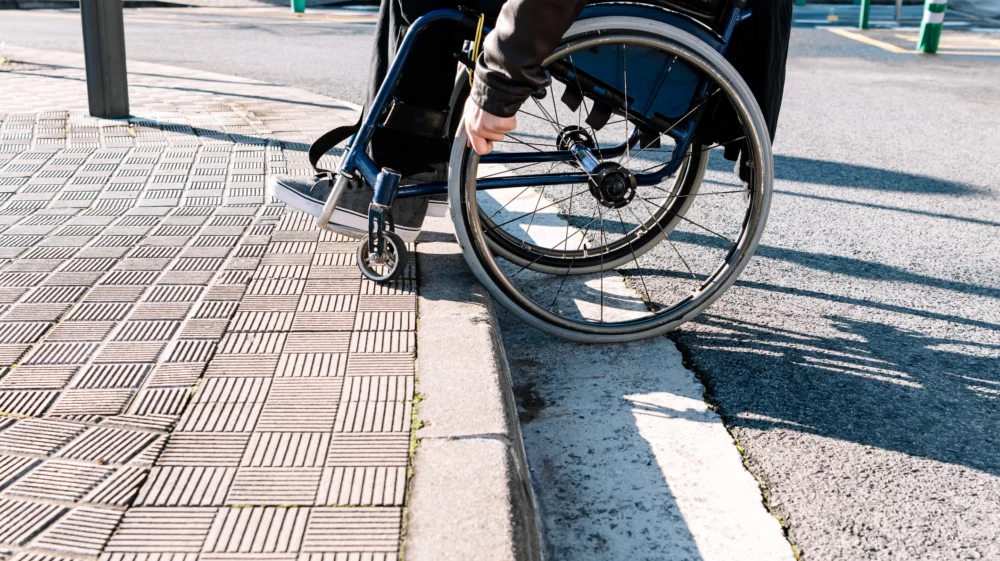
Sidewalks often sit directly beside fast traffic and are overloaded with infrastructure. Many flood in heavy rain or remain uncleared in winter, turning every step into risk assessment. Tactile paving for visually impaired people is discontinuous, and high curbs create barriers for wheelchair users and strollers.


More equitable design is emerging. A European Green Capital intervention project transformed the Old Town square from a transit space into a public living room. The Pollinator Highway stitched fragmented green patches into a linear recreational park with separated pedestrian and cycling paths.
A temporary park turned Tallinn Old Town from transit space to public living room.
Photo: Shimin Huang / SEI
Pollinator Highway integrates sustainable movement, recreation and biodiversity into one public space.
Photo: Shimin Huang / SEI
Elevated crosswalks now double as speed bumps for cars, physically prioritizing pedestrians. Well-lit underpasses improve safety. Designated e-scooter parking zones near bus stops support multimodal travel. Street seating is increasing, and pets are allowed on public transport.


Spatial injustice persists, but a shift towards more human-centred design is visible.
In Bangkok, low-income residents, informal workers and migrant communities face the greatest mobility barriers. Many suburban residents depend on motorbikes, facing high commuting costs and safety risks, or endure long public transport journeys
Many depend on motorbikes and long public transport journeys.
Photo: Johanna Lehtmets / SEI
Cars signal wealth and comfort, shielding occupants from heat and rain. Streets have been widened to accommodate growing motorized traffic while sidewalks shrink or disappear, forcing pedestrians to walk shoulder-to-shoulder with fast-moving traffic.
In an urban space designed for cars, pedestrians and cyclists sometimes have to fit together onto a lane that is narrower than the space allocated for a single car.
Photo: Johanna Lehtmets/ SEI
Meanwhile, elevated skywalks connect luxury malls above the noise and pollution. The city’s flagship skytrain integrates seamlessly with these walkways – yet fares remain out of reach for many.
Paths above the noise and pollution are reserved for the well-off.
Photo: Johanna Lehtmets / SEI
In Bangkok, affluence is closely tied to ease and comfort of travel.
Despite these challenges, Bangkok also offers examples of more inclusive and multifunctional mobility spaces. Elevated walkways, green corridors and shared public areas can provide safer, more accessible routes for pedestrians, while also creating spaces for rest, interaction and everyday life.
Accessible viewing platform in Bangkok.
Photo: Johanna Lehtmets / SEI
In some areas, mobility infrastructure is integrated with greenery and public space, softening the experience of movement and offering alternatives to street-level congestion. These environments show how mobility spaces can support not only movement, but also accessibility, comfort and social connection.
Clearly separated paths for different speeds of movement.
Photo: Johanna Lehtmets / SEI
Greenery can make everyday commutes more relaxing, but elevated paths away from noise and pollution are often a privilege and out of reach for many.
Photo: Johanna Lehtmets / SEI
Feature / Mobility spaces are not just routes but places where social life unfolds and a sense of belonging is shaped.
One-SEI program / SEI advances fair, inclusive, and low-emission transport solutions worldwide, bridging global insights with local action for a just mobility transition.
Project / Using a visual storytelling approach, this project documents everyday mobility practices and infrastructure use, revealing local issues.
Feature / What can a study on household waste in Bosnia and Herzegovina (BiH) teach us about driving change across the wider Western Balkans?
Feature / At the Bangkok Climate Action Week 2026, SEI Asia will showcase research and build pathways for climate action through science, dialogue, and engagement.
Journal article / A 40-year village study in Thailand shows how migration, return and circulation shape the country’s ongoing agrarian transition.