Representatives from SEI, SAILD and Chalmers University of Technology signed a collaboration agreement for sustainable development in Cameroon. The aim of this new collaboration is to advance sustainability concerns for deforestation-free landscapes and to ensure fairness and transparency in the countries supply chains.
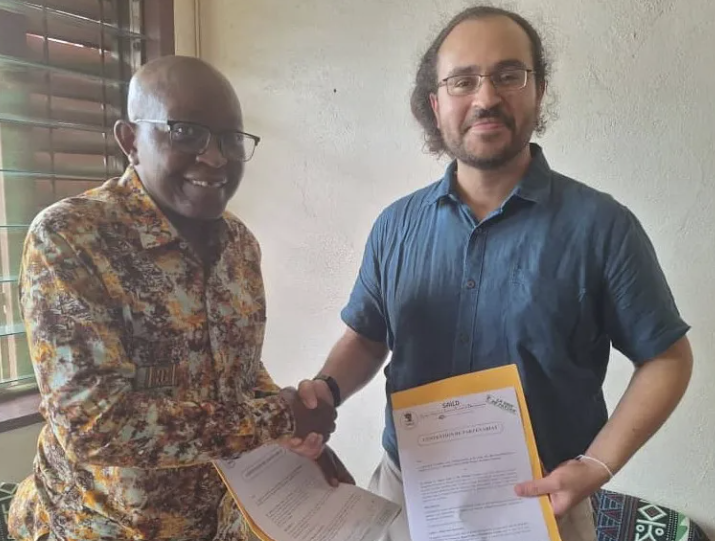
Representatives from SAILD, SEI and Chalmers after the signing ceremony that took place in the Elig-Essono district of Yaoundé, Cameroon.
Photo: SAILD.
Cameroon is a significant producer and exporter of agricultural products such as palm oil, cocoa, coffee, rubber, and soy. As a result, the country is directly impacted by the EU’s Regulation on Deforestation-Free Products, adopted in June 2023. The regulation aims to minimize the risk of products linked to deforestation and natural resource loss entering the European market, while promoting demand for products that are sustainably sourced.
The agreement, signed by researchers and representatives from SEI, SAILD, and Chalmers University, is part of the new project titled “Building an Evidence Base for Deforestation-Free Landscapes.” The project’s goal is to develop robust evidence to support deforestation-free landscapes in Cameroon.
To achieve this, the partners will jointly conduct a series of research studies involving key stakeholders.
We want to move science forward in an inclusive way, bringing the concerns that organizations like SAILD have that are based on practices and realities on the ground, into scientific discussions.
Yanou Malaïka, Chalmers University
“The idea is to do direct engagement work, including visits to the forests. We’re going to talk a lot with local populations to find out about their difficulties and needs, and their views on deforestation in the context in which they live,” explained Dr Yanou Malaïka from Chalmers University.
The insights gathered during these field surveys will contribute to a database that can inform environmental policymaking.
Representatives from SAILD (left) and Mairon Bastos Lima from SEI (right) signs the collaboration agreement.
Photo: SAILD.
This research will enable us to draw up an action plan, and to modify policies in a way that helps to reduce deforestation and promote sustainable development in line with the wishes and needs of populations and agriculture.
Mairon G. Bastos Lima, SEI
“We want to promote effective change with our scientific research. We want to get major decision-makers like the EU to consider the situation of the players who are most affected on the ground, and take this into account in their policies,” concluded Mairon G. Bastos Lima from SEI.
SAILD, SEI and Chalmers University of Technology researchers have already begun project implementation activities. The team includes Mairon G. Bastos Lima from SEI, Franck Ndjodo and Aristide Tchounkeu from SAILD in Cameroon and Yanou Malaïka from Chalmers.
They participated in the international symposium held in Yaoundé from March 5 to 6, 2025, under the theme “What environmental diplomacy mean for the Congo Basin.” The event also provided an opportunity to discuss the BEDROCK project with international experts on environmental issues.
SAILD (Support Service for Local Development Initiatives) is a not-for-profit NGO founded in 1988 with its general secretariat based in Yaoundé, Cameroon. SAILD runs three programmes: communication, food security and nutrition, and natural resource management.
Program / Understanding and improving the performance of supply-chain policies aimed at halting tropical deforestation.
Tool / Trase enables governments, companies and others to address the environmental impacts of supply chains.
Journal article / The study explores how Swedish agroecological farmers adopt and perceive digital technologies and what shapes their use.
Press release / New data from Trase reveals that the majority of the coffee imported globally comes from companies that supply the European market.
Feature / Municipalities and cities from Bosnia and Herzegovina visited Sweden for a study tour on sustainable agriculture run by BiH SuTra project.