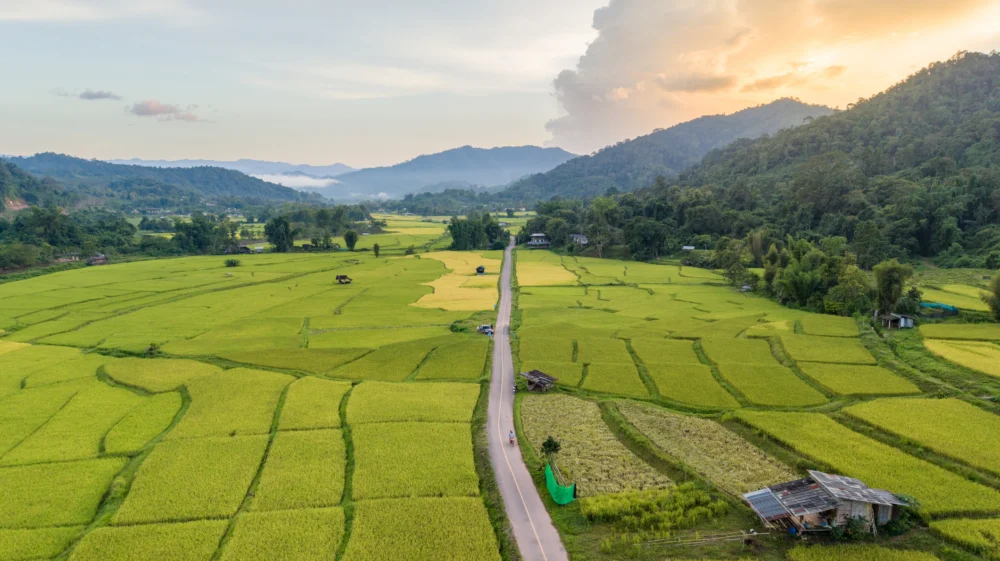
part of Same same but different: mobility and spatial justice in Tallinn and Bangkok
Start readingThe experiences captured in Tallinn and Bangkok are two threads in a much larger global tapestry of movement. Every city – whether compact or sprawling, coastal or inland, hot or cold – carries its rhythms, struggles and local solutions.
As part of SEI’s research program on sustainable transport and the Visual storytelling to rethink spatial justice through equity on the move project, we invited colleagues all over SEI to send in their captures of everyday mobility. This gave us an opportunity to compare conditions between different continents and build a photo bank for the future. From the collected photos mobility emerges as more than reaching a destination. It is about access, safety, dignity, identity and belonging, and about how people navigate systems that empower some and constrain others.
Mobility equity requires more than adding transport modes. It demands rebalancing space, the most finite urban resource, toward those whose lives depend on streets, sidewalks, buses and informal connectors.
These stories matter. And they are everywhere.
Cities can prioritize people over vehicles, reclaiming space and improving safety.
Berlin Fahrradstrasse.
Photo: Selma Guyon / SEI.
As a cyclist, enjoying the privilege of being the main user of a road without fearing for cars speeding up behind me or coming on the other side is quite amazing. Crossing Berlin on these roads is so fast. You feel safe and you don’t bother pedestrians. It’s much better than a cycling path that is often not well protected from the roads or used for parking by cars or as a sidewalk by pedestrians. Every city should have more of them. These roads are also very calm, contrasting with the main avenues with multiple lines of cars. It’s an example of spatial justice. – Selma Guyon
Bicycle parking rack in Helsinki, Finland.
Photo: Selma Guyon / SEI
This was probably created to raise awareness on the space that car parking takes in the street compared to bike parking. The structure can support ten bikes parked, while only one car can park on this space. Bike parking actually takes ten times less space than car parking. It matters that people see how streets could look so different if cycling was the norm, we would not have lines and lines of cars parked on both sides of the street (which aesthetic can be questioned) but one dense bike parking rack every 100 meters, which could leave space for more cycling paths, terrasses, gardens, vegetations, pedestrian paths and more. – Selma Guyon
Skuru Bridge reconstruction in Stockholm, Sweden, prioritises cars who have more room for movement than pedestrians and cyclists.
Photo: Tomas Thernström / SEI
The picture shows the old Skuru Bridge, which is currently being rebuilt. The cars have one lane in each direction, even though there is a new bridge next to it with two lanes in each direction. Cyclists and pedestrians have to share a roadway that is typically a maximum of two meters wide. This creates a dangerous traffic environment for cyclists and pedestrians. The picture shows in a good way how different traffic types are prioritized in traffic today. If Trafikverket had given cyclists and pedestrians the same value as cars, they might have chosen to close one direction for cars, as they can still travel on the new bridge. – Tomas Thernström
When design falls short, movement becomes unsafe, fragmented and unfair.
Broken and non-existent footpath in India.
Photo: Ananya Choudhury / SEI
A car parked in Old Town Tallinn, Estonia, covered with parking tickets.
Photo: Christian Korka
In Tallinn Old Town there is a car that constantly parks illegally. Clearly, the parking tickets do not bother them (they still park there to this day and with new parking fines). – Lilian Yallop.
A pedestrian crossing interesects the bike path in a kind of blind spot in Bergshamra, Solna, Sweden.
Photo: Maria Xylia / SEI
I feel this spot is quite dangerous when getting my kid to daycare. If a biker is not careful or turns too fast, they can hit us as we try to cross to the bridge. – Maria Xylia.
Mobility systems reflect culture, environment and local adaptation.
Shepherd on horseback at Arabel Plateau, Kyrgyzstan.
Photo: Miquel Muñoz Cabré / SEI
Animal transportation remains an important means of transportation in many parts of the world. Horses, donkeys, camels and other animals play important roles for transport of people and cargo in many areas, particularly those with inequitable access to roads and other transport infrastructure. Transport animals also play significant roles in their local ecosystems. – Miquel Muñoz Cabré.
A bridge called Festina Lente that passes over the Miljacka River and through the Sarajevo city in Bosnia and Herzegovina, in front of the Academy of Fine Arts.
Photo: Anneli Sundin / SEI
Festina Lente is Latin and an oxymoron, meaning “more haste, less speed”, encouraging careful planning and thoughtful action rather than frantic effort. It has an unusual loop in the middle, which did encourage me to slow down and enjoy the view. – Anneli Sundin
Mobility justice is not a distant ideal – it is built step by step, street by street.
Collection / This visual series explores how everyday journeys reveal inequality, access and belonging in cities.
One-SEI program / SEI advances fair, inclusive, and low-emission transport solutions worldwide, bridging global insights with local action for a just mobility transition.
Project / Using a visual storytelling approach, this project documents everyday mobility practices and infrastructure use, revealing local issues.
Feature / What can a study on household waste in Bosnia and Herzegovina (BiH) teach us about driving change across the wider Western Balkans?
Feature / At the Bangkok Climate Action Week 2026, SEI Asia will showcase research and build pathways for climate action through science, dialogue, and engagement.
Journal article / A 40-year village study in Thailand shows how migration, return and circulation shape the country’s ongoing agrarian transition.