Project / This project promotes an inclusive climate finance ecosystem for climate adaptation and mitigation in the Asia-Pacific region.
Project / CLIMATEFIT supports innovative financing mechanisms for climate change adaptation by providing key insights into financing sources and strategies.
Project / The project will identify capacity gaps related to creating an enabling environment for inclusive finance flows, with specific attention to adaptation finance.
The toolkit brings together reports, dashboards, interactive tools, brochures and a professional course that support national institutions, financial service providers and partners working on inclusive climate finance. The materials support diagnosis, capacity assessment, investor mapping, incentive selection, instrument design and skills development.
Resources ordered by the work sequence teams actually follow: diagnose barriers, assess capacity, map capital, choose incentives, design products, then train the people who will use them.
Products come from several projects. Follow the six steps in order:
Graphic: SEI Asia.
Establish why climate finance is not reaching priority sectors and groups. Use the country case studies first, then the interactive barrier dashboard to compare patterns across countries.
Documents capacity gaps, fragmented mandates, regulatory uncertainty and weak M&E systems that slow adaptation finance in four countries.
Annex to the policy barriers report. Filter barrier types and country patterns from the WP1 assessment.
After the policy picture is clear, identify who needs what skills. The regional dashboard summarises needs-assessment findings for environment agencies, finance ministries, CSOs and research partners.
Common gaps include international climate finance mechanisms, monitoring and evaluation, and operationalising gender equality and social inclusion.
Priority audiences in the assessment were environment and climate agency staff, finance and economic ministry staff, civil society, and academic partners. Move to Step 6 once target groups and skill gaps are agreed.
Identify which public, private and impact actors can finance inclusive adaptation, and where financial service providers sit in that landscape. The chart below shows how recorded climate finance currently moves through ICCAP countries — from sources and channels to modalities, measures and recipients.
ICCAP countries — climate finance flows. Total recorded flow $269.8 million (current USD). Top 10 donors shown individually; 116 grouped as Other Donors. Use this snapshot with the investor landscape tool to see both current flows and the wider actor map.
Explore investors and financing actors relevant to inclusive climate adaptation in the ICCAP geography.
Once you know who provides capital and how it currently flows, use Step 4 for public incentives and Step 5 to choose climate-finance instruments and facility designs such as RAIF.
Public authorities can improve project bankability with grants, guarantees, concessional loans, risk-sharing and softer policy tools. Start with the guidance, then filter the live database.
CLIMATEFIT D3.2. Taxonomy of 200+ examples across seven policy categories and 30 mechanism types, plus a selection process and bankability checklist.
Search and filter the CLIMATEFIT incentive database to match instruments to the constraints identified in Steps 1–3.
Translate diagnosis and investor mapping into instruments and vehicles that can move capital to financial service providers and, through them, to climate-vulnerable clients.
The CFI Taxonomy helps teams select climate-finance instruments that match the source, channel, modality and measure of the finance they need to mobilise.
Sixteen-module curriculum developed with Chulalongkorn University’s Centre for Ecological Economics. The course is available in English and Thai and the subtitles are available in English, Bahasa, Nepali, and Bangla.
Project / This project promotes an inclusive climate finance ecosystem for climate adaptation and mitigation in the Asia-Pacific region.
Project / The project will identify capacity gaps related to creating an enabling environment for inclusive finance flows, with specific attention to adaptation finance.
Project / CLIMATEFIT supports innovative financing mechanisms for climate change adaptation by providing key insights into financing sources and strategies.
For more information on the Centre for Finance for Sustainability, send your inquiries to [email protected].
Past event / This webinar featuring SEI Asia Affiliated Researcher and CFSB's Corrado Topi will shed light on initiatives and regulations on sustainable finance.
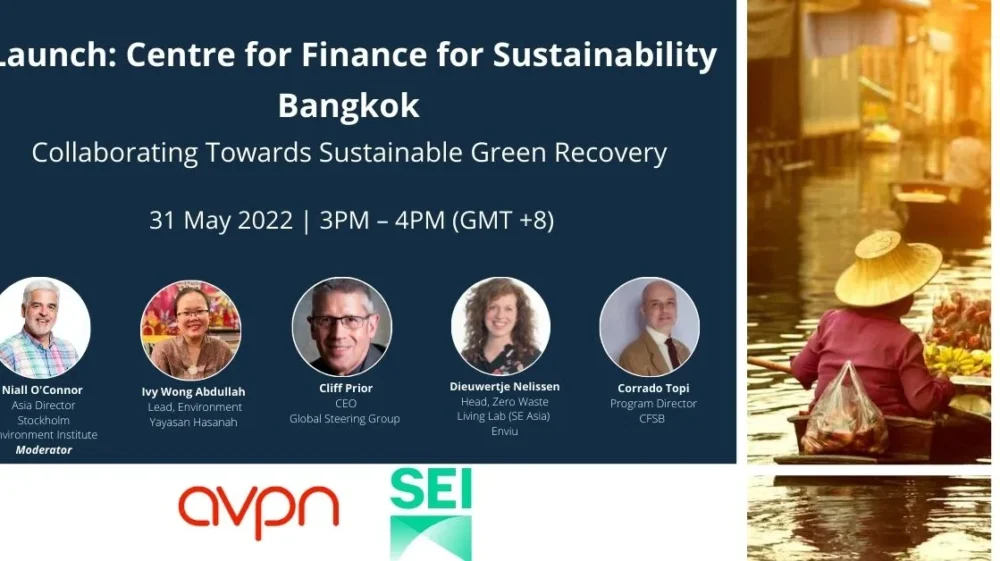
Past event / This session will officially launch the CFSB and further discuss the avenues in which collaboration can be sought toward sustainable green recovery.
Project / This project promotes an inclusive climate finance ecosystem for climate adaptation and mitigation in the Asia-Pacific region.