Editor’s choice
SEI is working with a consortium of universities and research institutes to evaluate the impacts of non-CO₂ climate pollutants on climate, weather, air quality and human health. Specifically, the project assesses the role and impacts of pollutants, besides CO₂, that drive or ‘force’ climate change. The project will also develop climate change mitigation options for policymaking in Europe, Latin America and Africa.
2022–2026
The FOCI project aims to provide policy recommendations by bridging knowledge gaps on the impact of non-CO₂ climate forcing pollutants (also known as short-lived climate pollutants) such as black carbon (soot), methane, tropospheric ozone, and hydrofluorocarbons. While the causes and processes connected to greenhouse gases such as carbon dioxide (CO₂) are well known, including its ability to trap and heat the earth’s atmosphere, and its environmental and health impacts, there is less information on the effects of many of these non-CO₂ forcers. FOCI will assess the environmental and health impacts of these non-CO₂ forcers, including how and where they arise.
To do this, researchers will use complex computer models to simulate interactions between various components of the earth’s systems. Such components, which includes the earth’s atmosphere, will be studied to understand and predict the impact of non-CO₂ forces on the earth’s climate system using the global Earth System Models (ESMs) and Regional Climate Models (RCMs). Findings from the research will inform the development and adaptation of climate-related policies.
The FOCI project has eight work packages. SEI will focus on work package five and seven.
SEI leads on:
Researchers at SEI are developing historical emission estimations and future projections in specific regions (Latin America and Africa) and sectors (agriculture, waste) to understand the influence of current climate change mitigation measures over the medium and long-term on all emitted non-CO₂ forcers.
Using SEI’s Low Emissions Analysis Platform (LEAP) tool, the project will develop new nationally appropriate emissions scenarios and mitigation assessments. The tool is also used to identify the economic costs of implementing non-CO₂ mitigation measures.
The study will provide an assessment framework with recommendations by which policymakers, planners and diverse stakeholders can develop integrated strategies for improved air quality and climate benefits. The methodologies, input data, and results used in developing the assessment will be made available to an existing community of 40,000 low-emission development practitioners. The assessment will be translated into suggested policy measures ensuring climate resilience is a central component of air quality and climate change planning processes.
For more information on the work packages visit the FOCI project website.
Press release / A new study reveals that 52% of the global drop in air pollution deaths (1990–2019) stems from improved healthcare and lower vulnerability.
7 April 2026 / About Pollution
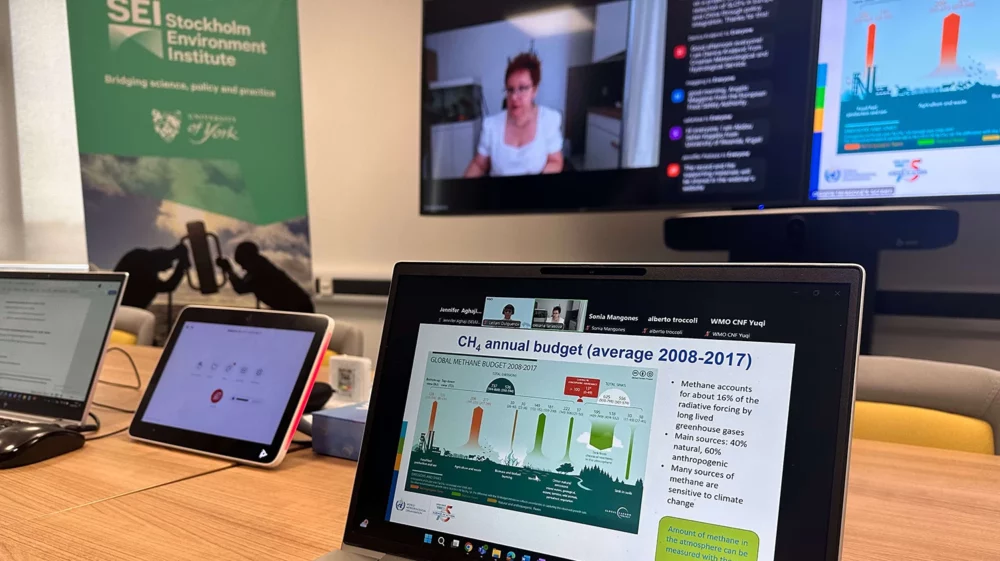
Feature / A FOCI webinar showcased how tackling SLCPs like methane and black carbon can rapidly improve air quality and curb global warming.
9 September 2025 / About Cities, Climate policy, Pollution, Short lived climate pollutants and Transport
Past event / The FOCI webinar offers an overview of SLCFs, their sources, trends, mitigation, and benefits for climate and air quality.
04 September 2025 / About Cities and Short lived climate pollutants
Perspective / Jenniffer Pedraza explores how clean air pledges must be backed by action, collaboration and investment to deliver real health and equity gains.
7 April 2025 / About Pollution, Short lived climate pollutants and Transport
Past event / See our presentation at the Air Pollution Conference Brazil on how FOCI is assessing the influence of climate change mitigation measures on non-CO2 forcers.
06 June 2024 / About Climate policy, Food and agriculture, Mitigation, Pollution and Short lived climate pollutants
Perspective / Collective action is needed to improve air quality in Latin American and the Caribbean. This perspective highlights trends and priorities for the region.
6 September 2023 / About Cities, Mitigation, Pollution and Short lived climate pollutants
Past event / Jenniffer Pedraza is presenting her work developing emissions scenarios in Latin America and the Caribbean at this global atmospheric chemistry conference.
09 September 2024 / About Adaptation, Climate policy, Energy access, Food and agriculture, Mitigation, Pollution and Short lived climate pollutants
Initiative / This initiative enables integrated national planning for Nationally Determined Contributions and Sustainable Development Goals.
2020 - 2024 / About Planning and modelling, Pollution and Sustainable Development Goals
Project / The project will look at the impact of air pollution in the world of work, including worker productivity, and work quality and quantity.
2020 - 2022 / About Pollution
Project / On behalf of CCAC, UNEP is cooperating with SEI to support the Ministry of Environment and Forestry of Kenya under SNAP.

2021 / About Cities, Pollution and Short lived climate pollutants