Science, policy and collaboration converged for cleaner skies and a safer climate on Clean Air Day.
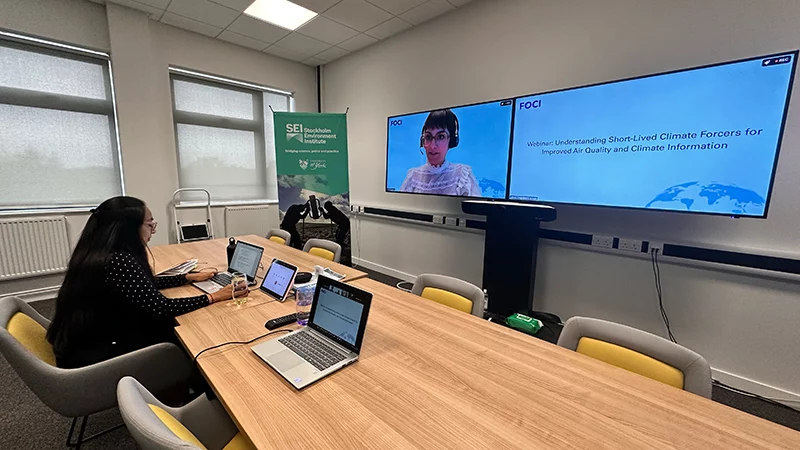
On 4 September 2025, the EU-HORIZON FOCI project hosted a webinar on one of the most pressing yet under-appreciated contributors to climate change and poor air quality: short-lived climate pollutants (SLCPs). These pollutants, including methane, black carbon and ground-level ozone, are powerful contributors to global warming and major threats to human health.
Organized by the World Meteorological Organisation, SEI and University of York, the event took place just days before International Day of Clean Air for Blue Skies. It underscored a critical point: cutting SLCPs is among the fastest and most effective ways to slow global warming while improving air quality. The FOCI project aims to deepen understanding of these pollutants, assess their impacts and develop strategies that protect both people and the planet.
While CO2 is the main driver of long-term climate change, SLCPs have an outsized short-term impact. They not only warm the atmosphere but also exacerbate air pollution, harming ecosystems and human health.
Sandro Finardi, a researcher on the FOCI project from ARIANET, said in his keynote presentation:“Air quality and climate change represent two sides of the same coin, addressing both issues together could lead to significant synergies and economic benefits while avoiding policy actions that mitigate one of the two issues but worsen the other”.
FOCI’s simulations show that while air pollution controls bring major benefits, they also create complex climate interactions that demand careful study. Still, the evidence is clear: cutting SLCPs delivers a rare “win-win”– reducing global warming in the near term while lowering the risks of respiratory illness, hospital admissions and premature deaths, particularly for communities most exposed to polluted air.
WMO experts present global methane trends and sources.
Photo: Jennifer Aghaji / SEI.
Unlike CO2, which can remain in the atmosphere for centuries, SLCPs have much shorter lifetimes, yet their impacts are substantial.
According to WMO expert Oksana Tarasova, trends in black carbon from 2000–2023 based on NASA’s MERRA-2 reanalysis reveal important regional patterns. In her presentation on the global trends and distribution of methane and black carbon, she noted: “Biomass burning, industrial emissions and transportation all show significant upward trends over the period.”
That is why regions from Africa to Latin America to Europe are stepping up efforts to regulate, monitor and eliminate SLCPs.
Evelyn Toure of Université Felix Houphouet-Boigny, a member of the African Clean Air Program, explained: “In Africa, the Integrated Assessment of Air Pollution and Climate Change highlights that ambitious SLCP actions could deliver extensive health benefits within just a decade.” The benefits span energy, waste, transport and other high-emitting sectors. For example, countries can significantly improve public health by 2030 by banning older vehicles and implementing advanced emission controls. Shifting to electric vehicles charged with renewable energy offers significant health and climate benefits by 2063, aligning with Agenda 2063’s focus on sustainable infrastructure.
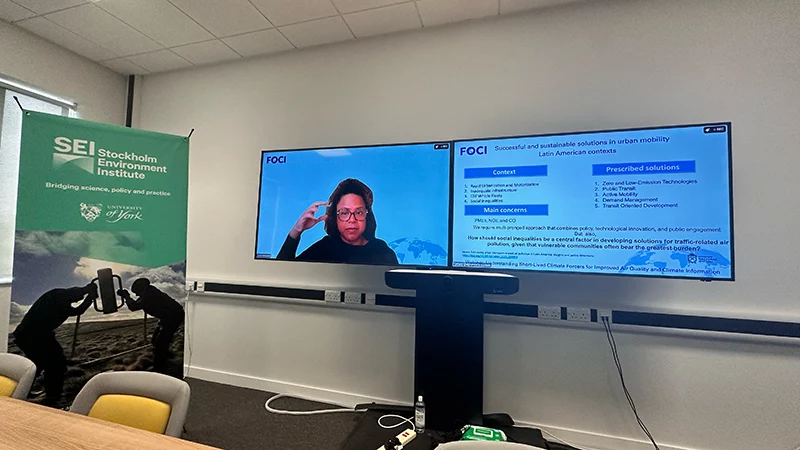
Discussion on sustainable urban mobility solutions in Latin America.
Photo: Jennifer Aghaji / SEI.
Latin America is also progressing. A multi-pronged approach that combines policy, technology and public engagement – while prioritizing vulnerable communities – can accelerate results. Bogotá, for example, has begun replacing diesel bus fleets with electric vehicles, reducing emissions and giving residents cleaner air to breathe. City leaders view this not only as climate action but also as a public health measure that reduces respiratory illnesses and eases pressure on healthcare systems.
In Africa and Latin America, governments are developing National SLCP Plans through the Climate and Clean Air Coalition’s Supporting National Action and Planning initiative, ensuring that transport, waste, agriculture and energy systems are addressed comprehensively. Europe, meanwhile, has adopted some of the world’s most ambitious legal frameworks.
These regional actions are supported by global frameworks, including the Climate and Clean Air Coalition, the Global Methane Pledge and the Kigali Amendment to the Montreal Protocol, as well as the 2024 UNEA-6 resolution. Together, these initiatives accelerate international cooperation, funding and technology sharing.
SEI’s Jenniffer Pedraza emphasized the importance of collaboration in her reflection: “This webinar has made it clear that solutions are available, but only through joint efforts can scientists, policymakers, and communities turn cutting-edge research into practical strategies that yield results.”
SEI’s Jenniffer Pedraza offers closing reflections.
Photo: Jennifer Aghaji / SEI.
FOCI is committed to driving this change by building networks that convert knowledge into policy action. The project’s overall results are expected to be completed in about one year.
Speakers at the event included experts from diverse fields and organizations, underscoring the need to improve understanding of the impacts of SLCPs on climate, air quality and health. Participants heard from Sonia Mangones of the Universidad Nacional de Colombia; Alberto Troccoli, representing the World Energy and Meteorological Council; and Leilani Dulguerov from WMO, all of whom shared insights from their respective domains.
Addressing SLCPs is among the quickest methods to slow warming. It is also a direct investment in public health and economic resilience. Climate change and air quality policies can maximize benefits and deliver a genuine “win-win” strategy. The way forward is clear: by reducing these pollutants, we can save lives today and build a safer climate for tomorrow.
You may access the webinar via the following link.
Project / SEI works with research institutes to assess the impact of pollutants, besides CO₂, that drive climate change, and to develop climate change mitigation options.
Project / This project aims to gather evidence and develop roadmaps to encourage investment in initiatives that lower black carbon emissions.
Press release / A new study reveals that 52% of the global drop in air pollution deaths (1990–2019) stems from improved healthcare and lower vulnerability.
Perspective / SEI experts detail how Latin American cooperation with the EU can boost its efforts to cut methane emissions, which cause powerful and rapid global heating.