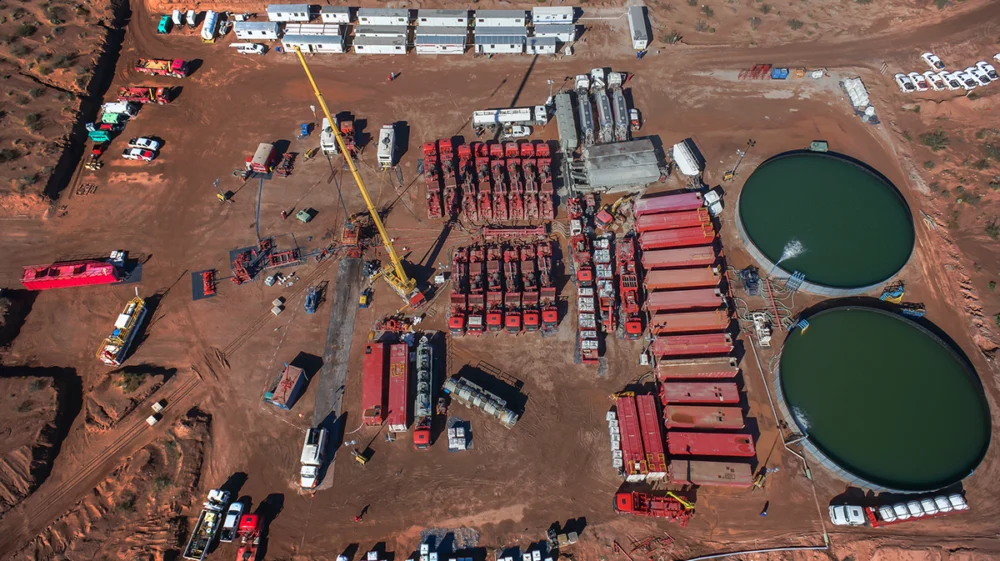
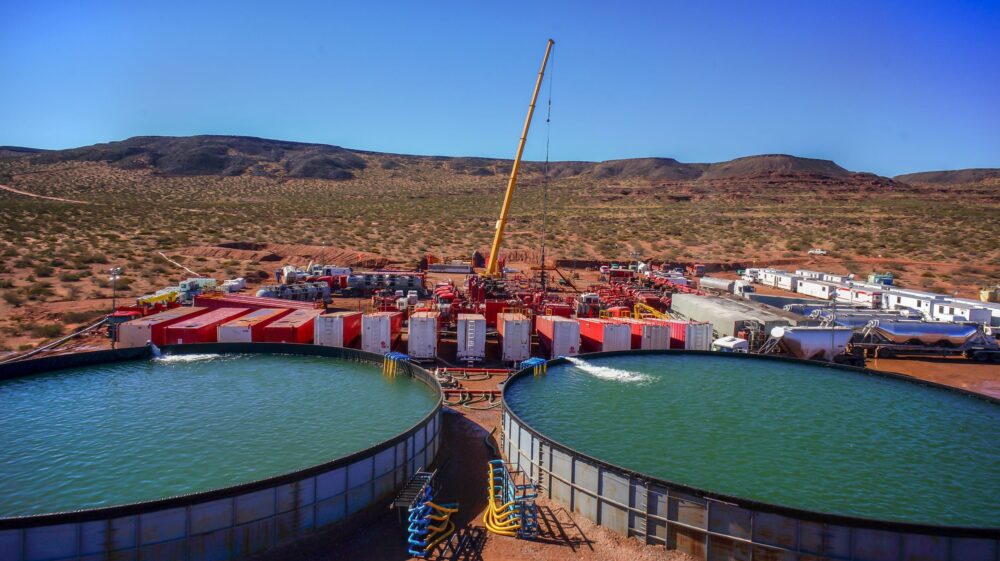
Non-conventional fossil fuel production, known as “fracking”, has expanded rapidly in Argentina since 2013, with plans to expand output to 1 million barrels daily by 2030 over the 2024 rate of 400 000 barrels per day.
While this production is intended to benefit Argentina’s national economy, it comes at a cost to environmental and community health locally.
Fracking expansion has come with piecemeal regulation at municipal and provincial levels, as well as a lack of data on how this fracking affects local communities and natural resources.
A view of the OBSERVAR platform, which identifies the locations of fracking and conventional oil wells in the Vaca Muerta region of Argentina.
SEI and the National University of Comahue sought to fill this data gap with OBSERV.EARTH, a publicly available Spanish-language platform developed with the help of remote sensing data. It identifies the locations of not only fracking wells, but also conventional oil wells, which can leak into soil and groundwater due to the seismic activity from fracking. This platform not only educates users, but provides a foundation to inform future regulation and encourages transparency from governments and fossil fuel companies.
As of 2024, researchers identified more than 3000 fracking wells that pose a high contamination risk to local water sources, farms and population centers, threatening public health and livelihoods. These wells are located within 1 km of rivers, communities, schools and agricultural irrigation canals.
Map of proximities of fracking wells to a) the Neuquén River in the Sauzal Bonito region (top), and b) to populations in the localities of Barrio Isla 10, Barrio Emergente, Barrio Costa Oeste and Barrio Calle Ciega No. 10 (bottom).
The research team also developed a virtual reality exhibit intended to educate the public about fracking’s impact on local populations and ecosystems
SEI brief / This policy brief introduces a fracking data platform, OBSERVAR, and calls for greater fracking regulation and transparency in Vaca Muerta, Argentina.
Media coverage / The Guardian details the negative consequences of fracking in the Vaca Muerta region of Argentina, where SEI scientists are studying the risks to locals.
Media coverage / SEI's partnership with a university in Argentina allows people to explore the intersections of fracking and local water supply with virtual reality.
SEI working paper / This paper draws from a literature review and spatial data to better understand the industry’s impact on the watershed and on long-term water security.
Perspective / As we decarbonize our energy system, we must also address the harmful public health and environmental impacts of oil and gas extraction.
Perspective / The vulnerability of fossil fuel-producing countries in Latin America has been exacerbated by Covid-19, but countries are only investing more in fossil fuels.
Feature / Learn more about SEI's efforts and research regarding the social acceptance of wind energy projects in La Guajira, Colombia.