Climate field schools based in ecosystem-based adaptation principles can help strengthen farmers’ livelihoods while enhancing climate resilience and sustainability.
In the 1980s, Indonesia pioneered the “farmer field schools” concept to build smallholders’ capacities. The schools focused first on integrated pest management and then more broadly on skills and knowledge to boost productivity and enhance livelihoods (Braun & Duveskog, 2008). The approach was so successful that it was replicated in countries worldwide (Phillips et al., 2014).
When the Asian Disaster Preparedness Center began searching for a tool in 2001 to introduce farmers to climate forecasting technology, connect it to their practices and learn about their perspectives, the pest management field schools stood out (ADPC, 2006). Several partners, including the Meteorology, Climatology, and Geophysical Agency of Indonesia (BMKG), teamed up to develop a new “climate field school” (CFS) curriculum aimed at helping farmers in Indramayu District, West Java, to manage flood and drought risks.
Like the original field schools, the program relied on agricultural extension officers trained to interpret and explain scientific climate information, identify locally appropriate adaptation strategies, and then train farmers and support them in adopting the new tools (ADPC, 2006). After the first pilot CFS was conducted in 2003, the model was gradually introduced to more communities in the district, and in Central Java in 2007.
In 2011, CFS was established as a formal BMKG program. By 2022, more than 18 600 participants had attended CFS sessions, which were held in 607 locations in 33 provinces across the country. A major assessment by the World Bank Group identified CFS as a key instrument for delivering support for climate-smart agriculture tailored to different farmers’ needs.
BMKG’s goal for CFS in the near term is to help farmers understand and use the climate information that the agency provides in partnership with agricultural extension officers. In the long term, the goal is to stimulate sustainable agro-businesses owned by farmer groups, with strategies and decision-making processes grounded in robust climate information.
This brief builds on insights from the project EbA-Enhanced Climate Field Schools for Climate Resilience (EECCLiRe) to make the case for expanding the scope of CFS to not only support farmers in using climate information, but also promote a broad range of strategies to enhance climate resilience and sustainability and strengthen livelihoods, all built on the principles of ecosystem-based adaptation. Such an approach would amplify the impact of CFS and advance key national objectives for both adaptation and mitigation.
Indonesia’s climate is naturally variable, and the original CFS were designed to help farmers cope with that variability, including extreme weather. In the last two decades, however, climate change has brought new levels of uncertainty, with more frequent and more severe extreme events, higher temperatures, worsening drought and fire risks, heavier rainfall, and growing flood and landslide risks.
Agriculture, fisheries and forestry contribute about one-eighth of Indonesia’s gross domestic product (GDP), and, in 2023, about 29% of workers were employed in agriculture. This means that effective climate action in this sector is crucial to the economy and the livelihoods of tens of millions of people.
Smallholders who grow cash crops without irrigation are at particularly high risk, as climate shocks can sharply reduce production, devastate their livelihoods, and trap them in chronic poverty. Smallholders in Indonesia produce many major crops, including valuable beverage crops such as coffee, tea and cocoa, with a combined export value of about USD 2.7 billion in 2022.
As an upper-middle-income country with stable institutions, relatively strong infrastructure and services, and very few people still living in extreme poverty, Indonesia is considered less vulnerable to climate change than poorer countries in the region. Still, the combination of vulnerabilities around agriculture and water, and limited readiness to adapt effectively, put Indonesia in the lower half of the Notre Dame Global Adaptation Initiative (ND-GAIN) Index for 2022, ranked 97th out of 188 countries.
The latest national data on poverty also show large disparities between urban and rural populations. An estimated 24.06 million Indonesians were below the national poverty line in September 2024, including 6.66% of urban and 11.34% of rural residents. In some provinces, the poverty rate is more than twice as high in rural areas as in urban areas. Climate change disproportionately impacts agriculture and affects rural households already living in or near poverty.
As noted in the introduction, farmer – and later, climate – field schools are well established in Indonesia as effective tools for providing climate information to farmers and training them to use it effectively in their planning and strategies. CFS have also been used to deliver market information, showcase new technologies and methods, and foster a collaborative and cooperative spirit among vulnerable and climate-sensitive groups and communities.
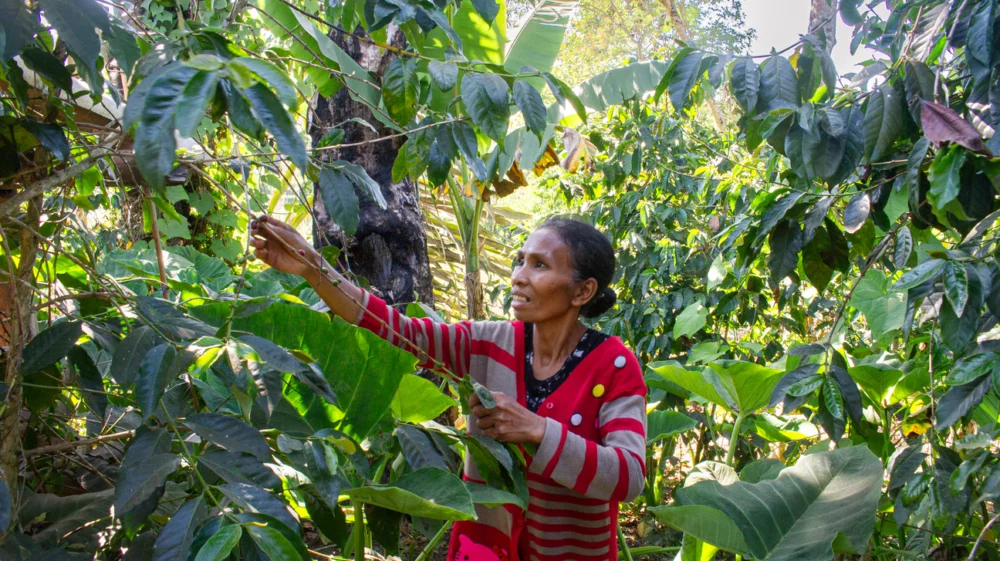
The EECCLiRe project, funded by the Global EbA Fund, built on this proven model, incorporating the principles of ecosystem-based adaptation (EbA) to deliver targeted support to Arabica coffee growers in Bali and Flores, East Nusa Tenggara, from 2023 to early 2025. The work involved BMKG, the sustainability think tank Sustainability and Resilience Ltd. (su-re.co), SEI Asia, local organizations and – as always – agricultural extension officers who were trained to teach the curriculum.
The project team has produced an in-depth report describing key activities and lessons learned and a brief summary of insights from an evaluation exercise. Here, we provide a quick overview of the two main components of the curriculum.
Agroforestry is the age-old practice of integrating trees and shrubs with crops and livestock, emulating natural ecosystems to make farms more productive and resilient. It is thus a key strategy for EbA, as it harnesses nature-based solutions and ecosystem services to reduce vulnerability to climate change. It is highly relevant to coffee producers, especially Arabica growers, as trees provide crucial shade to protect the crops.
Many Indonesian coffee farms already include shade trees, and agroforestry has long been promoted in the sector. However, planting trees also adds costs – for the trees, their maintenance, and shade management – and can reduce crop yields if not done properly, as shade slows plant metabolism.
The CFS in the EECCLiRE project highlighted agroforestry as a key EbA strategy, drawing on consultations with national and regional experts – and on farmers’ own knowledge and concerns – to tailor the curriculum to each context. For instance, in Bali, there was content on rorak (a technique to feed the roots of coffee plants with nutrients), biopores and organic fertilizer. In Flores, the emphasis was on plant pruning and rejuvenation, as well as new plantings. Some soil tests were also conducted, and demonstration plots were set up so farmers could see agroforestry techniques in action.
Promoting agroforestry through CFS could bring many benefits to farmers across Indonesia. Trees and shrubs planted among crops or on pastures can provide cooling shade, shelter for livestock and windbreaks; promote biodiversity; enrich the soil by adding essential nutrients and organic matter; regulate water flows; and improve soil water storage. They can also support climate change mitigation by increasing soil carbon storage and storing carbon in trees and shrubs.
Agroforestry systems can also reduce input costs. For example, incorporating nitrogen-fixing woody species as shade trees reduces the need for fertilizer and supports soil health. If a system is designed properly, agroforestry can lessen the need for pesticides by creating a conducive environment for natural predators of crop pests, such as beneficial insects, minimizing the need for chemical intervention.
Most crucially, agroforestry can have significant economic benefits for farmers and diversify their incomes. Coffee farmers in Indonesia often use avocado, cacao, durian and cinnamon trees for shade, all valuable cash crops. They are also harvested at different times than the main crop, and this crop diversification provides a buffer for households and helps them cope with any income losses due to extreme weather or other shocks over the year.
Farmers who participated in CFS through EECCLiRe were also introduced to biodigesters, which turn farm waste, especially manure, into biogas – an alternative fuel source for rural households – as well as a nutrient-rich slurry that can be used as an organic fertilizer.
This dual benefit reduces reliance on costly fossil fuels – or firewood – and chemical fertilizers, with economic and environmental benefits. However, in Indonesia, limited information and inadequate extension services have hindered adoption among smallholders (Putra et al., 2017).
CFS enabled the team to introduce the technology and identify enthusiastic farmers who wanted to try it, providing the basis for a deeper and more impactful collaboration. Given that women are disproportionately affected by indoor air pollution from firewood use and typically manage household energy needs, particular efforts were made to engage them – especially in Flores, where women play vital roles in farmers’ groups and cooperatives.
Participating farmers were trained to install and manage small-scale biogas systems, and they provided feedback on the results to the project team. The bio-slurry was used to fertilize coffee and other plants, and it was reported to improve soil health and increase yields. However, the amounts of biogas produced were too small, so a key takeaway from EECCLiRe was that larger digesters are needed to produce enough gas to meet routine cooking needs.
Further efforts are thus needed to improve the technology. Local technicians also need to be trained to troubleshoot problems encountered with daily use. Different kinds of feedstock must be tested and evaluated. In addition, elements such as gas meters must be refined further, as they often cause maintenance problems.
The CFS conducted through EECCLiRe only delivered a limited amount of training to farmers. Yet as highlighted by EECCLiRe, these field schools can help farmers learn about and adopt numerous climate-smart agricultural techniques together with the core CFS curriculum.
For example, future CFS could cover biochar, which enhances soil fertility, sequesters carbon and improves water retention. Biochar coolers can also help preserve perishable goods for longer periods under high temperatures. At farmers’ request, the Bali CFS covered biopores; future CFS could cover the use of biopores to create composting pits to enhance soil fertility and water retention.
These and other EbA-aligned strategies provide sustainable, low-cost, low-tech solutions for farmers in a fast-changing climate. Through easy-to-understand demonstrations, peer-to-peer learning, and training modules tailored to each context, CFS can equip farmers with actionable knowledge and hands-on experience to significantly enhance their climate resilience and strengthen their livelihoods.
It is important to stress that BMKG cannot do this alone. Agricultural extension services already play a key role in CFS, and international partners and Indonesian experts from academia, think tanks, and NGOs have provided crucial input and support to CFS over the years, including in the EECCLiRe project. Extension officers and local NGOs can also help sustain and amplify the impacts of CFS through ongoing support to farmers after the CFS have ended.
As noted above, BMKG aims for CFS to help farmers develop strong and climate-resilient agrobusinesses in the long term. The EECCLiRe project did not fully explore this potential, though it did begin to examine how farmers currently engage with eco-labels and sustainability standards (e.g., Rainforest Alliance, Fairtrade, and organic certification) and the extent to which they could support EbA while enhancing farmers’ livelihoods.
A key insight from the ecolabels analysis was that individual smallholders face significant challenges in achieving and maintaining certification, but it becomes much more feasible when they can do so through local cooperatives. Cooperatives also help smallholders achieve economies of scale, meet the demands needed for market access, and increase their bargaining power to get better prices.
CFS already engage with farmer cooperatives, also known as Koperasi Produsen and Badan Usaha Milik Desa(BUMDes), recognizing their central role in Indonesian agriculture. Cooperatives are also critical in enhancing farmers’ access to financial services, and they provide platforms for continuous knowledge-sharing and exchanging technical expertise.
In the EECCLiRe project in Wanagiri, Bali, several farmers had obtained Rainforest Alliance and/or USDA Organic certification through their local cooperative and sustained it for many years, with the cooperative handling most of the logistics. However, some cooperative members in Flores had been unsuccessful in pursuing Fairtrade certification. Some cooperatives had used a local origin label (i.e., geographical indication) to enhance the value of their coffee significantly, but the NGO that administers the label reported that only a fraction of potential participants (1080 out of 7000–8000) had been certified so far.
Just as effective cooperatives can help with certification, they may also play a key role in helping farmers comply with new international requirements, such as the EU’s Regulation on Deforestation-Free Products (EUDR). They can pool resources, interpret complex rules, and streamline the documentation process, making it easier for farmers to meet the new standards and continue accessing foreign markets.
Many cooperatives also provide financial services that bolster farmers’ economic resilience and can help them make investments that boost productivity. There is evidence that farmers who are members of cooperatives are more efficient than non-members (Sunarwibowo et al., 2024). As efforts are scaled up to use green finance in Indonesia to promote climate action on farms, cooperatives supported by CFS could be key partners.
CFS could also further enhance farmers’ decision-making and bargaining power by integrating climate forecasts with market information. This is particularly evident in coffee production, where weather and climate conditions directly affect yield quality and quantity.
With BMKG’s climate and seasonal forecasts, farmers gain insights into anticipated rainfall patterns, temperature fluctuations, and extreme events. By applying this knowledge, they can optimize farming practices—such as adjusting planting schedules, effectively applying inputs, and adopting climate-smart techniques—to achieve more consistent yields.
Commodities traders already use crop surveys to gauge supply levels, which inform pricing and contract negotiations. However, producers often lack such information, leaving them vulnerable to lower prices determined by downstream stakeholders. By connecting farmers to existing tools, such as the Sustainable Coffee Platform of Indonesia (SCOPI) post-harvesting guidelines, CFS can help farmers plan better and negotiate more effectively.
By pairing BMKG’s climate forecasts with yield estimation methods and market information, for instance, farmers can anticipate changes in the balance of supply and demand. This can enable them to better time their harvests, manage storage, and negotiate contracts based on more informed projections. Over time, this can boost their income and help keep their farms viable as small agro-businesses.
Indonesia has successfully used CFS to enhance the climate resilience of smallholder farmers, but there is potential to make an even greater impact. By integrating EbA principles and locally appropriate strategies into BMKG’s core curriculum for CFS, the EECCLiRe project showed how this proven approach can be even more transformative, supporting climate mitigation, adaptation, and stronger livelihoods simultaneously.
The strength of the CFS approach lies in its ability to connect climate science and data with actionable expert advice and technical support for farmers, which can then spread across communities through farmer networks and cooperatives. Moving forward, BMKG can build on this insight to maximise the impact of CFS across Indonesia, with programming tailored to specific crops and locations.
Close collaboration with agricultural extension officers and a wide range of partners is key, as such an approach requires a wide range of skills, resources, and knowledge. Farmers should also be treated as partners, not just as programme beneficiaries, as their local knowledge and connections are crucial to CFS’ ultimate success. Producer cooperatives could play a particularly important role in maximizing CFS’s impact.
This is an output of the EbA – Enhanced Climate Field Schools for Climate Resilience (EECCLiRe) project, funded by the Global EbA Fund. The Global EbA Fund is a catalytic funding mechanism for supporting innovative approaches to EbA to create enabling environments for its mainstreaming and scaling up. The fund is financed by the International Climate Initiative (IKI) of the German Federal Ministry for the Environment, Nature Conservation, Nuclear Safety and Consumer Protection (BMUV) and co-managed by the International Union for Conservation of Nature (IUCN) and partners. Learn more about the Fund and apply for a grant through the website here.
Albert Salamanca and Cynthia Crouse are affiliated with both SEI and Chulalongkorn University Social Research Institute (CUSRI).
This brief is based on the following report:
Salamanca, A., Davis, M., & Takama, T. (Eds.). (2025). Brewing resilience: Insights on ecosystem-based adaptation from Indonesia’s coffee sector. SEI Report. Stockholm Environment Institute. https://doi.org/10.51414/sei2025.029
ADPC. (2006). Changing perceptions and practices in risk management: Climate Field Schools. UNISDR Informs: Disaster Reduction in Asia Pacific, 2, 38–38.
Braun, A., & Duveskog, D. (2008). The Farmer Field School Approach – History, Global Assessment and Success Stories (Background Paper for the IFAD Rural Poverty Report 2011). https://www.g-fras.org/en/world-wide-extension-study/208-nutrition-for-ras-library/case-studies/889-the-farmer-field-school-approach-history-global-assessment-and-success-stories.html
Phillips, D., Waddington, H., & White, H. (2014). Better targeting of farmers as a channel for poverty reduction: A systematic review of Farmer Field Schools targeting. Development Studies Research, 1, 113–136. https://doi.org/10.1080/21665095.2014.924841
Putra, R. A. R. S., Liu, Z., & Lund, M. (2017). The impact of biogas technology adoption for farm households – Empirical evidence from mixed crop and livestock farming systems in Indonesia. Renewable and Sustainable Energy Reviews, 74, 1371–1378. https://doi.org/10.1016/j.rser.2016.11.164
Sunarwibowo, R. P., Ikhsan, M., Mahi, B. R., & Wisana, I. D. G. K. (2024). Efficiency of agricultural cooperative members in Indonesia. Asian Economic and Financial Review, 14(5), 367–388. https://doi.org/10.55493/5002.v14i5.5070
Project / This project is implemented by SEI Asia along with su-re.co, a sustainability think-be-do tank in Indonesia.
Other publication / This protocol provides a means of reviewing 10 years of CGIAR climate adaptation policy research to assess what actions most effectively achieve which goal.
Press release / New Trase data analysis highlights the need for stronger supply chain transparency as domestic demand grows and export data gaps widen.
Press release / New data from Trase reveals that the majority of the coffee imported globally comes from companies that supply the European market.