Are you still struggling to finish holiday leftovers, or perhaps one of your New Year’s resolutions is to be more climate-smart? Either way, reducing food waste is something we should all care about – and behavioural science can help us figure out how to do it effectively.
In Sweden, households generate the majority of the country’s food waste. With 33 kg of edible food discarded per person annually, supporting households in reducing their food waste is crucial to achieving Sweden’s ambitious sustainability goals. Yet, few food waste interventions are specifically designed for households, and even fewer are grounded in behavioural science or co-developed with households for real-life applicability.
To co-design practical science-based solutions for households to reduce their food waste, SEI and the Swedish University of Agricultural Sciences (SLU) partnered with The Gothenburg Region (Göteborgsregionen) in a Formas funded three-year project and engaged local households to test our approach.
Photo: Alexandra Fransson / SEI.
Everyone’s life is different, but most of us juggle work, family, friends and hobbies – making it challenging to adopt new habits. The sheer number of self-help books on incorporating new habits into old routines shows how difficult change can be for an individual, let alone an entire household. However, we know that behaviour is a result of three factors: capability, opportunity and motivation. For any behavioural intervention to work, all three must be present.
To identify the behaviours driving food waste, we conducted a series of interviews with households across the country. These insights informed the development of prototypes for interventions tailored to people’s capabilities while presenting opportunities for behaviour change. We quickly came to learn that without the third ingredient – motivation – the interventions would not work.
Prototyping, a common step in iterative co-design processes, involves creating crude versions of a product or service (in this case, interventions) for quick testing and evaluation to inform next steps. This approach allows for early changes, keeping the user perspective central while lowering the stakes of experimentation.
Fiona Lambe, Senior Research Fellow, SEI
Photo: Julia Engström / SEI.
The project gathered participating households for a workshop to explore four intervention prototypes aimed at reducing food waste by improving fridge organization practices, planning or knowledge:
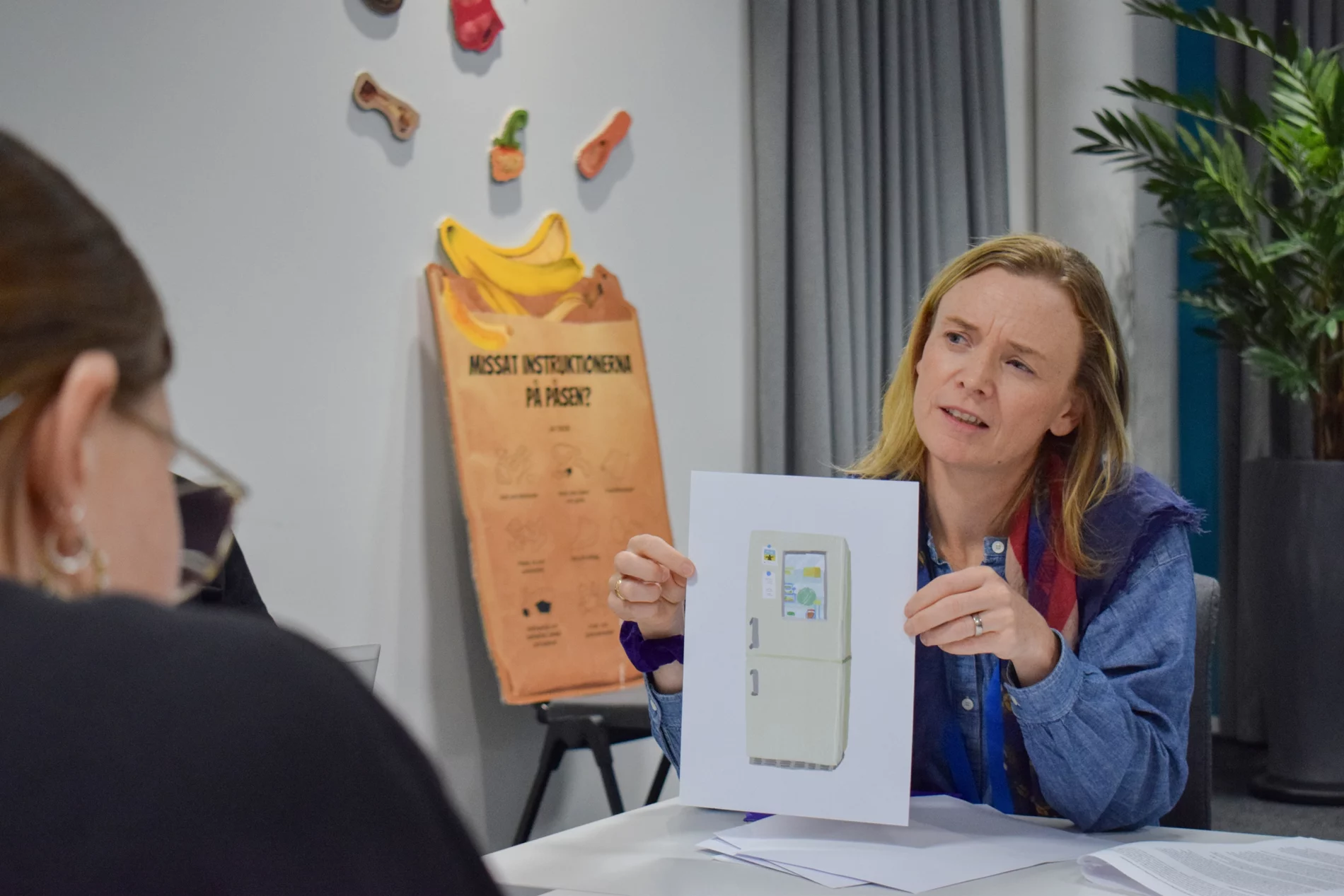
These prototypes were presented as illustrations, creating a shared understanding while encouraging participants to share ideas and interpretations.
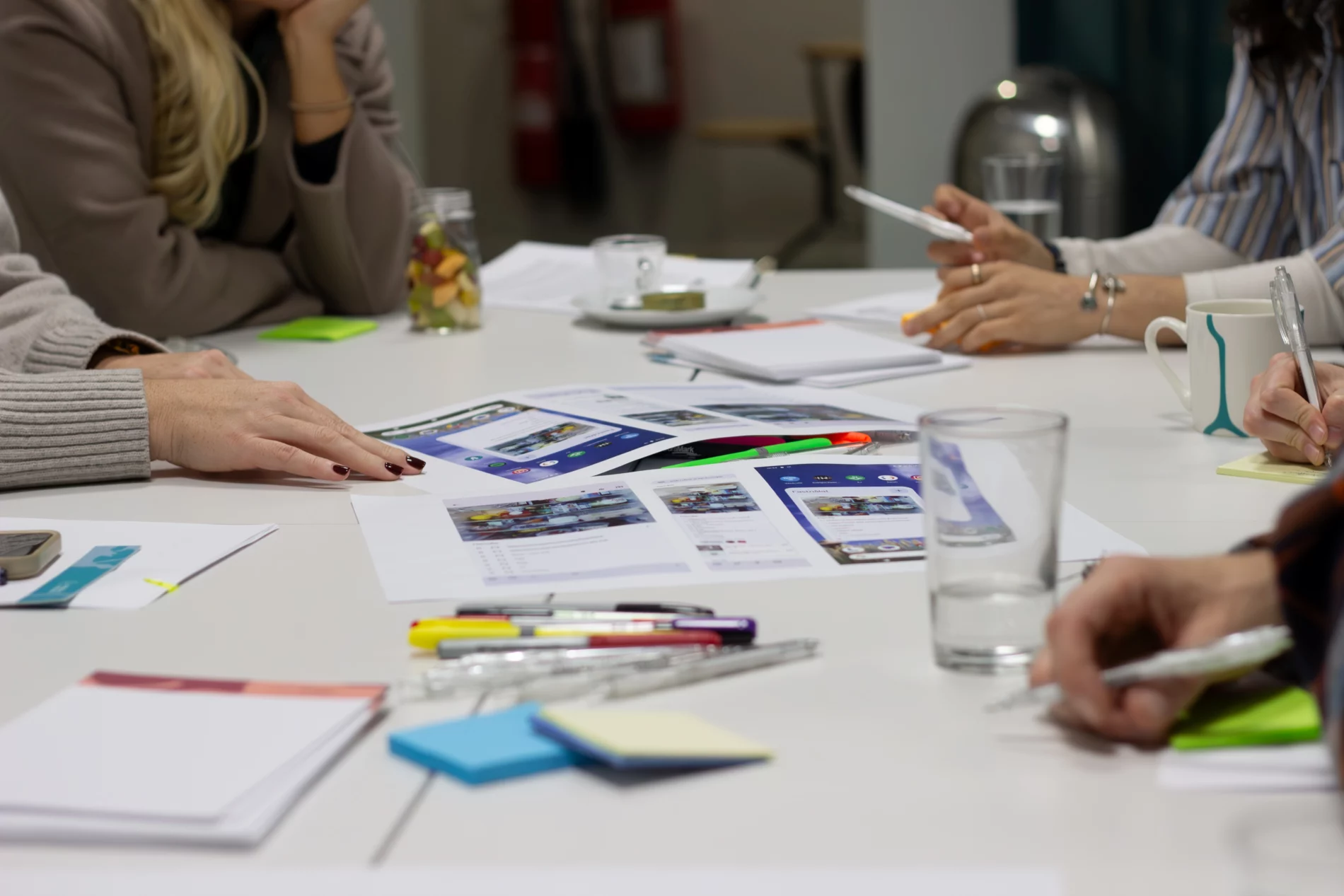
Prototypes for a fridge organizing system, including reminders, an app and a website interface.
Photo: Alexandra Fransson / SEI.
Participants identified various drivers of food waste, including overbuying due to store promotions like “2 for 1” deals, social norms such as the “ick” factor of eating food past its “use by” date, being considered “stingy” when saving food and the importance of being perceived as a good host by always having plenty of food at home for guests. Barriers included lack of time, limited fridge oversight, and insufficient knowledge about proper storage and food preparation.
Proposed interventions that were seen as low effort, easy to integrate or memory aids (like shopping lists, post-it notes on food containers or a clearly organized fridge) were especially popular. Better fridge organization and shopping lists paired with photos of fridge contents were the clear favourites.
Many participants were strongly motivated to reduce food waste, had already implemented effective measures to prevent it, or felt positively about most of our proposals. While this is encouraging for our mission to reduce waste, such high levels of motivation may not reflect the broader population outside of our workshops. To test our interventions in a more realistic context, we asked our participants to imagine themselves in the shoes of others and to invite someone less motivated to join the next workshop.
Based on participant feedback from the first workshop, we adjusted our initial interventions and presented the developed prototypes in a second workshop featuring real-life scenarios. This revealed new challenges and further underscored the crucial role of motivation.
Some interventions would work well for certain participants but not for others. For example, those accustomed to pen-and-paper grocery lists found digital lists too time-consuming, while adding photos of fridge contents felt confusing and involved too many steps. Similarly, fridge organizing systems were intuitive for some while odd and difficult to keep up for others.
“This is for people who are already interested in organizing their shopping.”
In some cases, skeptical participants identified that certain motivations could encourage their use of an intervention.
“I wouldn't use the stickers, they can be quite ugly. But if my kids were to come up with it, that would be okay.”
Applying these interventions requires effort, and if people don’t see a need to change their behaviour, the barrier becomes too high. Communication plays a key role in emphasizing the importance of reducing food waste. Different motivations – financial, environmental or civic responsibility – resonate with different people, and effective messaging cannot be identified from demographics alone.
“[We need] something small that makes its way into people's heads. That they identify themselves with. The idea of "I'm not a person who litters”, or “I'm a part of the non-smoking generation.””
The workshop revealed the need to tailor interventions to different household archetypes. By tapping into the varying motivations and pain points, we can ensure solutions become applicable for diverse lifestyles, covering all three ingredients for behaviour change: capability, opportunity and motivation.
In early spring, the co-designed interventions will be rolled out to participating households in the Gothenburg region. Food waste levels will be measured to evaluate the impact of the different interventions in real-world settings.
Now we’re cooking (with less waste!)
Project / Household food waste contributes significantly to greenhouse gas emissions. Urgent action is needed for Sweden to reduce it by 25% before 2025.
Journal article / This article maps consumer carbon footprints by urban density in Europe, revealing what drives the changes.
Journal article / The authors use the iSDG-Sweden system dynamics model to study the impacts and dynamics of combined degrowth policies in a high-income country.
Journal article / The largest wildfire in Sweden’s recent history affected nearby housing prices and time-on-market.