Editor’s choice
Editor’s choice
Record droughts and floods have hit many parts of the world in recent months, in line with UN warnings that we may be heading towards “water bankruptcy”. Managing water better is fast becoming one of the world’s most critical challenges. Here are five trends from World Water Week that will shape how it is done.
World Water Week has been held every year since 1991 to explore urgent water-related topics, with SEI as an active contributor throughout. Much of this year’s discussion centred on the UN report Global Water Bankruptcy by Professor Kaveh Madani, who attended the week to receive the Stockholm Water Prize. The report warns that the world is living “beyond its hydrological means”.
Water governance is also an area where SEI centres around the world hold deep expertise, and SEI researchers contributed to sessions throughout the program. Five trends stood out.
Artificial intelligence will shift every aspect of water management, and decision-makers need to prepare accordingly. AI can support better water management, but it also creates considerable risks for already stressed resources. The session “AI – water risks and opportunities”, organized by SIWI, unpacked both sides, with SEI Research Director Somya Joshi and Senior Research Fellow Biljana Macura among the speakers.
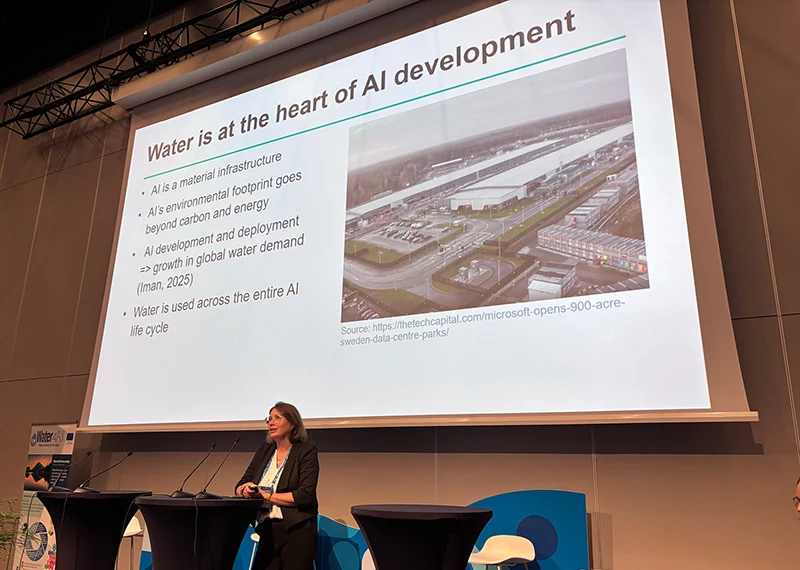
Macura noted that AI consumes vast amounts of water, from chip production to data centre cooling – impacts that are usually invisible to, and far removed from, the people who benefit from the technology. Governments and companies will need to regulate AI-driven water demand more closely, and pay much greater attention to how supply chains are organized and where key activities are located.
That can build transparency, trust and cooperation around shared waters, and stronger governance with it.
SEI Senior Research Fellow Biljana Macura sets out four principles for water-just AI governance at World Water Week 2026.
Photo: Somya Joshi / SEI.
Climate change is altering the water cycle, driving more severe droughts, floods and other extremes. The pattern is global, but the consequences are sharpest for people living in poverty without clean water and safe sanitation.
Bridging watershed management and the provision of water and sanitation services has been discussed for years; the priority now is to make it happen. SEI researchers contributed to several sessions on this, drawing on research from Africa, Asia, Europe, Latin America and the US. The cases showed that resilient water services depend on resilient watersheds, and that the main barriers are institutional and financial rather than technical. Fragmentation can be overcome by strengthening coordination across institutions, planning and finance – but these practices need to become far more widespread.
SEI also shared work from its One-SEI program on water and circularity, which is testing practical ways to link watershed management, water and sanitation services, and resource recovery across the water cycle. Examples include nature-based solutions that secure water resources, and processes that safely manage human and animal waste for reuse as fertilizer, benefiting both health and agricultural productivity.
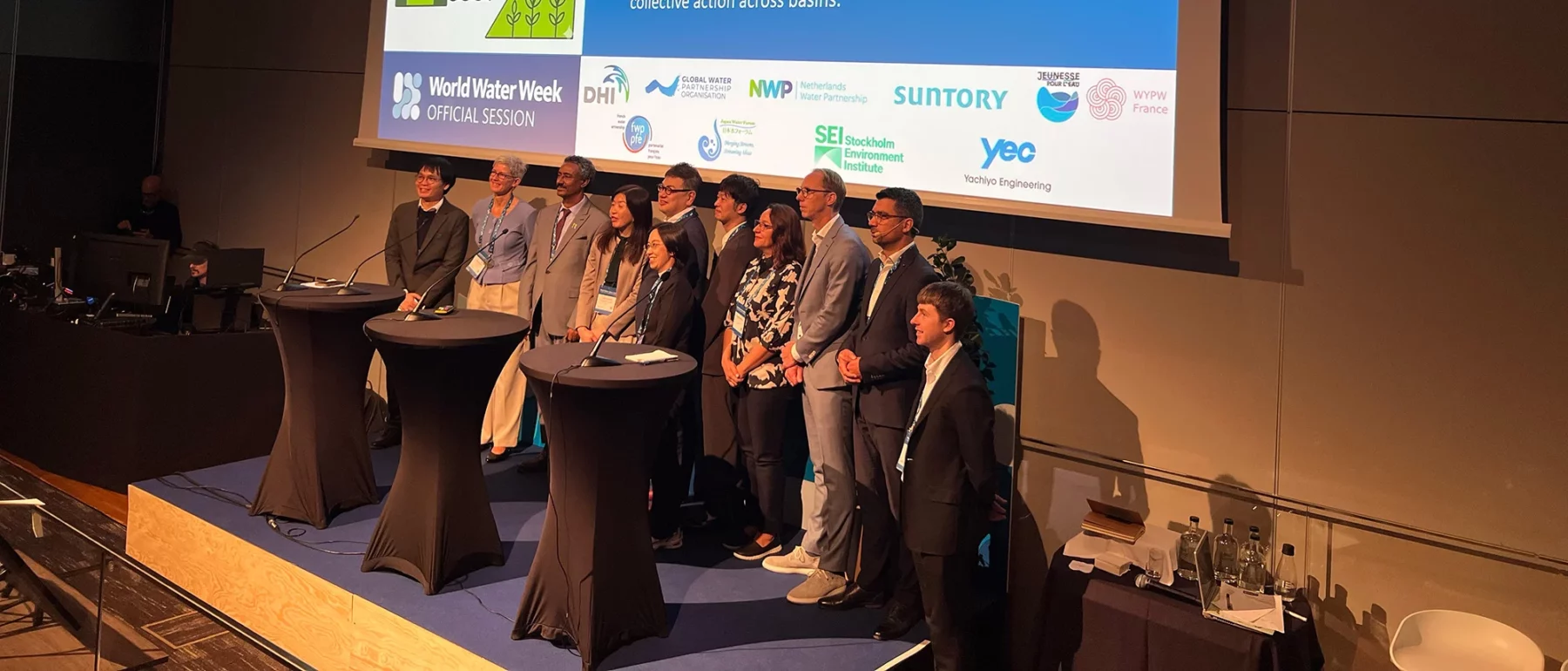
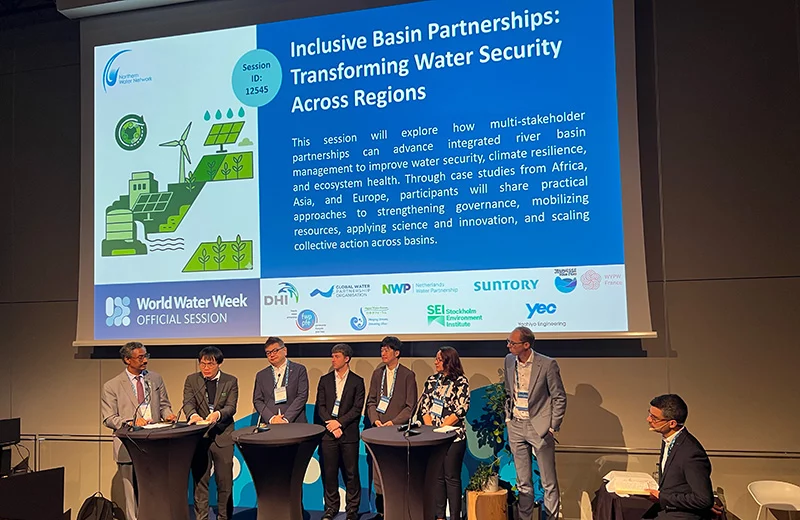
Speakers and organizers gather on stage at the close of the Inclusive Basin Partnerships session, a World Water Week official session co-convened by SEI.
Photo: Qiuandra Taylor / SEI.
A growing number of people are forced from their homes by conflict, persecution, natural disasters and climate emergencies such as extreme drought. Many others have spent years in refugee camps and are becoming more vulnerable as international development support shrinks.
Ensuring that displaced people still have access to water, sanitation and hygiene (WASH) cannot be solved through humanitarian response alone. Emergency interventions too often deliver temporary fixes while longer-term planning and investment fail to account for recurring crises and displacement, so services break down each time a shock hits. Bridging humanitarian and development approaches is essential if WASH systems are to keep functioning through crises and support communities over the long term.
SEI and the Swedish Red Cross hosted a session on concrete measures to strengthen the resilience and continuity of WASH services, focusing on how humanitarian and development actors can better align planning, financing and locally led solutions.
The private sector is paying more attention to water, but interest is held back because water remains chronically undervalued. SEI co-hosted a high-level breakfast dialogue on this together with the Coca-Cola Foundation Mexico, the Embassy of Mexico to Sweden, the Embassy of Sweden to Mexico and Water Wise Societies, bringing together senior voices from global governance, project finance and the private sector.
A common thread was that water is poorly accounted for in public budgets and political debate, which makes it hard to build a viable business case for investment. Only a fraction of water investment currently comes from the private sector, and the gap is structural rather than simply a matter of scale: the bottleneck is pipeline rather than capital. Cities understand their problems but lack early-stage funding for feasibility studies and impact assessments. Closing that gap requires grants and concessional finance up front, and a financial sector that treats water as a material risk rather than philanthropy.
Progress is uneven. Leading companies in food, beverages and heavy industry are embedding water stewardship into strategy and benchmarking across sectors, but voluntary action cannot substitute for regulation and public institutions with clear mandates. The message from business was direct: provide the governance frameworks and pricing signals that make the investment case, and industry will act at scale.
Many sessions looked ahead to the UN Water Conference in the United Arab Emirates in December. How water should be governed globally is a central question there, although the conference is unlikely to bring any significant change to the global water architecture.
Water is nonetheless becoming far more prominent across international processes, not least at the three Rio Convention COPs happening this year: the UN Convention to Combat Desertification COP17 (UNCCD) which took place in August, the UN Convention on Biological Diversity COP17 (CBD) in October and the UN Climate Change Conference COP31 (UNFCCC) in November.
SEI’s Engagement and Impact Director Annika Markovic welcomes this shift: “The new interest in the role of water for climate, biodiversity and development challenges is important and can lead to more effective solutions. SEI’s extensive water research helps decision-makers identify practical actions for more resilient societies and we will continue to support international policy processes,” she says.
Feature / Treated wastewater could irrigate Bolivia's small farms, but a workshop in La Paz showed that building the tool is only half the challenge.
Journal article / Researchers will conduct a review that is global in scope, with the aim to inform Swedish decision making on hydropower.
Project / Horizon Europe project advancing innovative, participatory approaches to water management and climate adaptation under deep uncertainty.