Editor’s choice
Editor’s choice
The assessment examines the economic, health and climate benefits of 25 proven solutions across energy, industry, transport, agriculture, cooking and waste. The goal is to provide evidence and actionable insights to accelerate implementation, improve health and strengthen economies, and to highlight the urgent need for integrated climate and clean air solutions.
Working with UNEP, CCAC and a range of partners, SEI co-authored and coordinated the development of the assessment.
The UNEP Hidden Assets: The Economic and Health Case for Climate and Clean Air Action assessment highlights the urgent need to tackle climate change and air pollution together. These challenges share many of the same sources, including fossil-fuel use, agriculture and industry, while pollutants such as methane and black carbon both contribute to climate change and harm the air we breathe.
Climate change and air pollution are closely linked, yet they are often addressed separately. The authors brings these issues together, providing the most comprehensive analysis to date of the costs and benefits of integrated climate and clean air action and how these benefits can be delivered quickly enough to improve health and protect the world’s most vulnerable communities.
What's new in this assessment is that we've explicitly linked climate change and air pollution together in an economic framework, we show that illness itself is a large and immediate cost across high to low income countries, and that there are viable and practical approaches to speeding up implementation of solutions on the ground to achieve substantial economic benefits in the near-term.
Professor Kevin Hicks, Stockholm Environment Institute (SEI), York centre, University of York
The assessment authors examines 25 proven solutions across energy, industry, transport, agriculture, cooking and waste. It shows that integrated action can deliver significant economic, health and climate benefits, with every USD 1 invested potentially generating around USD 15 in returns.
The authors findings highlight the scale of the opportunity. Full implementation by 2050 could prevent 144 million premature deaths and hundreds of millions of cases of chronic illness. Accelerating implementation could generate up to USD 10 trillion in savings by 2040, while every year of delay could forgo more than USD 1.5 trillion in benefits.
The authors also identifies institutional barriers as a key challenge to faster action. It stresses that the right policies, investment and enabling conditions can accelerate implementation and unlock benefits across all regions.
The authors emphasize that integrated climate and clean air action is an important opportunity to improve health, strengthen economies, safeguard ecosystems and build a healthier, more resilient future.
This new economic assessment clearly shows that there is a massive economic benefit to taking early action - further evidence that any delay in addressing the 8 million people needlessly suffering from air pollution and limiting the obvious impacts of climate change makes no sense at all.
Professor Johan Kuylenstierna, Stockholm Environment Institute (SEI), York centre, University of York
Project / SEI researchers and partners will create three assessments on economics, agriculture and food systems, and nitrous oxide to aid decision-making on SLCPs.
Project / The project supports the development of an Africa Clean Air Program continental roadmap and implementation plans.
Project / This project helps companies quantify, report, and reduce air pollutants across their value chain with tools and guidance to take meaningful climate action.
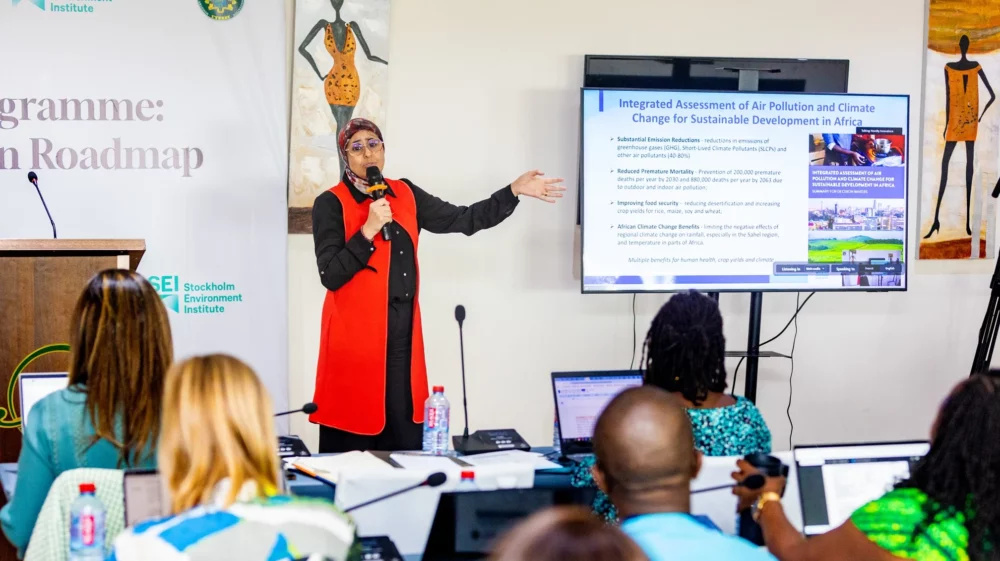
Feature / SEI researchers presented key insights and next steps for the African Clean Air Program (ACAP) Roadmap in Accra, Ghana.
Feature / The UN Global Nitrous Oxide Assessment, co-authored by SEI’s Kevin Hicks, urges bold action to cut N₂O emissions.
Press release / A new study reveals that 52% of the global drop in air pollution deaths (1990–2019) stems from improved healthcare and lower vulnerability.