SHAN STATE, MYANMAR – Unregulated gold mining in eastern Shan State raises concerns about the risk of cyanide contamination in key transboundary rivers near the Thai–Myanmar border, including the Mekong.
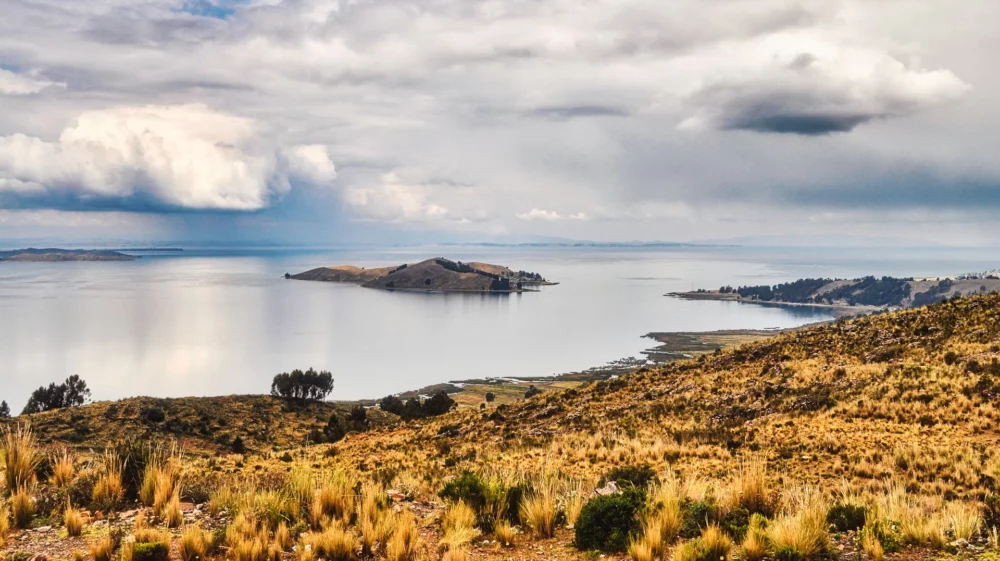
Loi Kham, which means ‘Golden Mountain’, is in Mong Len township in Myanmar’s eastern Shan State, near the Thai border. Photo: Shan State Farmers Network.
When Sai U, a 35-year-old farmer from a quiet village in Mong Len, Tachilek township, near the Thai border, watched his cattle approach a local pond for a drink, he never expected what would happen next.
“They drank the water, took a few steps, and just collapsed,” he said, recalling the moment with disbelief.
The pond had been fed by Nam Kham – the “Golden River” – a stream that flows from Loi Kham, or “Golden Mountain”, named for the flecks of gold said to sparkle in its soil.
To villagers like Sai U, the mountain is more than a mineral deposit – it is sacred ground.
“We were told there was gold in the mountain, which is why it’s called that,” he said. “But we never searched for it. For us, the mountain is spiritual – our ancestors live there.”
But that reverence was not shared by outsiders. In 2007, the first four Chinese miners arrived with an official concession. They carved into the mountain’s slopes, removing its crest and leaving behind a lunar landscape.
“They first arrived without modern technology, so they simply blasted the whole mountain. Only recently did they acquire a mineral vein detector to drill specific areas,” said Sai U, who watched the mountain being destroyed with his fellow villagers.
The Responsible Gold Mining Principles call for the safe storage, treatment, and disposal of cyanide waste to minimize environmental harm.
For example, the well-known Thai-Australian Chatree gold mine at the border between Thailand’s Phichit and Phetchabun provinces spans nearly 600 hectares, with a tailings pond covering nearly one-third of the site.
According to the company, the tailings pond is designed to reduce cyanide concentrations in wastewater from 130 ppm to below 20 ppm – levels considered safe for environmental discharge.
Despite these mitigation measures, the Chatree mine faced repeated allegations of chemical leakage into surrounding communities, leading to court cases and a government-ordered shutdown that lasted six years.
At least four countries – Germany, the Czech Republic, Hungary and Costa Rica – have banned the use of cyanide leaching in gold mining altogether, citing the high risk of environmental contamination.
Since 2000, the global mining industry has adhered to the International Cyanide Management Code, a voluntary initiative designed to promote the safe and responsible handling of cyanide in gold mining.
Multiple requests to interview Nyi Rang, a spokesperson for the UWSA, about whether the code is implemented in territories under their control went unanswered.
Thanapon Piman, a senior research fellow at the Stockholm Environment Institute, believes the international community should not wait for chemical concentrations to reach crisis levels before taking action.
Detecting rising chemical levels could prompt downstream countries to respond. These increases are evidence of what’s happening to the rivers.
Thanapon Piman, Senior Research Fellow at SEI Asia
While the public often views cyanide pollution as less urgent than flash floods or mudslides, Thanapon warned that the two issues are deeply interconnected.
“When floods occur, river levels rise across the system – including areas near mines where leaching ponds sit along the banks,” he explained. “You can imagine what toxic substances those floodwaters might carry downstream.”
In January 2025, following a distinguished diplomatic career, Busadee Santipitaks was appointed Chief Executive Officer of the Mekong River Commission (MRC) Secretariat – the intergovernmental body tasked with managing the Mekong’s transboundary water resources.
Upon taking up that role, she emphasized that strengthening river monitoring would be one of her top priorities to better understand the region’s increasingly complex water dynamics.
When asked about the risk of cyanide contamination from gold mining operations in the Mekong Basin, the MRC Secretariat responded through a communications officer’s email that “we have no comment on the specific details of your findings.”
That reply came as no surprise to researchers at the Shan Human Rights Foundation, who have been documenting the harmful effects of gold mining in eastern Shan State for nearly a decade.
“We’ve raised this issue in several workshops attended by MRC representatives since our initial findings,” said a foundation spokesperson, who requested anonymity due to security concerns. “They had no response then, and they have no response now.”
Feature / Key messages from the second Joint Steering Committee (JSC) meeting on water-related collaboration between ONWR and SEI Asia on 20 August 2026
Feature / The European Union recently recognized TRANSCEND, an interactive water planning approach supported by SEI.
Project / Horizon Europe project advancing innovative, participatory approaches to water management and climate adaptation under deep uncertainty.