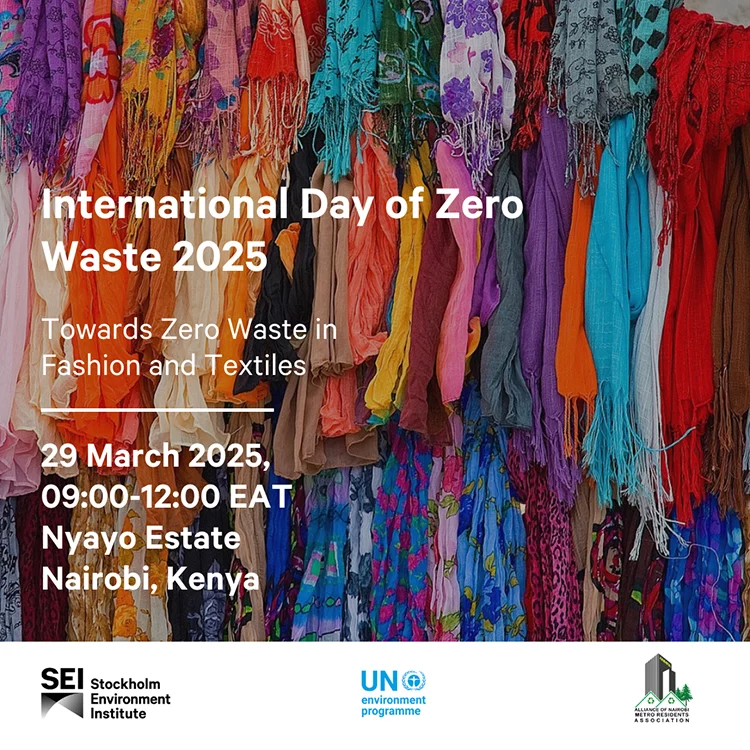
Alliance of Nairobi Metropolitan Residents Association (ANMRA), in partnership with SEI and UNEP, will host a celebratory event to highlight the benefits of sustainable waste management for addressing environmental pollution and contributing to better air quality and sustainable urban living. In line with the 2025 theme, the event will also highlight the need to address textile waste management.
Please note: This is a closed event with participation by invitation only.
Graphic: SEI.
The International Day of Zero Waste, observed annually on March 30th, aims to promote sustainable consumption and production practices and foster a circular economy. The 2025 theme, “Towards Zero Waste in Fashion and Textiles,” emphasizes the urgent need to reduce waste from the fashion and textile sector while promoting sustainability and circular economy principles.
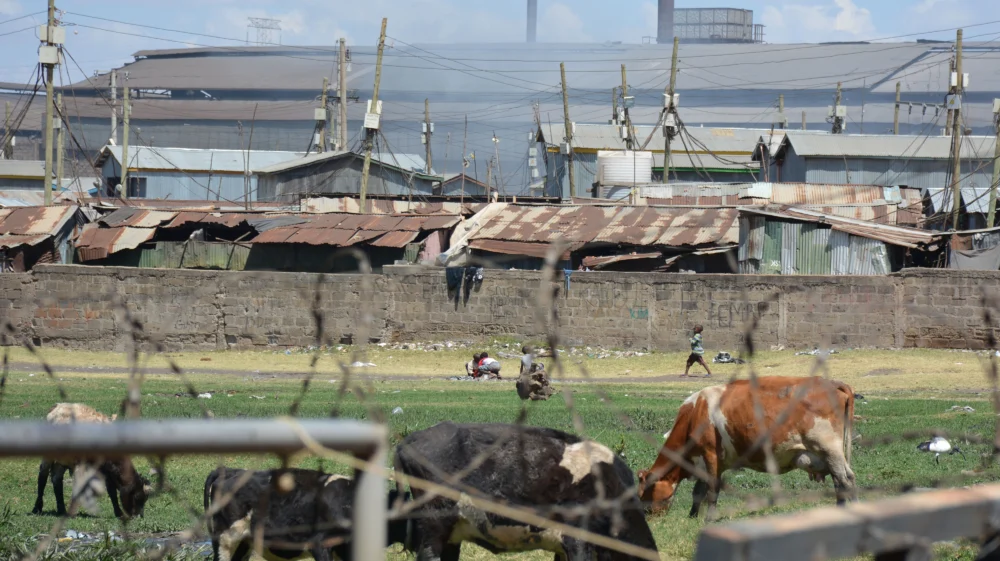
The fashion sector is a significant contributor to environmental degradation, with textile waste accounting for a substantial proportion of municipal solid waste. In Nairobi, informal textile markets, inadequate waste management infrastructure, and fast-fashion consumption patterns exacerbate the issue. With growing urban populations, particularly in residential estates such as Nyayo Estate, there is an increasing need to integrate sustainable waste management strategies to mitigate pollution and promote circularity in fashion. This event therefore presents a unique opportunity for ANMRA to showcase the best practices put in place to mitigate the effects and expansion of textile pollutions within residential areas.
Aligned with UNEP and UN-Habitat’s global advocacy for Zero Waste Day, stakeholders worldwide are encouraged to host complementary events from March 1st to April 5th. These activities range from seminars and webinars on waste management, repair workshops, clothing swaps, sustainable fashion showcases, and clean-ups. In Nairobi, this initiative presents a unique opportunity to integrate air quality monitoring and waste management, particularly within residential areas.
The Alliance of Nairobi Metropolitan Residents Association (ANMRA), in partnership with the Stockholm Environment Institute (SEI) and the United Nations Environment Programme (UNEP), has been actively engaged in environmental monitoring and public awareness. For the past one year, efforts have focused on assessing air quality within Nyayo Estate, leading to the successful deployment of two air quality sensors to measure pollutants such as particulate matter (PM2.5 and PM10) and carbon dioxide and relate these to weather parameters such as relative humidity, temperature, and air pressure. These sensors provide real-time data, equipping residents and estate managers with critical insights into pollution levels and potential sources.
Nyayo Estate is the largest single gated community in East and Central Africa, located in Embakasi, Nairobi, Kenya. The estate comprises approximately 5,000 housing units, providing residence to around 25,000 people during school terms and 30,000 residents when schools close, as families reunite. The estate is a well-planned residential area, featuring essential social amenities such as three schools, shopping centres, recreational spaces, and medical facilities. Its proximity to industrial zones, major transport routes, and Jomo Kenyatta International Airport (JKIA) makes it an area of interest for both environmental and urban sustainability studies. Given its high population density and mixed land use, Nyayo Estate presents a crucial case for integrating air quality monitoring and zero waste initiatives, ensuring a healthier and more sustainable urban environment for its residents.
Project / The project supports the development of an Africa Clean Air Program continental roadmap and implementation plans.
Journal article / "Breathing well" is about more than air quality: cleanliness, population and building density and the presence of vegetation all make a difference.
Feature / Discover how air quality research since the 1990s has shaped policy and highlighted the health, economic and social benefits of addressing air pollution.
Journal article / This research examines how changes in population vulnerability and exposure to air pollutants affect global air pollution-related mortality trends.