Policy coherence is widely seen as a critical tool for countries to advance their climate and sustainable development commitments. Recent research has shown that the consequences from effective policy coherence efforts tend to deliver broader societal benefits and inequality reduction; while, in contrast, incoherent policymaking not only fails to deliver societal benefits, but also create benefits for polluting industries and political elites. Moreover, there is a strong perception among policymakers and experts involved in climate policy that coherence is crucial for advancing just transition at all levels and governance domains.
The multi-level and cross-sectoral character of just transition and its ambition to leverage synergies between climate action, social equity and labour rights puts strong emphasis on effective coordination, coherence and integration strategies. Despite this, the literature on governance arrangements for the implementation of just transition strategies have not sufficiently assessed the role of policy coherence.
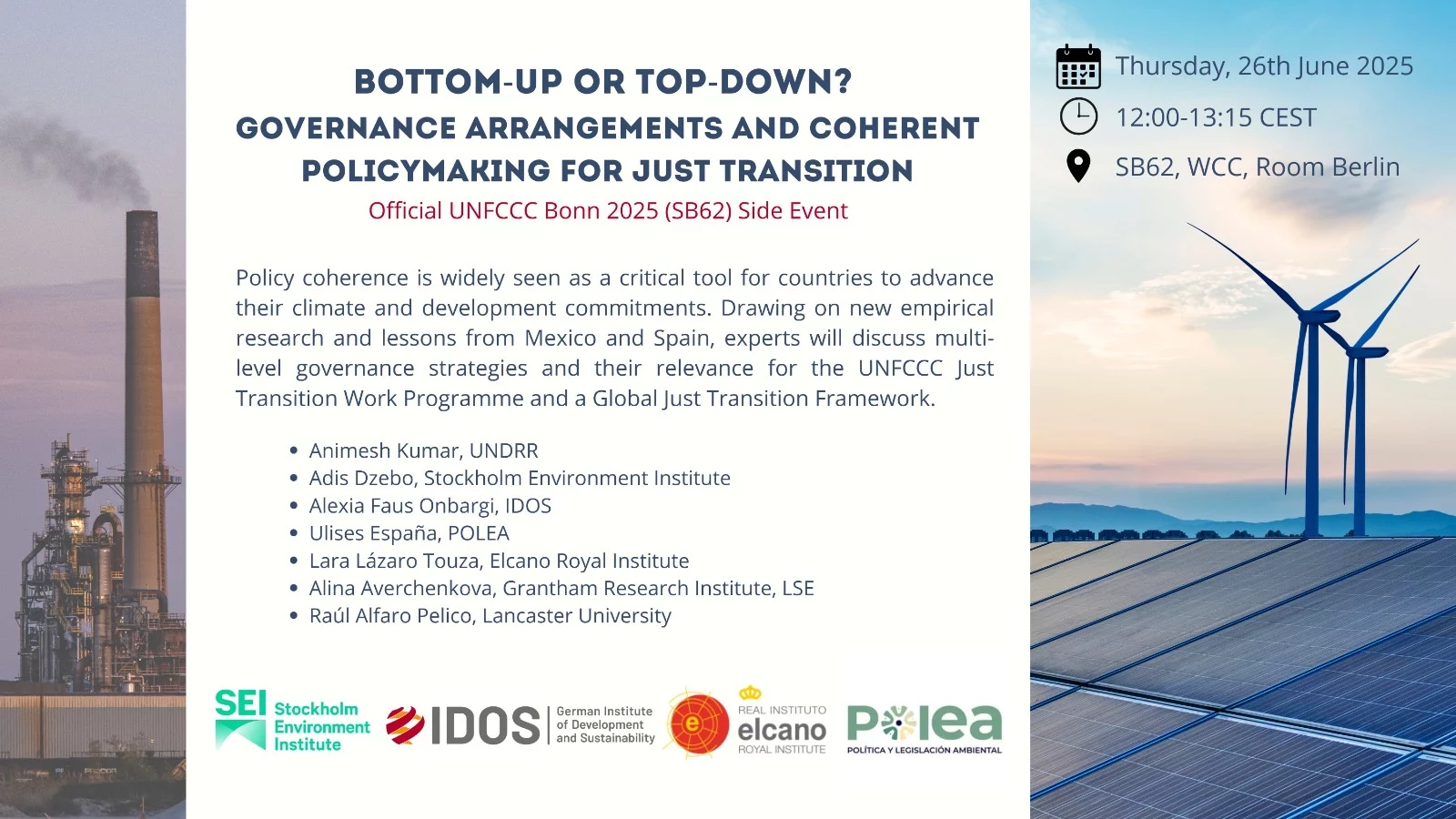
This event will present novel empirical findings on the consequences of policy coherence and their implications for just transition strategies across governance levels. It will also showcase experiences and lessons learned from the development of national and sub-national just transition strategies in Mexico and Spain. A panel of experts will discuss implications and explore how these insights could inform the UNFCCC Just Transition Work Programme (JTWP) and enable progress towards a Global Just Transition Framework.
Animesh Kumar, Head of UNDRR Bonn Office
Alina Averchenkova (online), Grantham Institute, London School of Economics
Raúl Alfaro Pelico, Lancaster University
Ulises España (online), POLEA
Lara Lázaro Touza, Real Instituto Elcano
Alexia Faus Onbargi, German Institute of Development and Sustainability
Adis Dzebo, Stockholm Environment Institute
Moderator: Richard Klein, Stockholm Environment Institute
This is a closed event taking place in person at SB62. Attendance is limited to registered SB62 participants with UNFCCC accreditation.
If you have any questions about participation, please contact Adis Dzebo: [email protected].
Journal article / This paper introduces an analytical framework hypothesizing how ideas, institutions, and interests may influence policy coherence at different policy stages.
Program / A program on aligning climate action, reduced inequalities and sustainable development.
Feature / Discover the key adaptation-related issues expected to play a large role at Bonn's SB62 meetings.
Journal article / Quantitative measures combined with free-text boxes in surveys can provide rich insights into the impact of citizen science activities on participants.
Feature / SEI US introduces a new research program focused on climate forecasting and capacity building.