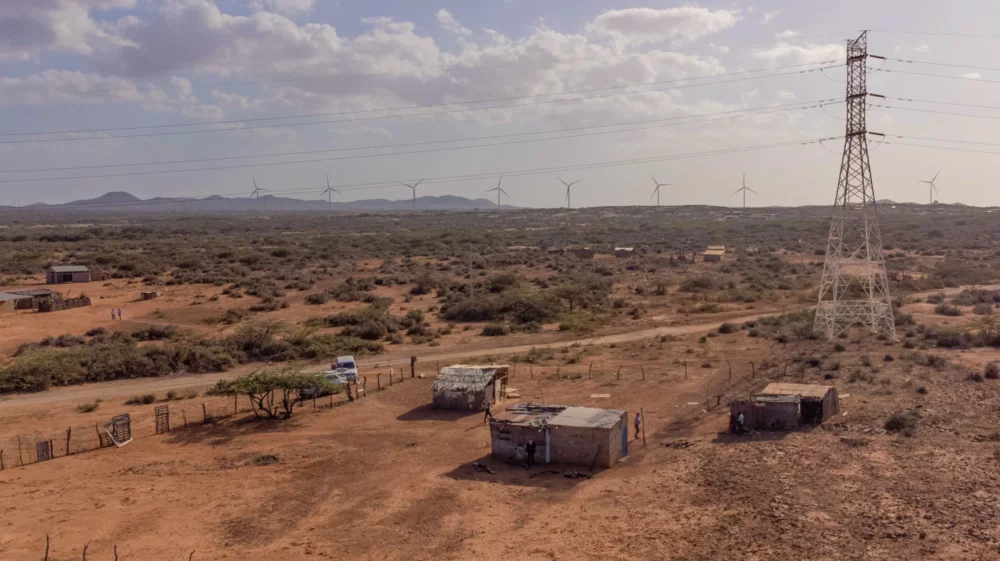
SEI researchers explore the experiences and challenges of community advisors, who play a vital role in advancing a just energy transition.
The rapid shift towards renewable energy has made efforts to ensure a just, inclusive, and equitable transition away from fossil fuels increasingly urgent. The growing presence of community advisers for renewable energy development projects suggests – at least on the surface – that progress is being made towards guaranteeing fairness in consultation and relationship processes between development companies and local communities in Colombia. The presence of such advisers is conceived as a right for communities involved in consultation and free, prior and informed consent (FPIC) processes for renewable energy projects to be adequately informed on related issues. Community advisers ideally possess the knowledge and experience that communities often lack to analyse key issues: the economic, environmental, health, social, and cultural implications of projects and activities have or may bring about, and the corresponding management measures. However, the role of community advisers has been significantly devalued due to poor practices observed within the framework of FPIC processes conducted prior to projects’ construction.
To respond to this development, SEI organized the discussion “The Role of Advisers in Wind Energy Consultations: Experiences and Challenges” as a space for dialogue and reflection. The event brought together practicing community advisers; representatives of energy companies; representatives from national and regional public-sector entities; and leaders and members of Wayuu communities. The meeting focused on analyzing the role, challenges and opportunities of community advisory services in promoting a just energy transition in La Guajira. This story shares the main reflections that emerged during the event.
Decision-making should remain within the community, with advisers acting strictly as support and guidance.
It is essential for communities to express their own perspectives in FPIC processes, preserving their sovereignty and autonomy and ensuring the genuine defense of their interests. During the discussion, advisers criticized the fact that some companies demand powers of attorney from them, and that the Colombian Ministry of the Interior accepts such demands. In contexts where powers of attorney exist, companies often address the designated representative exclusively. These representatives do not always consult with the community, and, therefore, they may usurp or replace the community’s own governing and representative institutions. If an adviser has a request for a company, it must be shared with the community’s authority, which makes related decisions. This process ensures transparency in the dialogue and allows the company to verify that the adviser is not overstepping the bounds of the role. Advisers should be figures who accompany and guide the community during the FPIC process, providing knowledge that is needed to help guarantee that the community is making informed decisions in exercise of its sovereignty and autonomy.
Video: Eduar Monsalve and Camilo Martelo / SEI
Women in the Wayuu culture are perceived as prudent leaders. In FPIC processes, women can act as mediators and advisers, with their leadership tending to promote dialogue and harmony among the community.
Thus, in consultation and advisory processes, women can play a significant role: they can mediate conflicts and advise on decision-making. Women who have a presence in community conflicts are seen within the Wayuu culture as prudent leaders, respected within their clan or “e’irükuu”. Their participation reflects an intention to engage in dialogue and helps foster ease among the parties. As “outsü” or “piache” (spiritual guide, in the local Wayuunaiki language), they can contribute to maintaining harmony both within their community and with other communities; they interpret dreams, which the Wayuu use to prepare for the future and any eventualities in their territory. In this sense, Wayuu women can help ensure that FPIC and advisory processes do not compromise community sovereignty and autonomy, and that the projects gain insights to help them adapt to local cultural dynamics.
Ultimately, FPIC should not be seen as setting the stage for confrontation. Instead, they should be viewed as constructive dialogue based on a culture of mutual understanding to reach agreements that respect and benefit communities.
Video: Eduar Monsalve and Camilo Martelo / SEI
Advisers must go beyond simply negotiating financial gains, prioritizing accurate identification and management of impacts. Furthermore, aspects such adviser obligations, suitability and fees must be regulated more directly.
During the discussion, advisers highlighted the need to identify and systematize best practices in advisory services to ensure more effective and ethical interactions with communities. Although the cost of hiring advisers is borne by project developers, some advisers impose conditions that force communities to relinquish a considerable portion of benefits and compensation, reducing the community’s opportunities to improve its living conditions. For instance, access to these resources can be manipulated through harmonization rituals and direct requests for a percentage of community compensation.
Demonetizing the role of advisers and the approach used FPIC processes is a crucial step. To achieve this, it is key to pay special attention to the phase when impacts are identified and analysed and management measures are formalized. This is the phase when the project’s impacts are discussed, and management measures are proposed and agreed upon to prevent, correct, mitigate, or compensate for these impacts. However, the discussion is often limited to compensation. A focus on monetary issues misses opportunities to implement other actions that could translate into greater long-term social, economic, and environmental benefits for the community. This approach requires a deep understanding of the territory and the potential impacts of the project.
Furthermore, the absence of specific regulations governing the role of advisers in FPIC processes implies that there is no limit on their fees. Aspects such as selection criteria, obligations, and monitoring mechanisms are also hazy. Therefore, it is necessary to establish regulations that define the scope of the adviser’s role in different stages of the process. These regulations should consider:
Video: Eduar Monsalve and Camilo Martelo / SEI
Adviser responsibilities should not end with the signing of a formal agreement. On the contrary, they become even more crucial in the follow-up and monitoring phases.
Panellists and discussion participants agreed that the adviser’s role should not be limited to formalizing agreements. Instead, advisers should play an active role throughout the project’s implementation, extending to the monitoring of the agreements. Continuous and detailed monitoring of each commitment is essential to ensure that the agreements are met, and that impact management measures are implemented correctly and adjusted as needed.
This monitoring process ensures not only transparency and accountability in project execution, but also promotes a positive long-term impact.
Video: Eduar Monsalve and Camilo Martelo / SEI
This story was written by SEI researchers based on the event, “The Role of Advisers in Wind Energy Consultations: Experiences and Challenges”, held in June 2024 led by SEI with the support of the University of La Guajira and the National Authority for Prior Consultation (Dirección de la Autoridad Nacional de Consulta Previa (DANCP).
We thank those who participated in the discussion and panellists Hernando Muñoz, Inés Guzmán, Mara Ortega, Rafael López and Roberto Fajardo. The audiovisual materials included in this story were produced by Eduar Monsalve and edited by Camilo Martelo and Eduar Monsalve. The script was led by Camilo Martelo. The text was edited by Karen Brandon.
Program / This programme aims to build a collaborative platform to accelerate renewable energy deployment in La Guajira.
Initiative / The Carbon Lock-In Initiative seeks to uncover and address the barriers that uphold the fossil fuel-based economy.
Perspective / Ahead of the First Conference on Transitioning Away from Fossil Fuels in Colombia, SEI experts name their priorities for advancing a fossil-free future.
Feature / Trase identifies the leading coffee trading companies and estimate where traders and markets source coffee from within key coffee-producing countries.
SEI report / This document offers a snapshot of the electric transmission sector in Colombia as of 2025.