There cannot be a just energy transition without gender justice. This means going beyond narrow approaches that only seek to compensate small groups affected by the transition such as formal workers who are mostly men and also questioning preconceived ideas about gender roles, often based on Eurocentric and upper-class perspectives.
It is not possible to have a just energy transition without gender justice. Achieving truly just energy transitions requires recognizing that gender relations in Latin America are built upon historic power dynamics that intersect with ethnicity and class. And in many contexts, these power dynamics perpetuate and reproduce gender-based violence and discrimination.
In many Indigenous communities, concepts of gender roles, expectations, and dynamics do not align with or mirror those found in non-Indigenous societies. This issue transcends linguistic or superficial alterations to Western gender roles. It reflects deeper, unique understandings of the world and social relationships, highlighting that gender is a dynamic construct shaped by specific cultural and historical contexts. The renewable energy rollouts in La Guajira, Colombia and João Câmara, Brazil highlight that fostering intercultural sensitivity is essential for integrating gender perspectives into a just energy transition, particularly within regions heavily populated by Indigenous communities.
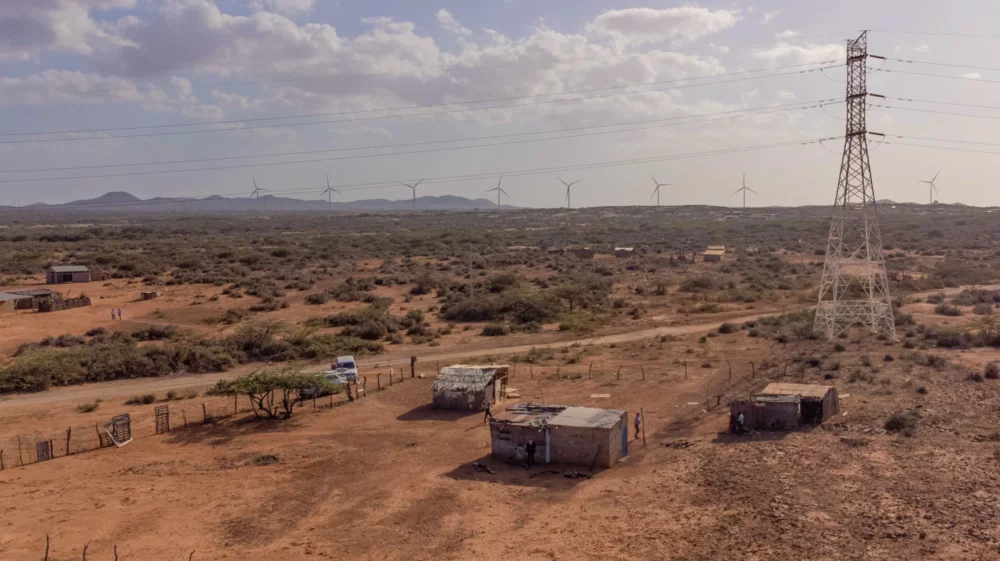
La Guajira is one of Colombia’s hotspots for renewable energy generation. But it is also home to the Indigenous Wayuu people. The Wayuu have faced imposed transformations for centuries, such as colonization, and economic exploitation, including imposition of mining and energy extraction, and poor effects of a centralized government.
Currently 46% of the population in La Guajira is part of the Wayuu people, and 62.5% of the area that is being used to generate renewable energy is protected Indigenous land. These are unseizable territories with their own government and community models. Its exceptional wind resources has made La Guajira a focal point for Colombia’s early wind energy projects. In this territory, Jepirachi, the first wind park in Colombia, was built in 2004. Seventeen years later, Guajira 1, the second wind park in the country, was created a few kilometres away. Today, La Guajira has become the national epicentre of wind parks, with more than 40 wind megaprojects at various stages, most of them being planned on Wayuu land.
In response, multiple movements have arisen that connect the defence of women’s rights with territorial, ethnic and environmental rights. A clear example is Sütsuin Jiyeyu Wayuu (Fuerza de Mujeres Wayuu), a women’s organization that defends human and environmental rights from armed conflict, megaprojects, and forced displacement.
Rio Grande do Norte is the Brazilian state with the second-highest number of operating wind parks, with 309 out of 1122 wind parks in the country. Jõao Câmara, a municipality in this state, is a national leader in wind energy, ranking among the top ten in the country for operating wind farms. Since 2011, the region has significantly expanded its wind energy infrastructure, becoming a hub for renewable energy in the Northeast region.
In 2020, João Câmara passed a law declaring the municipality as the “national wind capital”. However, beyond that, this municipality has the largest Indigenous population in the state, comprising 2400 Indigenous people of the Potiguara ethnicity, also known as the Mendonça de Amarelão people. Nonetheless, Rio Grande do Norte has not yet legally acknowledged Indigenous land.
Like many others, Indigenous communities in this region have also suffered violence and erasure due to colonization. While the Potiguara people have lived in Rio Grande do Norte since the 16th century, the foundation of Jõao Câmara at the beginning of the 20th century brought cotton plantations and cattle farms, displacing Indigenous people to a smaller area now known as the Amarelão community. Due to population growth, the Amarelão community started occupying other areas inside and outside the historical Mendonça territory, although this leaves them vulnerable, as many people live in these areas without legal protections.
The lack of recognition of this territory has enabled wind parks in the municipality to be installed near communities without prior consultation, generating direct and indirect impacts on the Amarelão community. Through the political organization of grassroots movements, mainly women, in 2024, the Mendonça developed their Protocol for Prior Consultation, filed with the state’s environmental department, and established legal guarantees that blocked new wind park development near their land without prior consultation.
Each Indigenous community responds to its own unique context. In the face of energy megaprojects, attempting to resolve local gender issues with preconceived ideas, external tools, and without genuine dialogue with the community is not only ineffective but can also deepen resistance.
Eduar Monsalve / SEI
In Indigenous territories, such as La Guajira and João Câmara – with traditions, lives, and worldviews that resist being replaced by Western practices and thought – it is essential to recognize that local conditions require approaches that are context-specific, internally driven and culturally relevant.
In Wayuu society, gender relations are grounded in matrilineal culture and ethnic belonging, in which masculine authority is linked to female kinship, while traditional practices, knowledge, and ethics are influenced by Western culture. Women play a key role in transmitting language, knowledge, and family organization, as clan membership is determined through the maternal line. However, in recent decades, contact with non-Wayuu society has fuelled economic, educative, and cultural transformations, and extractive projects have reshaped gender dynamics. These changes have created tensions between traditional practices and new forms of female participation and gender equity, sometimes referred to as “Western things” or “things from outside”.
The case of the Mendonça do Amarelão community is an example of female leadership resulting from its own historical process, tracing back to the 1980s, when women started occupying decision-making and representation spaces in their territory. Through their political participation and community organisation, women from the Amarelão community have built leadership rooted in care and a sense of community. Today, most communities in Mendonça do Amarelão are still led by women.
It is also important to recognize that each community has its own unique context. In energy megaprojects, addressing local gender problems through one-size-fits-all solutions and without dialogue can provoke resistance and lead to project failure, particularly when such approaches are viewed as externally imposed or rooted in foreign, colonial, or Western ideas. For this reason, it is essential to adopt a bottom-up approach that works alongside communities, listening to and valuing the voices that shape each territory.
Listening is the first step. It is crucial to acknowledge local gender relations in each community to better understand how women, men, and other genders relate to their territory. It is also important to learn each community’s definition of living well, as well as which changes are culturally viable and desirable. Just like gendered problems, gendered solutions are also not universal. As a result, solutions must be a participatory process instead of an outside imposition. This includes approaching local gender equity movements, understanding what the desired transformations are, and guaranteeing all people are taking part without discrimination – either by gender, ethnicity, socioeconomic status, age or sexual orientation, among others. This is especially important to achieving a truly just energy transition.
Adopting just energy transitions with a gender lens requires a concrete ethical commitment toward ending discrimination and inequity. This means solutions must be built on shared, understandable languages and frameworks that can be locally appropriated, driving legitimate and coherent change. Abandoning universal theories in favour of more tailored change models contributes to more effective engagements with Indigenous communities. It also fosters horizontal relationships and represents a step toward dismantling a colonial model that persists in state interventions, extractive industries, international cooperation and research.
Genuine just energy transitions are not created from the outside in remote offices. They are co-designed in territories, acknowledging that gender justice is not an accessory but a central element that must be adapted in dialogue with the communities where energy projects are being developed.
If we aspire to end all forms of discrimination and gender-based violence, we need to transform the practices and structures that uphold inequity. For real inclusion, we need to stop talking about communities and start working with them, weaving a collective pathway towards a social and ecological transformation that extends beyond energy alone.
SEI participates in Alianza TEJI (Energy Transitions, Justice and Equity), a network of organizations from Brazil, Chile, Colombia, and Mexico that promotes the integration of gender and intersectional perspectives into just energy transitions. This text reflects on ethnicity and gender issues emerging from the collaboration between Mujer y Medio Ambiente (MMA), the International Energy Initiative Brasil (IEI), and SEI in the context of just energy transitions in Indigenous communities.
Program / This programme aims to build a collaborative platform to accelerate renewable energy deployment in La Guajira.
Project / This project uses an intersectional lens to understand who bears the costs of the energy transition and who benefits from it.
SEI report / This document offers a snapshot of the electric transmission sector in Colombia as of 2025.
Perspective / Calls in Colombia to increase gas production could set the country down an environmentally and financially perilous path despite cleaner energy alternatives.
Past event / This webinar presents a publication that brings together lessons learned from an exchange between Indigenous communities in Brazil and Colombia.