With cars being a commuting lifeline worldwide, their contribution to air pollution is significant. This article presents the first global assessment on air pollution exposure in cars across ten cities: Dhaka (Bangladesh); Chennai (India); Guangzhou (China); Medellín (Colombia); São Paulo (Brazil); Cairo (Egypt); Sulaymaniyah (Iraq); Addis Ababa (Ethiopia); Blantyre (Malawi); and Dar-es-Salaam (Tanzania).
In the study, portable laser particle counters were used to develop a proxy of car-user exposure profiles and analyse the factors affecting particulate matter ≤2.5 μm (PM2.5; fine fraction) and ≤10 μm (PM2.5–10; coarse fraction).
Measurements were carried out during morning, off- and evening-peak hours under windows-open and windows-closed (fan-on and recirculation) conditions on predefined routes. For all cities, PM2.5 and PM10 concentrations were highest during windows-open, followed by fan-on and recirculation.
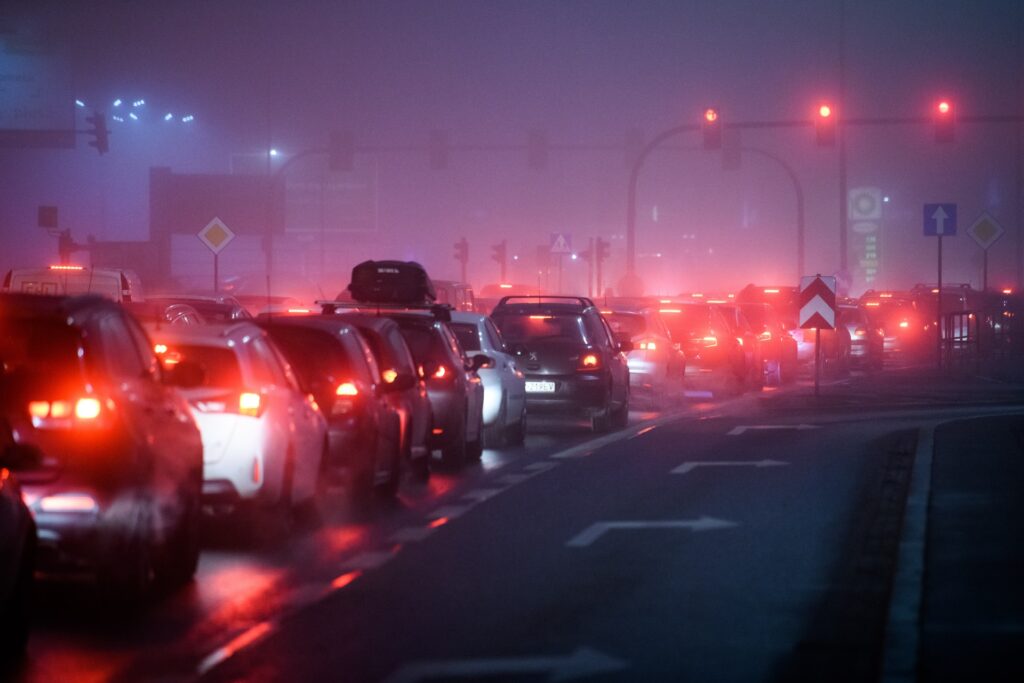
Photo: Jacek Dylag / Unsplash
Compared with recirculation, PM2.5 and PM10 were higher by up to 589% (Blantyre) and 1020% (São Paulo), during windows-open and higher by up to 385% (São Paulo) and 390% (São Paulo) during fan-on, respectively. Coarse particles dominated the PM fraction during windows-open while fine particles dominated during fan-on and recirculation, indicating filter effectiveness in removing coarse particles and a need for filters that limit the ingress of fine particles.
Spatial variation analysis during windows-open showed that pollution hotspots make up to a third of the total route-length. PM2.5 exposure for windows-open during off-peak hours was 91% and 40% less than morning and evening peak hours, respectively. Across cities, determinants of relatively high personal exposure doses included lower car speeds, temporally longer journeys, and higher in-car concentrations. It was also concluded that car-users in the least affluent cities experienced disproportionately higher in-car PM2.5 exposures.
Cities were classified into three groups according to low, intermediate, and high levels of PM exposure to car commuters, allowing to draw similarities and highlight best practices.
Project / A scientifically robust and policy-relevant framework to identify and assess priority measures that maximize the multiple-benefits for air quality and climate.
Journal article / "Breathing well" is about more than air quality: cleanliness, population and building density and the presence of vegetation all make a difference.
Feature / At the Bangkok Climate Action Week 2026, SEI Asia will showcase research and build pathways for climate action through science, dialogue, and engagement.
Project / Lao PDR is developing its first National Clean Air Strategy, drawing on emissions data, mitigation analysis and health benefits to guide action.