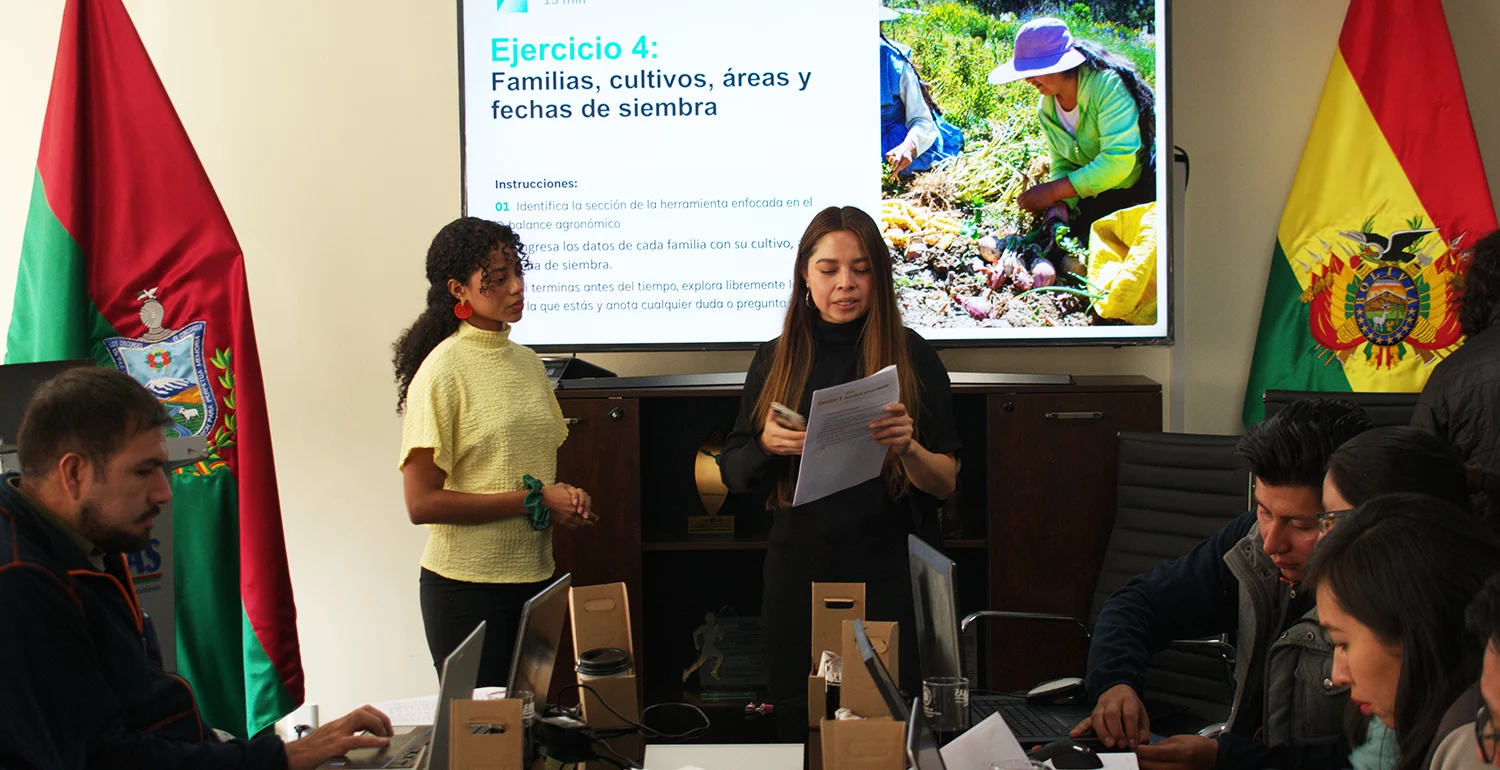
Involving users in building a tool can improve both how well it works and whether people take it up. In May 2026, SEI facilitated a user experience workshop in Bolivia, where participants tested a tool for assessing the potential to reuse treated wastewater in small-scale family farming.
Access to water for irrigation is a persistent challenge in rural and peri‑urban Bolivia. At the same time, decentralized wastewater treatment plants near agricultural areas are an underused resource. Treated wastewater offers both water and nutrients for crops, but using it well means planning around considers crop type, water demand, growth cycles, plot size, climate and local context. Without structured tools, that planning is hard for operators, technicians and local actors.
The workshop ran within the Bolivia WATCH II project, in partnership with the Empresa Pública Social de Agua y Saneamiento (EPSAS), which provides drinking water and manages sewage systems in La Paz and El Alto. Users tested a tool developed in a pilot project on reusing treated wastewater in the community of Chinchaya, while the team – Daniela Alzate, Nhilce N. Esquivel, Gustavo Ayala, Carla Liera and Marina Mautner – gathered learning on participatory processes and institutional co‑creation.
Three insights emerged about how this participatory space shaped the tool, strengthened institutional ownership, and surfaced the conditions needed to advance wastewater reuse in Bolivia.
Developing an effective tool means understanding not just the problem but the people who will help solve it, including their capacities and interests. Opening spaces for co‑creation between institutions is therefore important, as it allows approaches to be aligned and efforts to be steered in the same direction
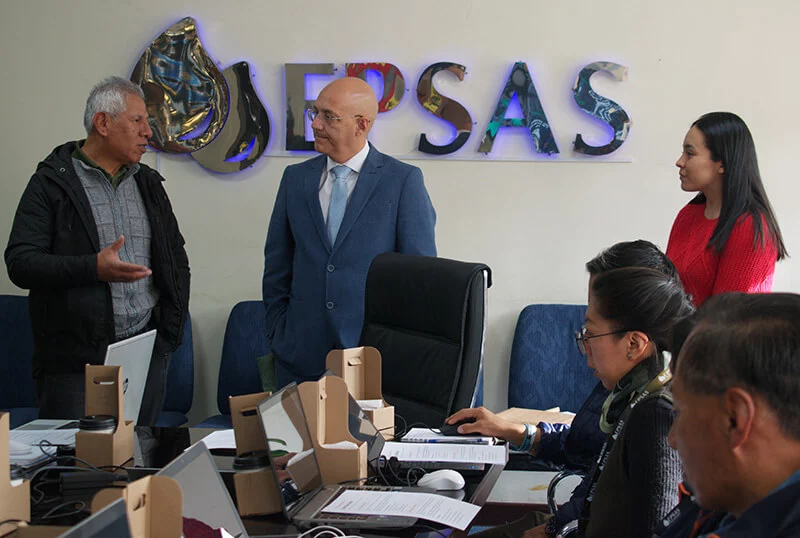
The workshop brought together EPSAS staff from different areas of the company, incorporating perspectives from various levels of decision-making.
Photo: María Fernanda Sánchez Maldonado / SEI Latin America.
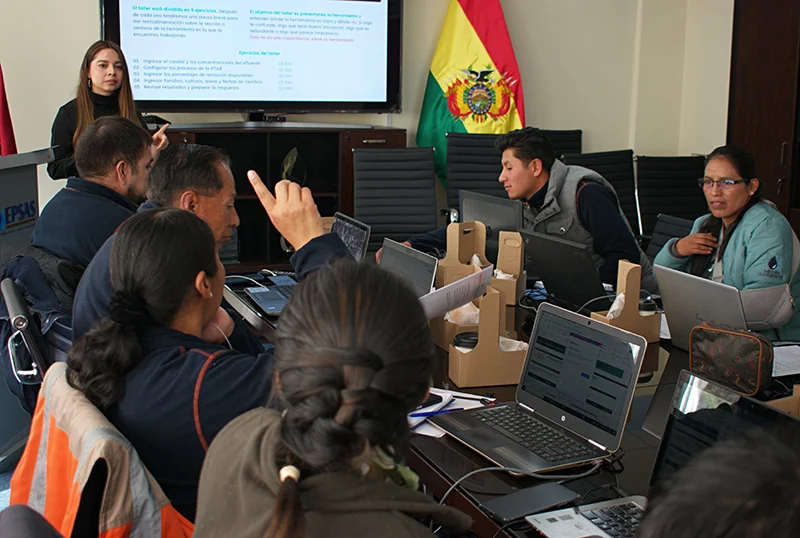
In this case, the user experience workshop created a space to exchange views on the functioning of the tool and on the reuse of treated wastewater in small‑scale agriculture in Bolivia. The workshop brought together people from different areas of EPSAS, enriching the feedback by incorporating perspectives from various decision‑making levels. The contributions pointed to improving data sources, facilitating navigation, making the presentation of results more understandable, and adjusting certain elements to the Bolivian context.
These discussions helped to ensure that the tool is not just a technical design but builds on the needs and insights of those who will use it.
Beyond feedback, the workshop opened a space to talk more broadly about the reuse of treated wastewater in small‑scale agriculture in Bolivia. Based on the presentation of the tool, participants proposed possible ways to use it in real contexts and raised concerns about the conditions needed to achieve safe irrigation with treated wastewater. This led to a conversation in which the SEI team was able to share lessons and experiences from the pilot reuse project.
Feedback gathered during the exercises led to changes in the tool's data sources, its navigation and the way results are presented.
Photo: María Fernanda Sánchez Maldonado / SEI Latin America.
The dialogue sparked institutional interest in reuse. Participants recognized the value of using treated wastewater to improve water‑resource efficiency and even raised the need to design treatment plants with a reuse focus from the start.
EPSAS’s participation strengthened institutional ownership of the tool and opened a broader conversation on reuse, including where it could be applied, under what conditions, with what information and what precautions would be necessary to move forward safely.
In addition to institutional interest, effective implementation requires clear information and technical criteria, as well as strong backing and capacity from the institutions involved. Those in charge must be able to assess under what conditions water can be reused safely, considering aspects such as water quality, crop type, health risks, necessary protection measures and the social and operational conditions of the context.
The new tool contributes to institutional strengthening by offering a means to support the planning of reuse projects in small‑scale agriculture. Furthermore, institutions interested in promoting such projects can draw on previous experiences in similar contexts and use tools that allow them to analyse scenarios and make informed decisions.
If reusing treated wastewater eases pressure on water resources, feeds the soil and cuts synthetic fertilizer use, why does it remain limited in Bolivia and much of Latin America? The workshop points beyond tool design to what is missing: institutional capacity, cross‑sector dialogue and technical solutions rooted in local context.
Participatory design can improve a tool, and it can also shift how institutions see their role in circular water management. Advancing safe, sustainable reuse will take more voices, more stakeholders and more exchange across countries and contexts.
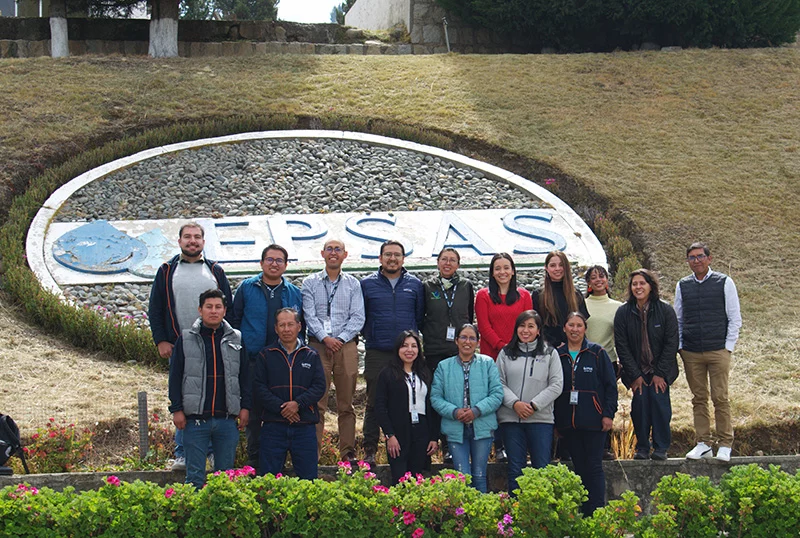
The workshop was facilitated by SEI and involved staff from different areas of EPSAS, the company that provides drinking water services and manages the sewerage systems in La Paz and El Alto.
Photo: María Fernanda Sánchez Maldonado / SEI Latin America.
The tool presented in this article will be showcased at the 36th SuSanA Meeting on 22 August 2026 in Stockholm. Join us there to learn more about the tool and speak directly with the team about lessons learned from the Bolivia pilot and the next steps for scaling such initiatives.
The tool helps plan decentralized wastewater treatment plants in agricultural areas so treated effluent can be reused in farming. It estimates the agricultural reuse potential by combining two inputs: the characteristics of the treated water available, and the water and nutrient needs of one or more crops. By combining these variables with agronomic and climatic data, the tool lets users evaluate:
Project / Bolivia WATCH works to arm the country's institutions with the information and capacity to connect two spheres: safe sanitation and watershed management.
Journal article / Study reveals widespread enteric infections in Bolivia, with strong links to water quality, sanitation and hygiene conditions in rural communities.
Journal article / This journal article describes how community-informed water systems modelling has fostered more resilient, equitable water management in Cambodia and Bolivia.
Project / This project will generate key insights and practical recommendations to strengthen transboundary water governance in the Acre Trinational River Basin