Lao PDR, in collaboration with SEI, the University of York, the University of Laos, and CCAC, is developing its first National Clean Air Strategy. Building on baseline emissions data, this two-year project brings together government, academia, and civil society to set goals, prioritize actions, and estimate health and climate benefits. The project aims to strengthen technical capacity and create a framework for sustainable air quality management.
2026–2028
Lao PDR currently does not have a national plan specifically designed to improve air quality across the country. Air pollution from sectors such as agriculture, transport, energy, industry, and other activities presents challenges for public health, the environment, and climate objectives.
With support from SEI and UNEP, the Government of Lao PDR has already developed important technical foundations to address these challenges. They have been working closely together to improve air quality management and find practical, evidence-based solutions to air pollution. These include a national air pollutant emissions inventory, emissions projections, mitigation assessments, and estimates of the health benefits associated with reducing air pollution.
Their partnership has focused on working with the Ministry of Natural Resources and Environment (now the Ministry of Agriculture and Environment) to develop an air pollution mitigation assessment, train government staff on emissions inventory tools, and support research to identify major sources of air pollutants at the provincial level.
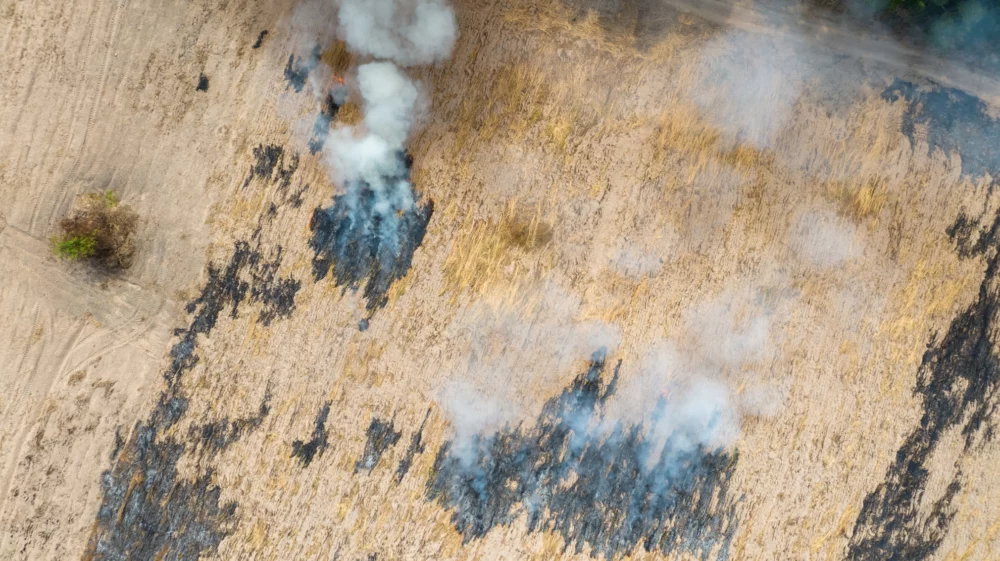
Until recently, Lao PDR had no national inventory of air pollutant emissions. Working with the Ministry, SEI researchers helped develop the country’s first national and subnational inventory of air pollutants and greenhouse gases, covering all 18 provinces and drawing mainly on national statistics. It identifies vegetation fires, household cooking, agriculture, electricity generation, and industry as the significant sources. Forest fires were the largest single contributor, accounting for 69% of fine particulate matter (PM2.5) emissions in 2019.
Because emissions are quantified at the provincial level, the inventory also shows how sources vary across the country and can be used to project future emissions and compare mitigation measures for their combined health and climate effects, including any trade-offs. The findings are presented in a published paper.
Building on this collaboration, the partners are now embarking on this new phase to develop Lao PDR’s first National Clean Air Strategy
The National Clean Air Strategy project will build on this work to establish a clear and coordinated national framework for reducing air pollution. The Plan will:
The plan will bring together:
Perspective / How can you tackle a problem without knowing its cause? SEI’s Connie O’Neill discusses air pollution and identifying sources to reduce emissions in Lao PDR.
13 December 2024 / About Cities, Pollution and Short lived climate pollutants
Journal article / Researchers from our York and Asia centres contributed to the first national and provincial air pollutant emissions inventory for Lao PDR.

8 April 2024 / About Pollution and Short lived climate pollutants
Project / Guatemala will develop a national SLCP plan outlining clear reduction actions, shaped through an inclusive stakeholder process and rigorous peer review.
2026 - 2027 / About Cities, Pollution and Short lived climate pollutants
Project / SEI and CCAC support Brazil's Ministry of Environment and Climate Change in developing a National Plan on SLCP to combat climate change and air pollution.
2024 - 2027 / About Cities, Pollution and Short lived climate pollutants
Project / SEI researchers and partners will create three assessments on economics, agriculture and food systems, and nitrous oxide to aid decision-making on SLCPs.
2024 - 2026 / About Cities, Pollution, Short lived climate pollutants and Transport
Other publication / This assessment shows 15 measures could clean air for 250 million people and reduce PM2.5 by 50-70% in Southeast Asia by 2030.
20 March 2025 / About Short lived climate pollutants
Perspective / How can you tackle a problem without knowing its cause? SEI’s Connie O’Neill discusses air pollution and identifying sources to reduce emissions in Lao PDR.
13 December 2024 / About Cities, Pollution and Short lived climate pollutants
Journal article / Researchers from our York and Asia centres contributed to the first national and provincial air pollutant emissions inventory for Lao PDR.

8 April 2024 / About Pollution and Short lived climate pollutants