In this blog post for Asian Development Bank (ADB), SEI researcher Gary Haq, alongside ADB environment specialists Karma Yangzom and Katherina Patdu, argues that national efforts alone cannot effectively address air pollution, as pollutants such as smoke, gases, and fine particulates frequently travel across borders in Asia. As a result, countries in Asia and the Pacific must collaborate regionally to address the problem.
Toxic air from vehicles, industry, and power stations, along with burning crops and forests, kills millions every year. No country can solve this alone.
Every day, the average adult takes between 17,000 and 25,000 breaths of air. Yet over 90% of Asia and the Pacific’s population—around 4 billion people—breathe air considered unsafe. From children inhaling toxic vehicle fumes on their walk to school to the seasonal haze and smog that grip communities, air pollution is affecting lives, economies, and public health across the region.
In 2023, air pollution caused around 7.9 million premature deaths worldwide. The People’s Republic of China and India each recorded over 2 million of those deaths. In South Asia, around 195 deaths per 100,000 people occurred because of air pollution—more than 10 times higher than in high-income countries. Beyond the loss of life, air pollution reduces labor productivity, increases healthcare costs, and damages crops. In Southeast Asia alone, air pollution-related deaths could cost as much as $600 billion a year by 2050.
While local action such as promoting public transport, walking, and cycling, alongside efforts to curb polluting industrial emissions and fossil fuel use, is vital, it is not enough. Air pollution does not respect national borders. Fine particulates, gases that create smog, and smoke from forest and agricultural fires can drift long distances and undo local air quality improvements. No single country can achieve clean air alone.
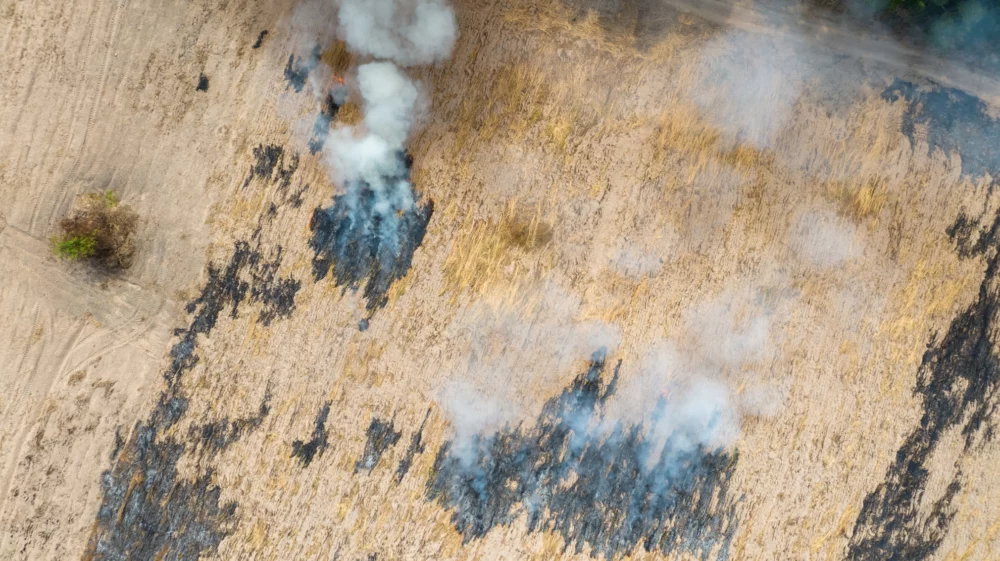
Cross-border seasonal haze and agricultural fires have made it harder for Thailand to achieve clean air, showing the need for stronger regional coordination across the Greater Mekong Subregion. In response to this challenge, the Asia Clean Blue Skies Program is promoting cooperation between countries to take practical measures to improve air quality, build skills, and develop partnerships across the region. Within zones where topography, meteorological conditions, and shared pollution sources lead to common air quality issues, such as the Greater Mekong Subregion, the program is supporting effort to reduce particulates from transport, agriculture, and industry. Over time, successful approaches will be scaled up and extended to other subregions.
A study by the UN Environment Programme shows that by working together, members of the Association of Southeast Asian Nations (ASEAN) could cut fine particulate pollution by 50%-70% by 2030 and increase the number of people breathing clean air from 80 million to over 250 million. The largest gains could come from reducing open burning of crops and waste and improving forest and peatland fire prevention. Additional progress would come from cutting emissions from agriculture and fossil fuel production, promoting cleaner wastewater and rice farming practices, and speeding up the shift to low-pollution cooling technologies. Many of these are major cross-border pollution sources, highlighting the need for regional cooperation.
Asian countries face similar drivers of air pollution: rapid urbanization and vehicle growth, residential and industrial fuel use, agriculture burning, and coal and other fossil fuel power generation. They also share the same challenges cleaning the air, including limited funding and technical capacity, weak air monitoring and data, poor enforcement of regulations, and cross-border pollution that undermines local efforts.
By working together, ASEAN could increase the number of people breathing clean air from 80 million to over 250 million
Karma Yangzom, Maria Katherina Patdu, Gary Haq
Shared pollution sources require common standards, harmonised monitoring systems and a larger scale of integrated investments from public and private sources across multiple sectors including transport, energy, agriculture, and health. Moving beyond fragmented national responses toward coordinated regional action—backed by targeted finance and enforcement—provides a lasting pathway to clean air.
Although efforts are underway to strengthen cooperation, progress remains limited and often confined to voluntary dialogue and information sharing. Stronger political commitment is needed to turn discussions into measurable improvements. There are, however, examples where regional efforts are delivering results. ASEAN, representing more than 700 million people, has established a platform for coordinating air pollution policy and adopted the first legally binding agreement to prevent, monitor, and stop cross-border haze from land and forest fires. While implementation challenges remain, this shows that Southeast Asia can move beyond dialogue toward regional commitments.
Achieving further emission reductions will require deeper scientific consensus, stronger institutions, greater political trust, and, over time, more coordinated and potentially binding approaches. In Southeast Asia, this includes expanding shared haze and hotspot monitoring systems operated through regional centers, reinforcing implementation of the transboundary haze agreement and improving coordination across the Greater Mekong Subregion during peak burning seasons. It will also mean aligning development finance with cleaner transport and agricultural practices.
Translating regional ambition into sustained emission reductions requires support from development agencies and multilateral development banks, which have a critical role in regional public goods such as air quality. By supporting joint research and monitoring, mobilizing public and private finance, and acting as neutral brokers in sensitive negotiations, they help countries overcome mistrust, unequal costs, and the large upfront investments that often block cooperation.
Achieving better air quality across Asia and the Pacific increasingly depends on working together. Clean air will not come from isolated national initiatives alone but from coordinated action—because people throughout the region share the same air.
This article was originally published by the Asian Development Bank blog on 11 March 2026 at the 12th Better Air Quality Conference (BAQ), 11–13 March 2026 in Bangkok. BAQ brings together policymakers, researchers, development partners and civil society to advance regional collaboration and solutions for cleaner air across Asia and the Pacific.
Project / Accelerating low carbon transport policies and plans that meet the mobility needs of marginalized groups in Indonesia.
Project / SEI works with research institutes to assess the impact of pollutants, besides CO₂, that drive climate change, and to develop climate change mitigation options.
Project / SEI researchers and partners will create three assessments on economics, agriculture and food systems, and nitrous oxide to aid decision-making on SLCPs.
Perspective / SEI Asia will lead sessions to explore research and innovative solutions to tackle the climate crisis during the Bangkok Climate Action Week (BKKCAW).
Other publication / This assessment shows 15 measures could clean air for 250 million people and reduce PM2.5 by 50-70% in Southeast Asia by 2030.
Perspective / An SEI study shows the need to urgently improve air quality both indoors and outdoors to protect the health of workers in Thailand.