The Conferences of the Parties (COP) are critical spaces where a sustainable future can be shaped or, if concrete actions are not taken, lead us to a point of no return.
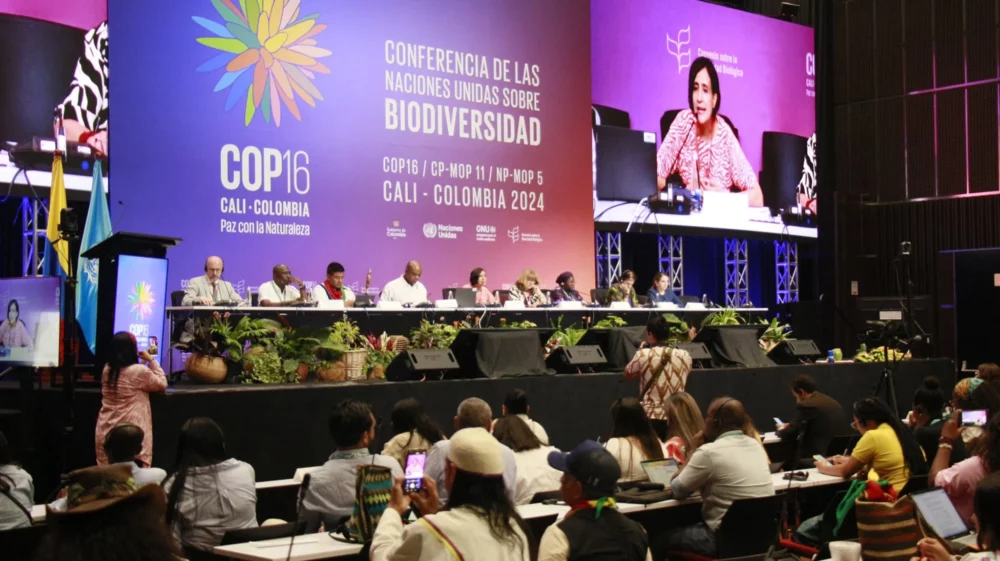
The recent COP16 of the Convention on Biological Diversity was the largest conference on nature protection to date, with more than 23.000 attendees, surpassing the initial estimate of 15.000. This reflects the critical need to protect biodiversity in the context of the triple planetary crisis.
It is essential that the biodiversity and climate change agendas act in concert because both issues are so deeply intertwined. Ecosystem destruction exacerbates climate change by releasing large amounts of carbon stored in nature, while climate change accelerates biodiversity loss. Therefore, integrating these agendas helps to achieve both conservation and mitigation goals and maximize impacts.
This article highlights five key issues discussed at COP16 in Cali, Colombia, that should influence discussions leading up to climate’s COP29 and COP30.
At various events during COP16, the ocean was defined as the “great connector” between biodiversity and climate change, emphasizing its crucial role in global environmental balance. In Cali, an important decision was made on Ecologically or Biologically Significant Marine Areas (EBSAs), which established a framework for identifying and reviewing these areas – a topic that has been debated since COP13. This progress will be essential for implementing the goals of the Global Biodiversity Framework and supporting the High Seas Treaty.
However, there are big challenges to making progress ocean-related issues. According to SEI researcher Lucia Licero, the goal of conserving 30% of the oceans by 2030 represents an ambitious commitment that requires strengthening national biodiversity strategies and creating synchronized action plans (NBSAPs). Lucia also highlights the need to preserve the resilience of marine ecosystems and coastal communities in the face of threats such as sea-level rise and acidification – issues strongly linked to climate change.
SEI’s research on community-led adaptation uses nature-based solutions to help restore coastal ecosystems and promote sustainable livelihoods. For example, the project Resilient Coasts in the Caribbean works towards the well-being of coastal populations while preserving marine biodiversity for future generations – a vital task, because nearly 40% of the global population lives near coastlines.
The bioeconomy is understood as an innovative economic model that uses biological resources sustainably, with the potential to bridge between environmental agendas. At an event led by SEI researcher Mónica Trujillo, speakers emphasized that the climate and biodiversity crises are interconnected, but so far, they have been addressed separately. This fragmented approach results in budgetary imbalances and a lack of equitable access to private finance. The event discussed how nature-based solutions and the bioeconomy emerge as important ways to address this disconnect.
Moreover, the bioeconomy in Latin America has become a key driver for integrating conservation and sustainable development goals in the region. Through the Latin American Bioeconomy Network, models have been promoted that recognize the value of biodiversity and biomass as sources of economic innovation and conservation. The principles of bioeconomy, for example, agreed upon during the G20, create a sustainability foundation where biodiversity and the economy not only coexist but enrich each other.
A notable achievement during COP16 was the launch of the Pan-Amazonian Bioeconomy Network, an alliance aimed at fostering cooperation and the exchange of technologies and knowledge in the Amazon region. The network’’s goal is for bioeconomy in the Amazon to be recognized as a relevant sector by 2035. Additionally, regional collaboration is proposed as an important driver for the bioeconomy in Latin America. For example, at COP16, Colombia and Brazil signed an agreement to develop açaí. But adequate financing with reasonable expectations remains a challenge, and a long-term vision is needed to create lasting impacts.
The event, led by SEI researcher Mónica Trujillo, during COP16 emphasized that the climate and biodiversity crises are interconnected, but so far, they have been addressed separately.
Camilo Martelo/SEI
At the event “Bioeconomy for Biodiversity in the Tropics: Challenges in Value Chains”, a panel of experts discussed how the bioeconomy can align climate and biodiversity agendas. Offering perspectives from the business sector, technological innovation, and public policy, the panel explored the potential of this economic model to drive a transition toward sustainability.
Camilo Martelo/SEI
A milestone was reached at COP16 with the creation of the Subsidiary Body for Indigenous Peoples and Local Communities, which will play a key role in the decision-making process within the Convention on Biological Diversity that ensures the inclusion of Indigenous voices in global policy on biodiversity. Another development was the consolidation of the “Amazon G9”, a block representing Indigenous Peoples from the nine Amazon countries. This alliance will strengthen the demands and rights of these communities, who are essential guardians of biodiversity in the Amazon.
Indigenous peoples possess ancestral knowledge about their territories, which is crucial for implementing effective conservation strategies. Their inclusion in these global negotiation spaces underscores the importance of recognizing their role not only as vulnerable communities but as strategic leaders in the fight to protect ecosystems.
4. Finance: the missing piece
One of the most contentious issues at COP16 was finance. Megadiverse countries like Colombia face major challenges in delivering on their commitments without having the necessary resources to do so. While COP16 promoted the participation of local and regional governments – who ultimately implement budgets in cities and remote areas – two key issues, which will be crucial at COP29 and COP30, remained unresolved: the need for a solid financial strategy and a monitoring framework for implementing the Kunming-Montreal Global Biodiversity Framework of 2022.
COP29, which is being billed as the “finance COP”, will mark a crucial point in financial commitments on conservation and climate change. In this context, countries face the challenge of advancing new climate finance goals aligned with environmental protection and emission reduction targets. For these commitments to be effective, it will be essential to not only secure the necessary funds but also create clear and efficient mechanisms for monitoring the use of the funds – a topic on which no consensus was reached during COP16.
Furthermore, discussions at COP16 noted that the “elephant in the room” for biodiversity conservation is fossil fuels. Moving away from a fossil fuel-based economy and transitioning to clean energy models requires an unprecedented mobilization of financial and technical resources, especially in developing countries. This issue is fundamental to defining how future investments will be structured to meet environmental commitments without compromising the socio-economic development of the most vulnerable regions.
Overcoming these challenges should be a priority in the upcoming negotiations.
At COP16, the “elephant in the room” during biodiversity talks was the issue of fossil fuels.
Camilo Martelo/SEI
Green technologies offer innovative solutions to mitigate climate change and preserve biodiversity. However, their production costs are still not competitive with traditional technologies. Camilo Garzón, SEI researcher, explains that bioplastics, for example, hold promise for reducing dependence on conventional plastics but require investment to reduce their costs and scale-up production. Advances in solar energy are a good illustration of how emerging technologies can become profitable and accessible with the right long-term financial support.
With pilot projects and innovation centres already underway in various regions of the world, promoting green technologies holds great potential for the transition to low-carbon and sustainable economies. However, for these technologies to be effective, governments and the private sector will need to commit to investing in research and development.
Protecting biodiversity and combating climate change cannot wait. As we move toward COP29 and COP30, commitment and action are essential. These five topics represent key pieces of a puzzle that can only be solved with collective will and cooperation. Latin America has a crucial role to play in this mission, and the region’s incomparable biodiversity and cultural wealth give it unique responsibility and power. With COP30 scheduled to take place in Belém, Brazil, and Costa Rica co-hosting with France the UN Ocean Conference 2025, the world will look to this region to lead by example in conservation and sustainable development.
A big question remains: will the upcoming COPs succeed in reaching agreements on critical issues like financing? The window for action is closing, and every decision counts.
Past event / Join SEI at CBD COP16 in Colombia to explore innovative solutions for advancing global biodiversity action and sustainable development.
Project / The Resilient Coasts Caribbean Sea project operates "living labs" for coastal ecosystem management using nature-based solutions.
Program / SEI is supporting the strengthening of the cassava value chain in Colombia to increase its sustainability, competitiveness and circularity.
Past event / Join this webinar, where leading experts from different backgrounds will analyse the outcomes of the UN Biodiversity Conference (COP16).
Past event / Join SEI at CBD COP16 in Colombia to explore innovative solutions for advancing global biodiversity action and sustainable development.
Event on 19 October in Dublin / How can bioeconomy businesses move from biodiversity commitments to scalable solutions that create value for both nature and people?