At this year’s Agri4D conference, the links between scientific evidence, science translation and research funding will be explored. Here, insights from the AgriFoSe2030 research program demonstrate how science can drive concrete societal solutions.
This article was originally published in Swedish in Global Bar Magazine on 23 September 2025. It is republished here in English with permission from the publisher.
Sweden has a strong track record of global research collaboration and translating research into policy and practice. Strengthening these efforts can ensure that development aid builds long-term capacity and delivers tangible benefits for society, reinforcing Sweden’s reputation as a trusted leader in knowledge-driven development cooperation.
In recent years, several countries in the Organisation for Economic Co-operation and Development (OECD), including the US, France, Germany and the UK, have reduced public spending on official development assistance (ODA), including the research components of aid budgets. OECD projections suggest that funding cuts will deepen in 2025, ranging from 9% to 17% on top of the 9% reductions made in 2024, with countries in sub-Saharan African expected to face the most severe declines of between 16% and 28%. This trend is expected to continue, with 11 OECD countries already announcing additional funding cuts for 2025–27, signalling a sustained reduction in development support.
In 2022, Sweden’s government ended its 1% gross national income (GNI) aid commitment, and in 2024 aid fell to about 0.8% of GNI – though this is still higher than the UN target of 0.7%. This shift came during a re-evaluation of development aid allocations and renewed prioritization of security needs, including increasing support to Ukraine. Funding for research within Sweden’s aid budget has also been reduced, drawing criticism from the Swedish science community, which argues that research is vital for knowledge-based and effective development cooperation. In the US, similar criticism has been expressed in response to recent cuts in its ODA budget. On both sides of the Atlantic, arguments have been made that reductions in research allocations create a vicious cycle by weakening universities’ and research institutes’ ability to demonstrate societal relevance and showcase tangible results. Some researchers also argue that these reductions risk undermining decades of investment in strengthening research capacities in lower-income countries.
Despite the recent cuts to development assistance budgets, Sweden retains an admirable legacy of fostering international research collaboration. This positions the country to play a lead role in strengthening the integration between science and sustainable development, and in responding to calls by the High-Level Political Forum (HLPF) on Sustainable Development for investment in science-based transformative change. By facilitating the translation of science into policies and practices, Sweden can help accelerate progress on the Sustainable Development Goals (SDGs), and demonstrate how research can directly contribute to sustainable development outcomes. Several initiatives supporting this kind of science translation are already under way; one notable example is the Agriculture for Food Security (AgriFoSe2030) program funded by the Swedish International Development Cooperation Agency (Sida).
The AgriFoSe2030 science translation model, developed through a collaboration of four Swedish research institutes together with partners in countries in sub-Saharan Africa, and in East and Southeast Asia, advocates for embedding societal relevance and accountability into the research process from the very start. It seeks to build capacity to practically use research results.
Rather than treating research translation and practical application as an isolated pursuit or optional afterthought, researchers trained through the AgriFoSe2030 program roll up their sleeves and work side by side with farmers, policymakers and businesses to co-create knowledge, contextualize solutions and translate recommendations into practice.
This science translation approach is built on four key pillars:
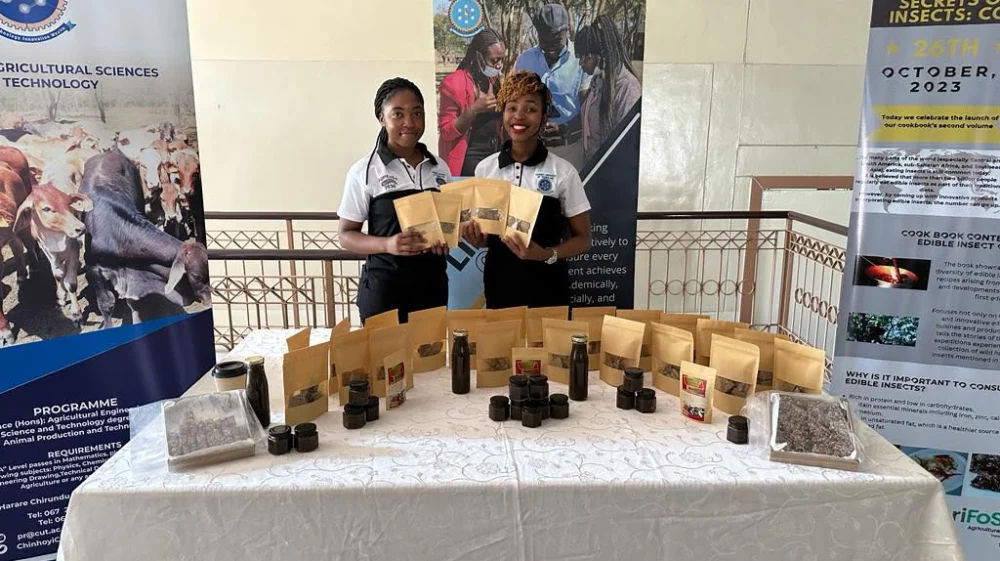
Instead of measuring success through academic publications, AgriFoSe2030 measures success through capacity developed, livelihoods improved, and evidence-based policies and processes adopted. Below are some examples.
Trader selling insects at the Chinhoyi Edible Insects Market, Zimbabwe.
Photo: SEI.
Women in Kiruhura District, western Uganda, demonstrate traditional techniques for processing milk to ghee and butter, to produce a final cosmetic product.
Photo: James Tembo.
This is science translation in action. It embeds accountability and creates value not just for individual households, but for entire rural economies, for example, by linking farmers, agripreneurs and value-chain actors to the best available science. The long-term results include job creation, increased socio-economic and ecological resilience, and increased competitiveness.
Crucially, AgriFoSe2030 is shifting leadership on science translation from Swedish universities to African and Asian partners. In doing so, it ensures Swedish investments build enduring capacity and results that outlast donor funding – reinforcing Sweden’s reputation as a leader in global sustainable development.
For Sweden, the science translation approach could not be more timely. As the government seeks ways to demonstrate that every tax krona invested in research produces value, AgriFoSe2030 offers a practical response. Its use of theory of change frameworks, monitoring and evaluation systems, and illustrative change projects ensures that research evidence is linked to measurable and meaningful impact.
At a time of public skepticism and shifting development priorities, AgriFoSe2030 demonstrates that translating scientific evidence into practical societal outcomes can bring clear and lasting benefits. By training researchers as science translators, fostering partnerships beyond academia, including the private sector, and systematically tracking outcomes, public investment in research becomes one of the most effective tools governments can use to deliver on their development mandates.
However, fully realizing this potential requires governments to establish or expand specialized funding mechanisms to support the practical implementation of scientific recommendations. This would make it easier for evidence-based insights to be taken up in policy and practice.
AgriFoSe2030 is funded by Sida and supports the achievement of UN Sustainable Development Goal 2 – “End hunger, achieve food security and improved nutrition and promote sustainable agriculture” – in lower-income countries. It does so by synthesizing and translating existing science into policy and practice, and by developing capacity to enable that transition.
Read more at: www.slu.se/agrifose
Project / Agriculture for Food Security (AgriFoSe2030) translates science into policy and practice.
Feature / Read how SEI-supported training is enhancing Ugandan women’s dairy skills, fostering economic and community growth.
Feature / In a groundbreaking event held at Chinhoyi University of Technology in Zimbabwe, the "Edible Insects: Food for the Future" cookbook was unveiled.
Journal article / The study explores how Swedish agroecological farmers adopt and perceive digital technologies and what shapes their use.