part of Change stories
Start readingFor more than three decades, SEI Tallinn has helped inform and shape climate, environment and sustainability agendas of Estonia and beyond – in neighbouring Baltic Sea states and in Eastern European countries.
SEI Tallinn’s expertise and close working relationship with the Estonian government have contributed to the country’s progress over a period of enormous economic and political change and geopolitical upheaval, with the full-scale Russian invasion of Ukraine making energy independence a policy priority.
Working with a combination of policy-relevant research and practical consulting, the centre has played a key role in providing greater understanding about policy levers that can advance green agendas in Estonia – which provided an effective springboard for ongoing work in the wider region. SEI and Estonia have sought to share insights from their experiences to help demonstrate ways that other countries in the region can pursue similar reforms needed to join the EU and to achieve their own climate, environment and sustainability aims.
In 1992, SEI established a centre in Tallinn to focus on work in the Baltic Sea region and Eastern Europe. Estonia was then newly re-independent (as of August 1991) from the Soviet Union. It faced an energy crisis, widespread pollution, and a lack of modern governance. At that critical time, SEI Tallinn offered expertise on how to devise policies to tackle key energy, climate and environmental issues – and to understand the socio-economic impacts, incorporating both costs and benefits.
From the start, the centre focused on environmental policy. SEI Tallinn helped Estonia to rebuild and develop modern environmental policy and governance capacity by building partnerships with key institutions. SEI Tallinn’s work helped Estonia adopt key climate and environmental standards that laid foundations to demonstrate readiness for EU membership. After Estonia formally joined the EU in 2004, the centre continued to help the country address evolving EU climate and environmental policy measures and obligations.
In the decades since, SEI Tallinn has continued to provide Estonia with key policy analyses, impact assessments and capacity building. Its work informed the country’s 2019 pledge to achieve climate neutrality by 2050 – a milestone decision and goal for a country that has long relied on oil shale to generate its electricity. The centre’s work has helped the country devise actions to expand the use of renewable energy, improve waste management, protect nature areas and key species, and adopt measures to enhance the living environment.
SEI Tallinn played an expert advisory role in preparing the country for EU membership on environmental and sustainability policy requirements. The Director of SEI Tallinn of that time was appointed as a member of the governmental commission and chairman of the subcommittee on environmental policy. SEI Tallinn wrote key background papers, conducted critical analyses, and set up relevant seminars and courses on key topics. For example, the centre provided technical and methodological expertise needed to establish the Natura 2000 network in Estonia to connect protected biodiversity spaces in Europe, and to build capacity to comply with EU directives on birds, habitats, environmental impact assessments, and greenhouse gas emissions trading. After Estonia’s EU accession in 2004, SEI Tallinn continued to formulate the government’s environmental policy agenda and to help embed long-term, sustainability-oriented planning into governance. It prepared draft laws, conducted studies, and offered training for civil servants.
SEI Tallinn and partners helped Estonia prepare its national sustainable development strategy (Sustainable Estonia 21, approved by Parliament in 2005) and updates more than a decade later. As part of this, in 2015, Kaja Peterson, then SEI Tallinn’s Sustainable Development Program Director, was appointed to chair Estonia’s National Sustainable Development Commission.
Others in the region took note of Estonia’s fast pace of change, and the analytical and capacitybuilding approaches it had developed. Responding to requests, SEI Tallinn began working with other countries across Central and Eastern Europe. It worked with Estonia’s Baltic-state neighbours, Latvia and Lithuania; and with Hungary, Poland and Slovenia – which also joined the EU in 2004.
For example, through an EU-funded program, SEI Tallinn helped Poland implement an EU management scheme to improve environmental performance in the public and private sectors. SEI Tallinn helped establish a verification system, and it provided guidance and training to both public- and private-sector workers in Poland. The centre then undertook similar work to help implement the same environmental quality-assurance scheme in Hungary, Latvia and Lithuania – and, later, to use it in regional tourism enterprises. In the Baltic Sea region the centre supported waste management decision-making and the development of waste management systems.
In 2019, the European Commission proposed establishing an EU-wide goal of achieving climate neutrality by 2050, requiring all Member States to provide their national positions on the ambition level and implementation pathway. As then-Prime Minister Jüri Ratas later reflected, there was strong hesitation in the coalition about whether such a commitment was financially viable – reflecting Estonia’s historical reliance on oil shale.
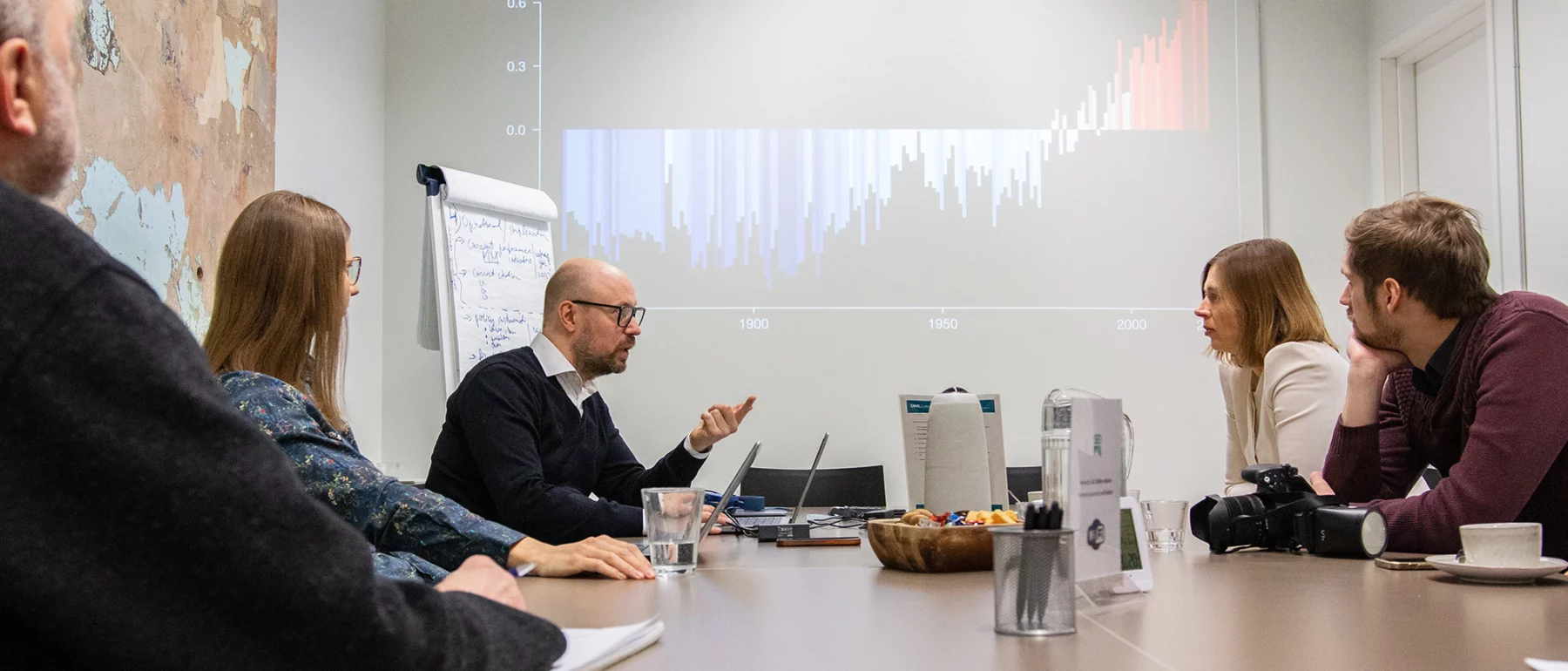
Against this backdrop, the government chose SEI Tallinn to study the feasibility of the commitment for Estonia. SEI Tallinn’s commissioned report concluded that reaching climate neutrality in Estonia by 2050 is technically possible – so long as all sectors (private, public and non-profit) contribute to the aim – and can be profitable in the long term if strategically wise investments are carried out to reach the goal. This work helped inform Estonia’s 2019 decision to formally pledge to achieve climate neutrality by 2050, in line with the European Green Deal. The Estonian pledge explicitly references SEI’s work.
As part of this work, SEI Tallinn created a bespoke, climate-neutrality modelling tool for the Estonian government to test the impacts of different measures by adjusting implementation levels and scenarios. This helped decision-makers understand the package of measures needed to reach the target – and the likely costs, potential savings and implications for jobs and GDP. Used in both national policy processes and in EU-level climate neutrality negotiations, this approach helped demonstrate that a strategic approach to climate neutrality could deliver clear long-term environmental and economic benefits for Estonia.
The centre’s work continues to inform policy on related issues. For example, in 2022, SEI Tallinn and partners were commissioned to conduct a baseline study to develop policies to support a high-quality, sustainable living environment. The work led SEI Tallinn and partners to create a toolbox used by spatial planners.
The climate neutrality decision accelerated energy system changes that required more detailed analyses, and SEI Tallinn provided these. For example, in recent years the centre worked closely with ministries and national stakeholders to map out decarbonization pathways in three critical sectors: gas (for Baltic states, including Estonia, and Finland), electricity production, and heating and cooling. These studies have not only supported Estonia’s climate targets but also enhanced the country’s energy independence and resilience in the face of geopolitical shocks, including those arising from the Russian invasion of Ukraine.
Proposed activities for electricity, heating and cooling, and gas sectors in the Estonian Energy Sector Development Plan (ENMAK 2035) stem from SEI-supported studies showing how the sector can be developed to meet 100% national energy demand with renewables by 2030 and climate neutrality by 2050.
SEI Tallinn has also played a role in accelerating other state-level strategic changes in different fields. In 2021, Prime Minister Kaja Kallas appointed SEI Tallinn’s Centre Director, Lauri Tammiste, to chair the Green Policy Expert Group. Bringing together representatives from business, academia and policy, the group identified key areas for Estonia’s green transition, pinpointed the main bottlenecks, and offered policy recommendations to overcome them. The group’s 2022 report strongly influenced the political agenda, and many of its recommendations were reflected in the 2023 coalition agreement. The agreement included the following: a holistic green policy action plan incorporating about 80% of the expert group’s proposals, the creation of a dedicated Climate Ministry to bring key topics under one government umbrella, streamlined planning procedures for wind parks, increased investments in electricity grids and energy efficiency, and the launch of the largest auction for renewable electricity in Estonia. The coalition also committed to gearing up green agenda actions across all sectors, with spatial planning as a priority. This led to the establishment of the Land and Spatial Developing Board, with SEI experts actively advising on practical issues of the processes that underpin related reforms.
Estonia’s experiences demonstrate that it is possible to be flexible and fast in adopting new environmental and climate obligations. As a result, other countries are increasingly looking to Estonia for practical advice.
This is now evident in SEI’s work elsewhere – for example, in Moldova, Ukraine, Armenia, Albania, and Bosnia and Herzegovina, all of which are seeking to make similar progress. Estonia’s practical reform experiences and SEI’s analytical expertise and advice can help support other countries to advance their own climate and governance transitions and aims. By sharing lessons and providing an evidence base for change, Estonia and SEI, are now helping to build confidence in other regions that a green transition is both possible and beneficial.
The green transition expert group played an important role in structuring the actions necessary for green transition in the coming years. The involvement of scientists and experts in the process gave a valuable input to the decision-making process in the government, which resulted with the adoption of the first national Green Transition Action Plan. I am thankful that Lauri led the expert group throughout these months, as I’m convinced that it formed a basis for further important developments in implementing the green transition policies.
Kristi Klaas, Deputy Secretary General for Green Transition in the Ministry of Climate in Estonia; former Green Reform Coordinator at the Government Office (2022–23)
Trust and timing are key for every major change. Over the years, Estonia has adapted a lot – to evolving EU policies and to new geopolitical realities – and so has SEI Tallinn. In these processes, our ability to adapt and to work with government, communities and partners according to their changing needs made us an effective partner.
Using high-quality data and studies helps build transparency and credibility. To succeed in making such changes, a country must build the public’s trust in the government, its decisionmaking criteria and its decision-makers. Countries can begin to do this by using high-quality data and studies to inform their decisions. They can then strengthen confidence of the government by making its strategic choices based on that knowledge, consistently following through, and continuing to push forward.
Data alone are not enough. Political courage and commitment are also essential. One of our most important lessons has been to understand the limits of data. Great tools and analyses can point the way forward, but they can never replace political courage and commitment, the presence or absence of which opens or closes windows of opportunity
We would like to highly commend SEI Tallinn for their professional work and their swift response to the rapid changes in Estonia. In particular, we would like to highlight the professionalism of the SEI, which enabled to operationally change the direction and content of the work to match real processes in Estonia. In this way, it was possible to use the suggestions, recommendations and ideas of SEI experts in the preparation and implementation of change, sometimes even online. As a result, the creation of the Land and Spatial Development Board (MARU) as a new structure has been launched, with an aim to starting its work in January 2025. We appreciate SEI’s broad engagement with Estonian society, ranging from politicians and ministry officials to private sector representatives.
Jüri Rass, Deputy Secretary General for Construction, Ministry of Climate (2023)
Project / Green Agenda supports Armenia, Moldova and Ukraine in their efforts to achieve climate neutrality through green transition.
Project / The ESAP 2030+ project supports the development of a Bosnia and Herzegovina country-wide environmental strategy and action plan.
Project
Project / This project aims to create a spatial planning development strategy and an action plan as well as put in place institutional arrangements in Estonia.
Project / This study will propose and analyse reforms in Estonia that will enable the country to achieve climate-neutral electricity production by 2050.
Project / The objective of this study is to identify possible scenarios that would help to achieve a carbon neutral heating and cooling sector in Estonia by 2050.
SEI annual report / Across a changing global landscape, SEI delivers knowledge and solutions to drive sustainable development forward.
Other publication / This brief for NetZeroCities highlights how recent changes to EU sustainability reporting rules may indirectly affect municipalities.
Press release / New Trase data analysis highlights the need for stronger supply chain transparency as domestic demand grows and export data gaps widen.