This study, part of the SEI-led CANDIES project, explores how carbon footprint labels influence consumers’ food choices in real-life retail settings. Through an in-store experiment at Urban Deli in Stockholm, the research examines whether providing climate impact information at the point of purchase can encourage more sustainable food decisions.
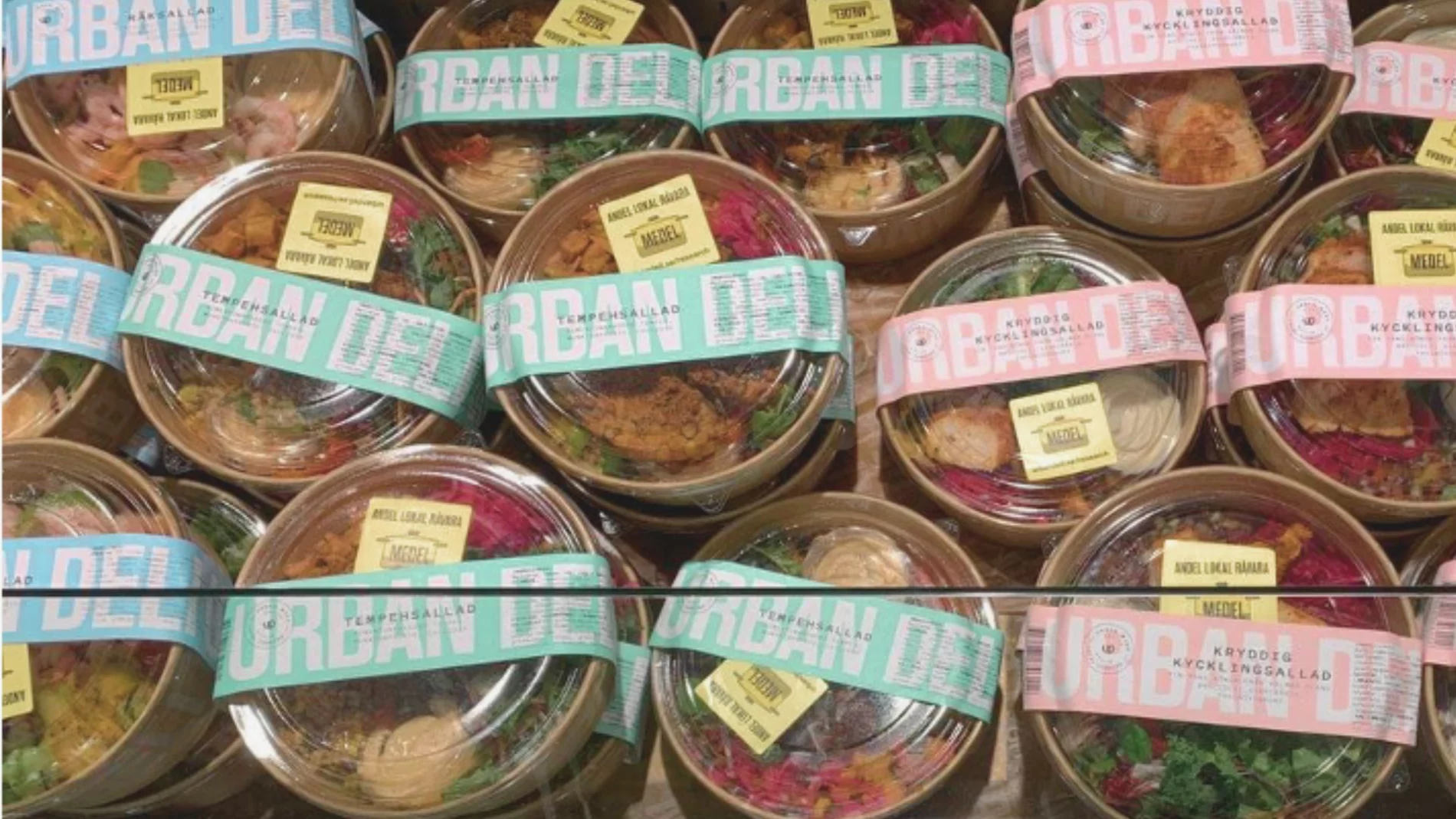
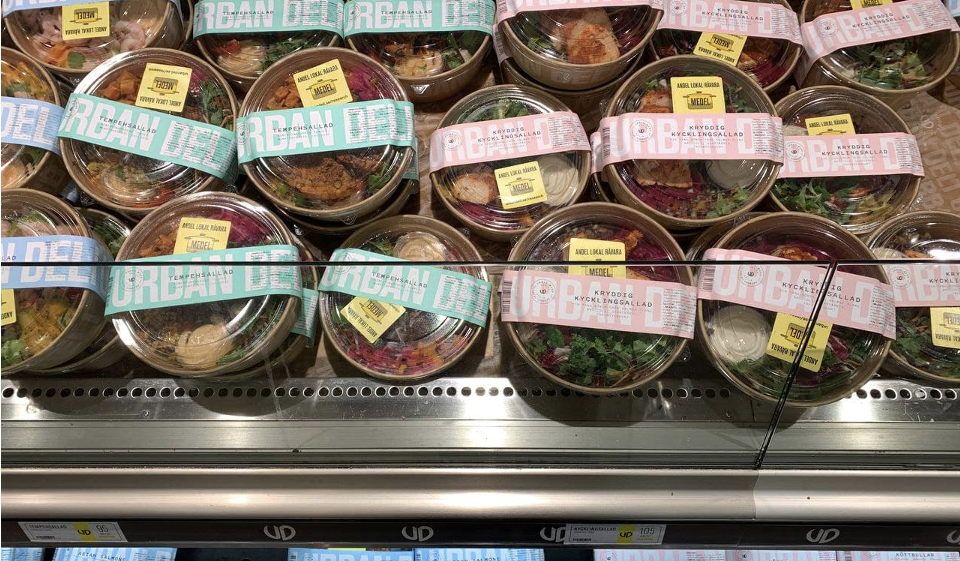
Urban Deli lunch boxes with labels. Photo: Astrid Nilsson / SEI.
Urban Deli lunch boxes with labels. Photo: Astrid Nilsson / SEI.
This study investigates how climate impact information influences consumers’ in-store decision-making. To increase our understanding of consumer behaviour in relation to food choices and environmental impact, further research is needed to explore how consumers act in real-life settings rather than their intended behaviours.
The authors conducted a real-life experiment in a food retail setting, where they studied the impact of carbon footprint labels on consumer choice. To do this, the authors used qualitative and quantitative methods, and applied the Capability, Opportunity, Motivation-Behaviour (COM-B) model to frame consumer behaviour.
They found that the labels did provide consumers with increased capability and opportunity to make more climate-friendly food choices, but they failed to trigger consumer motivation to choose these options. To enhance motivation, there may be a need to implement other forms of interventions alongside labels. However, labels can continue to increase knowledge about the environmental impact of food products and pave the way for additional behavioural change initiatives. This study also provides insights into how collaborating with private retailers on research projects can influence study design. These insights could be useful to those aiming to conduct similar studies.
Project / The Carbon Neutral Digestive Initiative - Enhancing Systems (CANDIES) brings the carbon emissions of food production directly to consumers at the supermarket.
Project / Carbon Neutral Digestive Initiative - Enhancing Systems (CANDIES) ger konsumenter möjligheten att göra klimatvänligare val vid köptillfället.
Journal article / A new study from SEI's CANDIES project looks at how consumer food choices can be influenced to become more sustainable.
SEI report / A comprehensive qualitative case study of Urban Deli investigated how digital tools support the retailer with necessary information to become more sustainable.
Feature / The CANDIES research project is conducting in-store experiments to see if and how consumers can be supported to choose food with a lower CO₂ footprint.