The Consumption Compass 2.0 is a web-based interactive tool that illustrates and analyses the climate impact of household consumption in Sweden developed by SEI. The innovative tool aims to guide Swedish municipalities and regions to reduce greenhouse gas emissions linked to consumption.
By offering an in-depth analysis of households’ climate footprint at the local and for over 100 different consumption areas, SEI’s tool serves as an important starting point in discussions about our consumption patterns.
With this tool, Swedish municipalities have the opportunity to identify specific consumption areas where policy measures can make a difference.
The launch of SEI’s Consumption Compass 2.0 brought together experts from SEI Headquarters, SEI Tallinn and SEI US, the Swedish Environmental Protection Agency and the Swedish municipalities of Umeå and Kalmar.
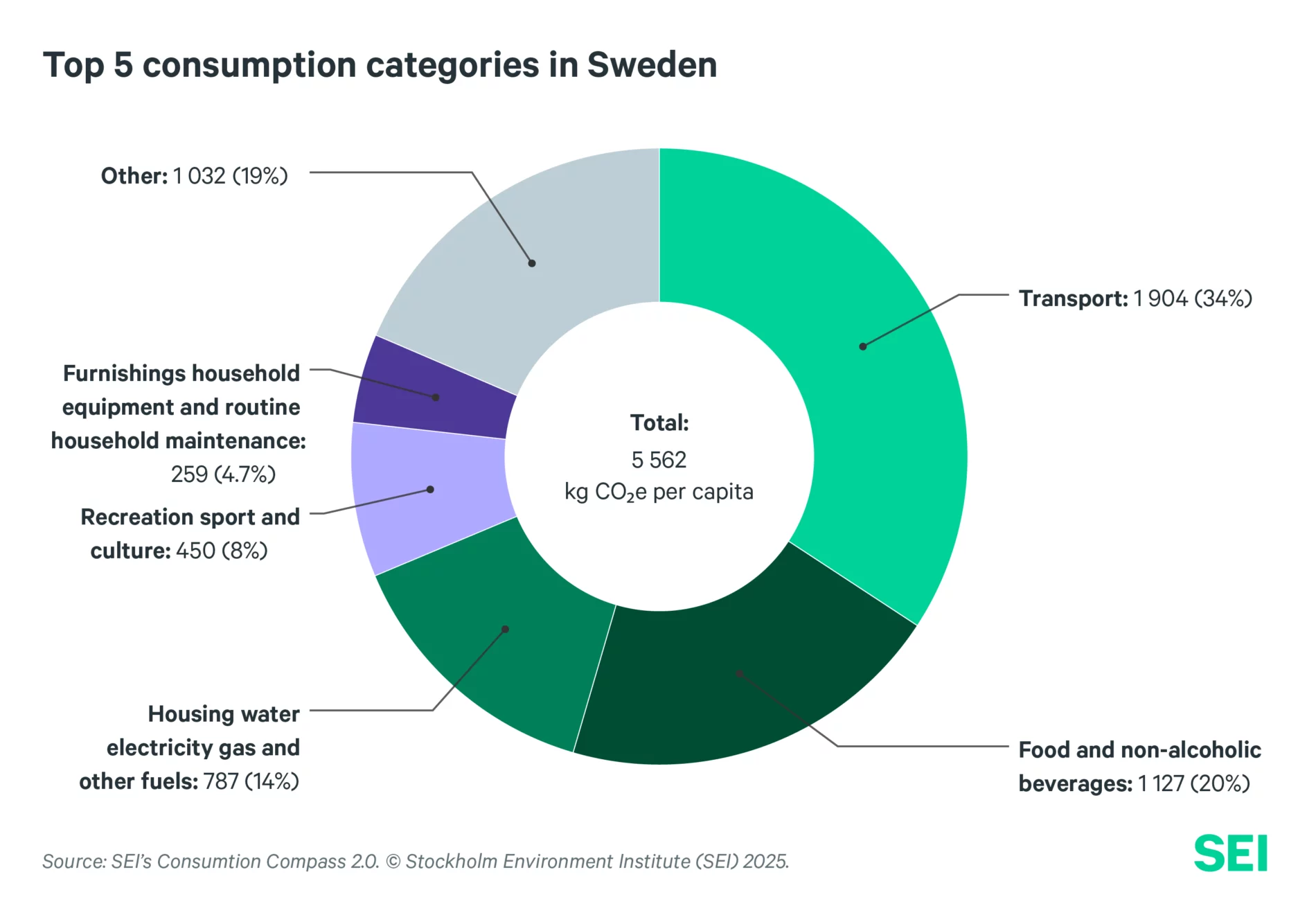
Figure showing the top consumption categories contributing to individual greenhouse gas emissions in Sweden. Transport and food dominate emissions, making up over half of the total per capita emissions.
SEI’s Consumption Compass 2.0. Mia Shu / SEI.
Now fully web-integrated, the interactive tool features a time series illustrating how consumption-based emissions have evolved from 2019 to 2023. Comparison between different municipalities, regions and areas are made possible for over hundred different consumption categories.
SEI’s Consumption Compass 2.0 and its data are protected under the Creative Commons license: CC BYNC-ND 4.0. © Stockholm Environment Institute 2025.
Explore the data and methods behind Consumption Compass 2.0:
SEI working paper / Learn about the methods and data behind the second version of Consumption Compass, a tool developed by SEI to promote sustainable consumption at the local level
Past event / Join the launch of SEI's Consumption Compass, analysing climate change impacts from Swedish households – streamed live for public viewing.
SEI working paper / Learn about the methods and data behind the second version of Consumption Compass, a tool developed by SEI to promote sustainable consumption at the local level
Feature / SEI is now developing the Consumption Compass for Swedish municipalities to address their consumption-based emissions.
Feature / Discover how SEI's Consumption Compass aids Swedish municipalities is boosting smarter consumption.
Feature / In close collaboration with Kalmar and Umeå Municipalities and the company InsightOne, SEI developed and launched the Consumption Compass in April 2022
The Consumption Compass 2.0 is led and developed by Stockholm Environment Institute, in close collaboration with the the Swedish municipalities Umeå and Kalmar, and supported by data from InsightOne. The development of the tool is funded by Formas, the Swedish Research Council for Sustainable Development. The web integration has been performed by Cloudberry.
A reference group with representatives from the following organizations have been guiding the tool development:
This updated version builds on the original Consumption Compass launched in 2022. The aim is to further develop the compass and monitor implementation and use of the tool among Sweden’s municipalities and regions.
Team Leader: Cities, Communities and Consumption; Senior Research Fellow
SEI Headquarters
Project / Konsumtionskompassen är ett projekt samt ett innovativt verktyg som tydliggör utsläppen av växthusgaser från konsumtion i Sverige.
Tool / SEI:s Konsumtionskompass illustrerar och analyserar klimatpåverkan från hushållens konsumtion på kommunal, läns och riksnivå.
Project / Understanding local government drivers for sustainable consumption (UNLOCK) investigates how incentive structures shape sustainable consumption behaviours.
Project / Creating practical tools for decisionmakers in Lund to leverage sustainable consumption and socially just climate transitions.
SEI brief / This SEI brief outlines how the UK can address regulatory and other barriers to achieve its ambition to expand community-owned, renewable energy sources.
Press release / As El Niño intensifies across the Amazon, new research in Science highlights the urgent need to better protect the region’s remaining forests from disturbances.